i Short answer
News fading bets against the initial knee-jerk price reaction to a major scheduled release, anticipating reversal once volatility settles.
This is a higher-risk technique combining elements of news trading and fading.
📋 ON THIS PAGE
1. The specific premise behind news fading
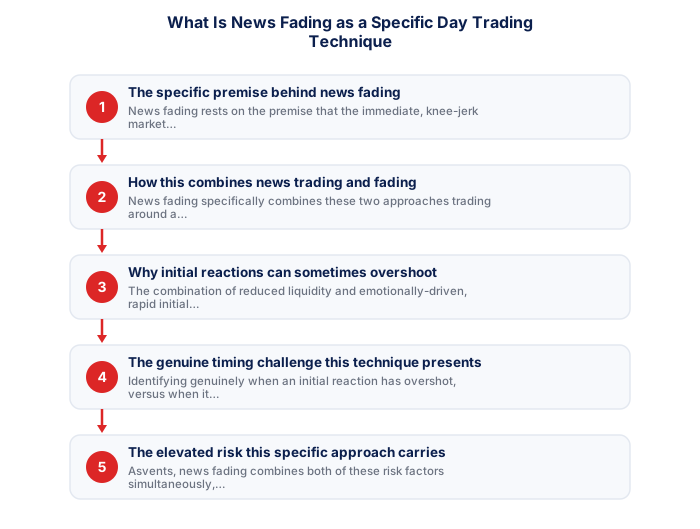
News fading rests on the premise that the immediate, knee-jerk market reaction to a major scheduled release, sometimes overshoots what the underlying data genuinely warrants, creating an opportunity to bet against this initial move, anticipating at least a partial reversal once this overreaction settles.
It's worth understanding this as a bet against crowd psychology specifically, rather than against the data itself. The premise isn't that the market misread the news, it's that the emotional intensity of trading in the first few moments after a release can push price further than even an accurate reading of that data would justify, an overshoot the fade specifically aims to capture as that emotional intensity settles.
2. How this combines news trading and fading
News fading specifically combines these two approaches, trading around a scheduled news event, while betting against rather than with the initial directional reaction.
This combination is worth appreciating as genuinely more demanding than either approach alone, since it requires correctly reading not just what the news means, the news trading component, but also correctly judging that the market's initial read of that meaning has gone too far, the fading component, two separate judgement calls stacked on top of each other.
3. Why initial reactions can sometimes overshoot
The combination of reduced liquidity and emotionally-driven, rapid initial trading can sometimes push price further than the underlying data genuinely justifies, creating the kind of overshoot that news fading specifically aims to capture as price subsequently corrects.
It's worth recognising this as a specific instance of a broader pattern that shows up throughout market psychology: crowds reacting quickly under uncertainty tend to overweight the most immediately salient information and underweight nuance, exactly the conditions a scheduled news release creates in its first few minutes.
- Economic calendar checked for high-impact events
- Key levels marked for target instruments
- Maximum trades per session defined
- Stop-losses set on overnight positions
- Backup connectivity available
- Eskom schedule checked
- Post-session journal time scheduled
4. The genuine timing challenge this technique presents
Identifying genuinely when an initial reaction has overshot, versus when it accurately reflects a genuine, lasting shift in fundamental outlook, represents a difficult judgement call requiring considerable experience and careful timing, since entering too early into a still-developing initial move carries significant risk.
This is worth being honest with yourself about specifically, since the temptation to fade a move simply because it feels unusually large is strong, but 'feels large' and 'has genuinely overshot the data' are not the same judgement, and confusing the two is a common, costly mistake for traders newer to this specific technique.
| Session | SAST | Instruments | Liquidity |
|---|---|---|---|
| Pre-market | 07:00-09:00 | Any | Low |
| JSE morning | 09:00-12:00 | JSE shares | High |
| Midday lull | 12:00-15:00 | Any | Low |
| London-NY overlap | 15:00-17:00 | Major forex | Very high |
| NY afternoon | 17:00-21:00 | Major forex | Medium |
5. The elevated risk this specific approach carries
Asvents, news fading combines both of these risk factors simultaneously, making it a particularly demanding, higher-risk technique compared to either news trading or fading applied independently in less volatile conditions.
6. Why this requires particularly disciplined application
Evidence-based application of higher-risk techniques generally, news fading specifically benefits from particularly tight, predetermined risk management and a clear, specific thesis about why the initial reaction genuinely overshot, rather than fading purely based on the move feeling intuitively large or surprising.
A useful discipline worth adopting: writing down your specific reasoning for why you believe a particular reaction has overshot, before entering the fade, rather than relying on an in-the-moment feeling. If you can't articulate a concrete reason beyond 'that move looks too big,' that's worth treating as a signal to stay out rather than a green light to proceed.
News fading involves entering against an initial news-driven spike, betting on an overreaction and partial reversal. It requires very precise timing and carries high execution risk from wide spreads during the spike itself.
★ Why It Matters
Worth being precise about the risk here: this technique deliberately positions against the immediate market consensus reaction, which means a stop-loss discipline that's followed without hesitation matters more here than in almost any other day trading approach, given how wrong an initial fade read can go.
✕ Common mistakes
- Assuming every initial knee-jerk reaction will reverse. Some initial reactions are genuinely sustained rather than overreactions.
- Combining this with other counter-trend techniques without considering compounded risk. Stacking similar high-risk approaches together can amplify overall exposure.
- Not practising this specific technique on demo before attempting it live. Its higher-risk nature makes practice especially valuable here.
Key Takeaways
- News fading bets against the initial knee-jerk reaction to a release, anticipating reversal once the immediate volatility settles, a higher-risk specific technique.
- News fading bets against the initial knee-jerk price reaction to a major scheduled release, anticipating reversal once volatility settles.
- This is a higher-risk technique combining elements of news trading and fading.
- The specific premise behind news fading.
- How this combines news trading and fading.
See also: What Is News Trading and How Is It Different From Technical Trading? and What Is Fading the Move and Is It a Sound Day Trading Approach?.
Frequently asked follow-up questions
Is news fading suitable for beginners?
Given its combined elevated risk profile, this is generally considered an advanced technique better suited to traders with substantial prior experience in both news trading and fading separately.
How long after a news release do traders typically attempt this fade?
Timing varies considerably by trader and specific event; many wait for some initial settling before considering this kind of contrarian entry, though exact timing requires considerable judgement.
Does news fading work better for certain types of economic releases?
Some traders find this technique more applicable to releases prone to algorithmic or emotionally-driven overreaction, though this requires ongoing, careful evaluation rather than a fixed, universal rule.
