i Short answer
JSE trading halts temporarily pause activity in a specific share or the broader market under certain defined circumstances.
This requires day traders to adjust pending orders and exit plans during this temporarily unavailable trading window.
📋 ON THIS PAGE
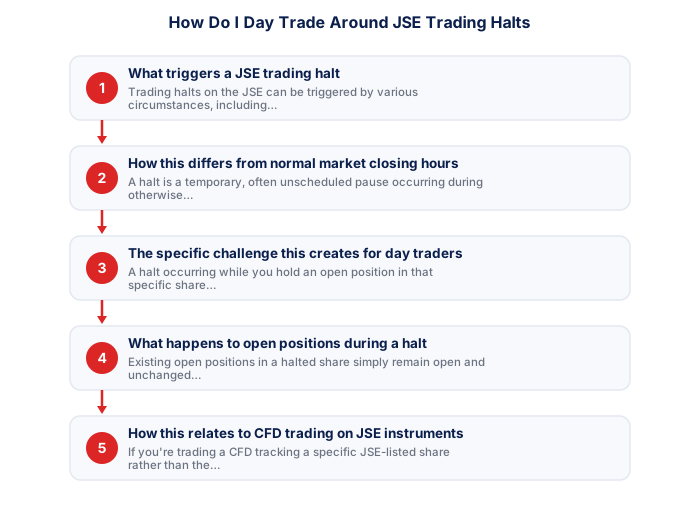
1. What triggers a JSE trading halt
Trading halts on the JSE can be triggered by various circumstances, including pending material company announcements requiring a pause to ensure fair, orderly trading once information becomes public, or circuit-breaker mechanisms designed to pause trading temporarily during periods of unusually extreme, rapid price movement, helping prevent disorderly market conditions.
It's worth checking a company's recent news and announcement history before entering an active day trading position in that specific share, particularly for companies known to be in the midst of significant corporate activity, since this kind of quick check can flag an elevated halt risk worth factoring into your decision.
2. How this differs from normal market closing hours
A halt is a temporary, often unscheduled pause occurring during otherwise normal trading hours, distinct from the JSE simply being closed outside its regular daily operating hours or on a public holiday. A halt specifically interrupts what would otherwise be an active trading session.
This distinction is worth keeping clear specifically because the two situations call for different responses, a scheduled closing is entirely predictable and simply requires planning your session around known hours, while a halt is genuinely unpredictable and requires the kind of contingency thinking discussed further below.
- SARB economic calendar checked for the week
- Next Eskom load shedding schedule reviewed
- GNU stability news reviewed
- Stats SA data releases noted
- Credit agency review dates checked
- US/global events that move EM risk noted
3. The specific challenge this creates for day traders
Given how important actively managing positions within a session is to day trading, a halt occurring while you hold an open position in that specific share creates a genuine challenge, since you cannot close, adjust, or add to that position until trading resumes, regardless of how market conditions might be evolving elsewhere during this pause.
This is worth accepting as a genuine, structural limitation of trading individual JSE shares specifically, rather than a flaw in your own execution or planning, even the most disciplined, well-prepared trader can't avoid this risk entirely when trading individual, halt-eligible instruments.
| Event | Frequency | ZAR impact | Source |
|---|---|---|---|
| SARB MPC | 6x per year | High | resbank.co.za |
| Budget Speech | Annual (February) | Very high | treasury.gov.za |
| Credit reviews | Annual each agency | Very high | Agency sites |
| Stats SA CPI | Monthly | Medium | statssa.gov.za |
| Eskom stage | As needed | Low-medium | eskomsepush.com |
- SA context provides genuine informational edge
- ZAR pairs accessible via FSCA brokers in ZAR accounts
- Rand volatility creates larger intraday ranges
- 6 SARB meetings/year create regular macro setups
- Higher geopolitical risk than G10 pairs
- Load shedding creates unique operational disruptions
- SA rand liquidity thinner than major G10 pairs
- SA-specific news requires constant local monitoring
4. What happens to open positions during a halt
Existing open positions in a halted share simply remain open and unchanged during the pause itself, with no further price movement or trading activity occurring in that specific instrument until the halt is lifted and trading resumes, at which point price discovery continues, sometimes with significant movement reflecting whatever news or information prompted the halt.
It's worth mentally preparing for this specific possibility in advance, accepting that a position could gap significantly upon resumption helps you approach the eventual reopening calmly rather than reactively, since panicking at that point rarely improves the outcome and can lead to exactly the kind of undisciplined decision-making this site cautions against elsewhere.
5. How this relates to CFD trading on JSE instruments
If you're trading a CFD tracking a specific JSE-listed share rather than the share directly, this CFD's pricing and tradability typically also pauses during the underlying share's halt, since the CFD's price discovery depends directly on the underlying exchange-listed instrument's own active trading.
It's worth confirming this specific mechanic directly with your broker before trading JSE share CFDs actively, since understanding exactly how your particular platform handles a halted underlying instrument removes any uncertainty about what you can and can't do with an affected position during exactly the moment you might need that clarity most.
6. Practical preparation for this possibility
Given the genuine unpredictability of trading halts, maintaining awareness of any pending major company announcements for shares you're actively trading, and accepting this as a normal, if infrequent, operational risk specific to individual share trading helps you prepare realistic expectations for this particular South African market structure consideration.
The afternoon overlap is where a South African trader finds the most activity. liquidity
Existing open positions in a halted share remain open and unchanged during the pause, while new orders simply can't be entered until trading resumes.
★ Why It Matters
A detail worth building into your routine for JSE day trading: halts are disclosed via SENS announcements before they fully take effect. Traders who watch the SENS feed directly get meaningfully more warning than those relying solely on their platform's price feed freezing.
✕ Common mistakes
- Not adjusting pending orders before a known scheduled halt. Orders can behave unpredictably once trading resumes.
- Assuming halts are rare enough to ignore in planning. Specific shares and events make halts more common than traders expect.
- Trading immediately at resumption without checking for a wide opening gap. Halted shares can reopen at a meaningfully different price.
Key Takeaways
- JSE trading halts pause activity in a specific share temporarily, requiring day traders to adjust orders and exit plans during this unavailable trading window.
- JSE trading halts temporarily pause activity in a specific share or the broader market under certain defined circumstances.
- This requires day traders to adjust pending orders and exit plans during this temporarily unavailable trading window.
- What triggers a JSE trading halt.
- How this differs from normal market closing hours.
Frequently asked follow-up questions
How long do JSE trading halts typically last?
This varies considerably depending on the specific reason for the halt, ranging from brief pauses to longer suspensions pending significant company news.
Are trading halts common on the JSE?
These are relatively infrequent events specific to individual shares facing particular circumstances, rather than a routine, regular occurrence across normal trading.
Does a halt affect the broader JSE Top 40 index?
A halt in one specific constituent share can affect index calculation methodology temporarily, though this typically doesn't halt trading in the broader index or index-tracking CFDs entirely.
