i Short answer
A genuine day trading edge requires verification at the day trading timeframe and frequency specifically.
An edge doesn't automatically transfer between fundamentally different trading styles and timeframes.
📋 ON THIS PAGE
- Why an edge is genuinely style and timeframe specific
- The mistake of assuming an edge automatically transfers
- How day trading edges typically differ structurally
- The sample size challenge specific to day trading verification
- Accounting for day trading-specific costs in edge calculation
- Verifying your own specific day trading edge
1. Why an edge is genuinely style and timeframe specific
A genuine trading edge describes a particular strategy's validated statistical performance under particular, defined conditions. A different timeframe, instrument, or trading frequency represents genuinely different conditions requiring its own separate verification rather than assuming a validated edge automatically applies.
2. The mistake of assuming an edge automatically transfers
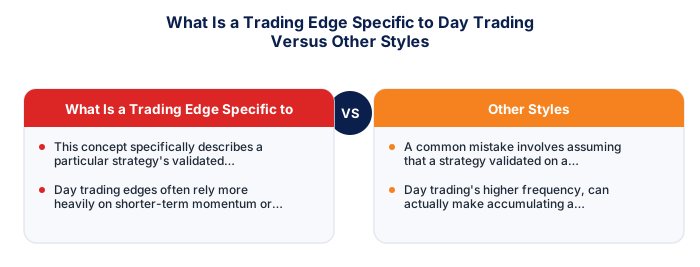
A common mistake involves assuming that a strategy validated on a longer-timeframe swing trading approach will automatically work equally well when compressed into a day trading timeframe, when in reality the underlying market dynamics can genuinely differ meaningfully between these different timeframes.
3. How day trading edges typically differ structurally
Day trading edges often rely more heavily on shorter-term momentum or mean-reversion patterns, and intraday liquidity and session-timing dynamics, that simply don't apply in the same way to longer-timeframe strategies, making genuinely independent verification at this specific timeframe essential.
- Economic calendar checked for high-impact events
- Key levels marked for target instruments
- Maximum trades per session defined
- Stop-losses set on overnight positions
- Backup connectivity available
- Eskom schedule checked
- Post-session journal time scheduled
4. The sample size challenge specific to day trading verification
Day trading's higher frequency can actually make accumulating a sufficiently large sample somewhat faster in calendar time compared to lower-frequency styles, though the same fundamental statistical reliability requirements for genuine edge verification still apply regardless of this faster accumulation pace.
| Session | SAST | Instruments | Liquidity |
|---|---|---|---|
| Pre-market | 07:00-09:00 | Any | Low |
| JSE morning | 09:00-12:00 | JSE shares | High |
| Midday lull | 12:00-15:00 | Any | Low |
| London-NY overlap | 15:00-17:00 | Major forex | Very high |
| NY afternoon | 17:00-21:00 | Major forex | Medium |
5. Accounting for day trading-specific costs in edge calculation
Genuine edge verification for day trading must account for its higher-frequency cost accumulation, since a strategy showing positive gross expectancy might actually show negative net expectancy once these accumulated day trading-specific costs are properly subtracted.
6. Verifying your own specific day trading edge
Practically, this means backtesting and forward-testing your specific day trading strategy at its actual intended timeframe and frequency, rather than relying on validation performed at a different timeframe or assuming a strategy's general reputation translates directly into a genuine, verified day trading edge.
Every South African trader who approaches the market with a structured plan, clear risk parameters, and disciplined execution starts each session from a position of strength that the majority of retail participants, who operate reactively and without documented rules, do not have. Building and maintaining this structural advantage requires consistent effort rather than exceptional talent, which means it is accessible to any trader willing to invest the time in proper preparation and honest self-assessment.
A swing trading edge verifies on daily or weekly data over a longer period.
A day trading edge is based on intraday patterns and verified with high-frequency data. A swing trading edge relies on daily or weekly patterns and requires a longer verification period due to fewer signals.
★ Why It Matters
Worth being precise about: an edge validated on daily charts doesn't carry statistical weight for 5-minute chart day trading, even if it's conceptually the 'same' pattern, since the underlying market microstructure and noise characteristics genuinely differ between these timeframes.
✕ Common mistakes
- Treating 'the same pattern' as equally valid regardless of timeframe. Statistical validation needs to happen at the actual timeframe you intend to trade.
- Not separately backtesting an edge at the specific frequency you plan to use it. Different frequencies expose a strategy to genuinely different conditions.
- Assuming success at one trading style guarantees transferable skill to another. Day trading and slower styles draw on meaningfully different specific skills.
South African day traders face a practical challenge that their international counterparts do not: the primary high-liquidity window for major forex pairs, the London-New York overlap, falls between 15:00 and 17:00 SAST, one of the most common afternoon load shedding time slots. Building explicit contingencies for this overlap, including backup connectivity, pre-set stops on all open positions before the window, and a reduced position size policy during load shedding windows, converts this operational risk into a managed condition rather than an unplanned disruption.
Key Takeaways
- A genuine day trading edge requires verification at the day trading timeframe and frequency specifically, since edges don't automatically transfer between styles.
- A genuine day trading edge requires verification at the day trading timeframe and frequency specifically.
- An edge doesn't automatically transfer between fundamentally different trading styles and timeframes.
- Why an edge is genuinely style and timeframe specific.
- The mistake of assuming an edge automatically transfers.
Frequently asked follow-up questions
Can I use the same indicators for day trading edge verification as longer timeframes?
The same general indicator toolkit often applies, though specific parameter settings and verification still need conducting at your actual intended day trading timeframe.
How quickly can I genuinely verify a day trading edge given higher frequency?
This varies by your specific trading frequency, though the same fundamental sample-size requirements still apply regardless of how quickly trades accumulate.
Does a day trading edge ever decay faster than longer-timeframe edges?
This can vary by specific strategy and market conditions, though no universal rule determines which style's edges decay faster overall.
