i Short answer
Overconfidence bias leads traders to overestimate their own skill and underestimate genuine risk, often emerging after a string of recent winning trades.
This typically manifests as increased position size position sizes and reduced risk discipline at precisely the moments when a reversion to normal results may be due.
📋 ON THIS PAGE
- How overconfidence bias typically develops over time
- Specific behavioural manifestations to watch for
- Why winning streaks are particularly dangerous for this bias
- The illusion of control component specifically
- Practical countermeasures against overconfidence
- Distinguishing genuine skill growth from simple overconfidence
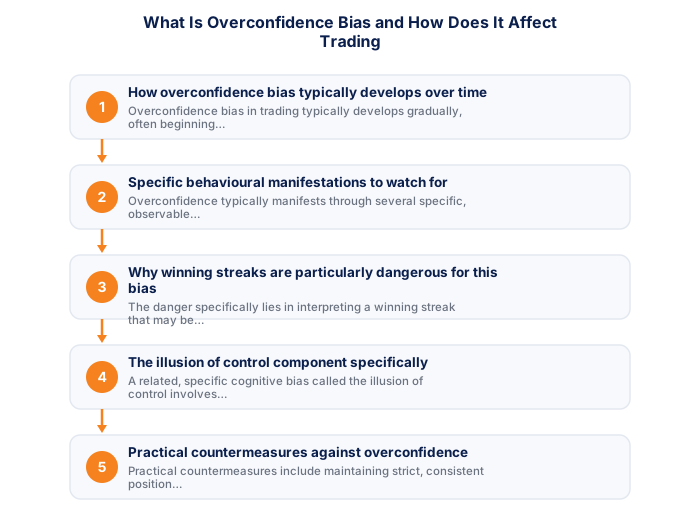
1. How overconfidence bias typically develops over time
Overconfidence bias typically builds gradually, often starting with a string of successful trades that may reflect genuine skill, favourable conditions, plain chance, or some mix of the three, but which the trader tends to credit mostly, or entirely, to their own skill regardless of how much luck actually played a part.
This pattern is well documented in behavioural psychology generally: people attribute successes to internal skill and failures to external factors. In trading, that tendency can compound dangerously over a winning streak, as confidence builds faster than any real, demonstrated skill.
What makes this especially hard to catch in real time is that the feeling accompanying it is genuinely pleasant, growing confidence, a sense of finally 'getting it,' a willingness to trust your own instincts more. None of that feels like a warning sign in the moment; it feels like progress, which is exactly why the shift from healthy, earned confidence into overconfidence tends to happen without a clear line the trader notices crossing.
2. Specific behavioural manifestations to watch for
Overconfidence tends to show up through a few observable behaviours: pushing position sizes beyond your predetermined risk percentage simply because recent success has built unwarranted confidence; drifting from your tested strategy's entry criteria, taking trades that don't really meet your rules because you've convinced yourself your improved "feel" for the market justifies it; and loosening or dropping stop-loss discipline on the mistaken belief that recent success means you no longer need that same protection.
Naming these patterns explicitly, rather than just experiencing overconfidence as a vague, pleasant feeling of being "in the zone," helps you catch and interrupt the bias before it produces the outsized losses that often follow a stretch of overconfident, undisciplined trading.
- Emotional state is neutral
- Yesterday's results not influencing today
- Trading plan is open and reviewed
- Loss limit for today defined and accepted
- Phone notifications silenced
- Backup connectivity confirmed
- Written rules eliminate in-the-moment decisions
- Journalling creates a feedback loop for improvement
- Pre-session checks reduce emotionally-driven entries
- Regular breaks prevent compounding mistakes
- Building discipline requires active daily effort
- Losses immediately test emotional stability
- No external accountability in retail trading
- Social pressure to perform can override rules
Write your trading plan
Entry rules, risk rules, and conditions to NOT trade, all in writing.
Pre-session check
Check your emotional state before opening your platform. Skip if not neutral.
Execute only plan setups
Take only positions that fully match your written criteria.
Journal after each trade
Record rationale, emotion at entry, and outcome immediately after closing.
Weekly rules review
Assess rule adherence weekly. Adjust strategy based on evidence, not emotion.
A useful habit is periodically re-reading your own trading plan and strategy rules verbatim, rather than relying on memory of what they say. It's common for a trader's recollection of their own rules to quietly loosen over a winning streak, even while they'd insist, if asked, that they're still following the same approach they started with.
3. Why winning streaks are particularly dangerous for this bias
Just like losing streaks, winning streaks are subject to normal statistical variance. Even a strategy with only modest real edge will produce winning streaks purely by chance from time to time. The danger is reading a streak that's largely down to luck as proof of dramatically improved skill, pushing you toward the overconfident behaviours above at exactly the moment when more caution, not more risk-taking, would be the statistically sound response.
This ties into a broader pattern: emotional and cognitive responses to both winning and losing streaks tend to push you toward exactly the wrong adjustments at exactly the wrong moments, which is why predetermined, rule-based discipline matters regardless of which way your recent results have gone.
One useful discipline is deciding, before a winning streak ever happens, exactly what would justify increasing position size, ideally a larger, statistically meaningful sample of results rather than any specific number of consecutive wins, since a short streak on its own tells you very little about whether your edge has genuinely improved.
4. The illusion of control component specifically
A related bias, the illusion of control, involves overestimating your ability to influence or predict inherently uncertain outcomes. In trading, this looks like believing you can predict short-term price movements with more certainty than your strategy's actual track record supports, leading you to take on positions or risks out of proportion with your real, evidence-based edge.
This often compounds with overconfidence more broadly, creating a potent combination where a trader feels both unusually skilled and unusually able to predict genuinely uncertain markets, a combination that frequently precedes some of the more severe trading losses.
This bias can be particularly persistent because markets do sometimes move in ways that appear to confirm a trader's prediction, purely by chance, reinforcing the belief in a predictive ability that a larger, more honest sample of outcomes wouldn't actually support. A handful of correct predictions feels like evidence; it usually isn't, on its own, statistically meaningful evidence at all.
5. Practical countermeasures against overconfidence
Useful countermeasures: keep strict, consistent position sizing rules regardless of recent results, resisting the urge to size up just because of a winning streak; regularly review your trading journal looking specifically for moments you deviated from your tested criteria, and honestly ask whether overconfidence played a role; and deliberately notice and acknowledge the role of luck in your results, rather than defaulting to skill-based credit for every win.
That last one, practising a more balanced, honest read of your own results, directly counters the attributional bias above. It takes real, deliberate effort to keep up, but it's one of the more targeted responses to this specific pattern.
Some traders find it useful to keep a running, simple tally distinguishing trades where a genuine, rules-based edge was clearly present from trades where the outcome came down more to favourable circumstance. Over time, this tally builds a more honest, evidence-based picture of your actual skill than relying on overall win/loss results alone, which don't distinguish between the two.
6. Distinguishing genuine skill growth from simple overconfidence
Genuine skill improvement over time is real, and it does justify some added confidence as your experience and track record actually grow. The key distinction is between confidence that's proportionate to a large, rigorously evaluated sample of results (see trading edge verification), versus confidence inflated by a recent, smaller sample that doesn't yet provide reliable evidence of real improvement.
Keeping that distinction clear, grounding your confidence in sample-size-appropriate evidence rather than in how recent results simply feel, is the practical key to letting real confidence grow over time without tipping into overconfidence.
Overconfidence tends to peak after winning streaks, exactly when traders raise position sizes or relax risk discipline. A fixed percentage position sizing rule prevents overconfidence from compounding account risk.
★ Why It Matters
Worth tracking: your position sizes in the week right after your three best trades of the past year. A noticeable size increase right after strong results is one of the more measurable, personal signatures of overconfidence bias actually showing up in your behaviour.
✕ Common mistakes
- Not tracking your own sizing patterns following your best trades. This specific check often reveals overconfidence you weren't consciously aware of.
- Treating a winning streak as proof of skill rather than possible favourable variance. Distinguishing these requires a properly sized sample, not a few good trades.
- Reducing risk discipline precisely when a reversion to normal results may be due. This timing makes overconfidence particularly costly.
Is this a mindset problem or a method problem?
Look at whether the rules were kept. Kept and losing is a method issue; broken under pressure is not. Telling the two apart covers it in full.
Is it normal to feel anxious about this?
Some is ordinary and some is a signal the position is too large for your tolerance. Fear before entry covers where the line sits.
Key Takeaways
- Overconfidence bias leads traders to overestimate their skill and underestimate risk, often following a string of wins. Learn how to recognise and counter it.
- Overconfidence bias leads traders to overestimate their own skill and underestimate genuine risk, often emerging after a string of recent winning trades.
- This typically manifests as increased position sizes and reduced risk discipline at precisely the moments when a reversion to normal results may be due.
- How overconfidence bias typically develops over time.
- Specific behavioural manifestations to watch for.
Frequently asked follow-up questions
Is some confidence in trading genuinely a good thing?
Yes. Confidence proportionate to genuine, rigorously demonstrated skill and a large evaluated sample is healthy. The concern is confidence that outruns the evidence supporting it.
Can overconfidence affect experienced traders too?
Yes. It isn't limited to beginners and can affect traders at any experience level, particularly after an unusually strong recent run.
How can my trading journal specifically help identify overconfidence?
Reviewing entries for increased position sizing or strategy deviation right after winning periods helps you spot this pattern in your own actual trading history.
