i Short answer
Recognising that FOMO-driven entries violate your own predetermined strategy criteria, and accepting missed opportunities as an acceptable cost of disciplined trading, helps manage this common impulse.
📋 ON THIS PAGE
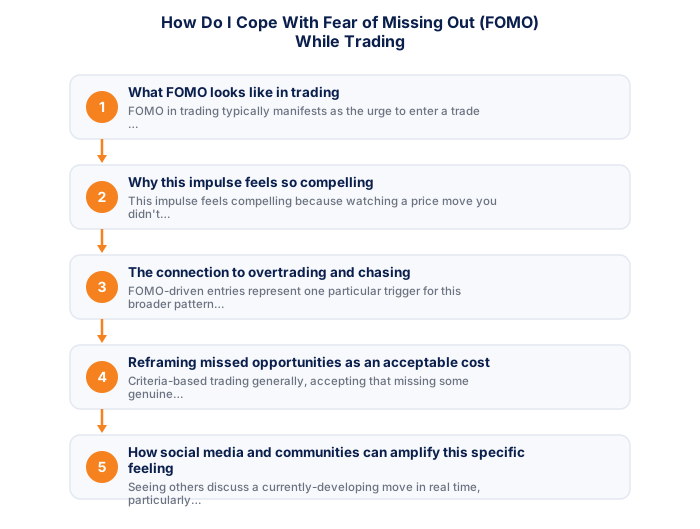
1. What FOMO specifically looks like in trading
FOMO in trading typically manifests as the urge to enter a trade because price has already moved significantly without you, driven by anxiety about missing further potential gains, rather than because the current setup genuinely meets your predetermined strategy criteria at this specific point in time.
It's worth noticing the specific physical or emotional sensation that accompanies this urge for you personally, a tightness, a racing thought pattern, an urgent need to act immediately, since recognising your own particular signature for this feeling makes it considerably easier to catch in the moment, before it translates into an actual impulsive trade.
2. Why this impulse feels so genuinely compelling
This impulse feels compelling because watching a price move you didn't participate in creates genuine, visceral discomfort, even though, rationally, missing one specific opportunity has no bearing on your strategy's overall long-term statistical performance.
It's worth reminding yourself explicitly, in the moment this discomfort arises, that this feeling is a well-documented, near-universal psychological response rather than a personal failing or unique weakness, that reframe alone can take some of the urgency out of the impulse without needing to fully eliminate the underlying discomfort.
- Emotional state is neutral
- Yesterday's results not influencing today
- Trading plan is open and reviewed
- Loss limit for today defined and accepted
- Phone notifications silenced
- Backup connectivity confirmed
- Written rules eliminate in-the-moment decisions
- Journalling creates a feedback loop for improvement
- Pre-session checks reduce emotionally-driven entries
- Regular breaks prevent compounding mistakes
- Building discipline requires active daily effort
- Losses immediately test emotional stability
- No external accountability in retail trading
- Social pressure to perform can override rules
Write your trading plan
Entry rules, risk rules, and conditions to NOT trade, all in writing.
Pre-session check
Check your emotional state before opening your platform. Skip if not neutral.
Execute only plan setups
Take only positions that fully match your written criteria.
Journal after each trade
Record rationale, emotion at entry, and outcome immediately after closing.
Weekly rules review
Assess rule adherence weekly. Adjust strategy based on evidence, not emotion.
3. The connection to overtrading and chasing
As, FOMO-driven entries represent one particular trigger for this broader pattern, entering a trade that doesn't genuinely meet predetermined criteria, in this case motivated by the discomfort of having already missed a developing move rather than genuine, independent analytical confidence in the trade at this specific, now-later point.
It's worth tracking FOMO-driven entries as their own specific category in your trading journal, separate from other criteria violations, since seeing the concrete, accumulated cost of this particular pattern over time tends to be more motivating for genuine change than a vague, general awareness that it happens sometimes.
4. Reframing missed opportunities as an acceptable cost
Criteria-based trading generally, accepting that missing some genuine opportunities is an inherent, acceptable cost of maintaining the discipline that protects you from the far more numerous poor, undisciplined entries this same discipline also prevents, supports a more balanced, sustainable perspective than treating every missed move as a genuine failure.
This reframe is worth practising explicitly and repeatedly until it genuinely sinks in, since intellectually understanding this trade-off and actually feeling at peace with it in the heat of a missed move are two different things, the second only comes with sustained, deliberate practice of the first.
5. How social media and communities can amplify this specific feeling
Seeing others discuss a currently-developing move in real time, particularly within an enthusiastic community setting, can specifically amplify FOMO beyond what you might experience observing the same price action in isolation, making mindful engagement with this kind of content particularly relevant here.
It's worth being deliberate about when you check these sources specifically, avoiding social media or community channels during your active analysis and decision-making windows removes a significant source of this amplification effect, saving that engagement for times when you're not actively making live trading decisions.
6. Practical techniques for managing FOMO in the moment
Practical techniques include explicitly checking your predetermined checklist criteria, before any entry regardless of how compelling the urge to chase a moved price feels, reminding yourself of the broader sample-size perspective, and stepping away briefly from active monitoring if the impulse feels particularly strong in a specific moment.
FOMO entries typically happen after a price has already moved significantly, well past where a genuine, criteria-based entry would have triggered.
★ Why It Matters
A reframe that tends to land well: every missed trade you didn't take because it failed your own entry criteria is data confirming your criteria are being followed, not a loss, traders who relabel missed opportunities this way in their journal report less FOMO over time.
✕ Common mistakes
- Entering trades after price has already moved significantly. This often means entering near a move's exhaustion, not its genuine start.
- Treating every missed move as a personal failure. A missed trade outside your criteria is disciplined behaviour, not a mistake.
- Not logging FOMO-driven trades separately in your journal. Without tracking, it's hard to see the pattern's real cost over time.
- Chasing a move to 'catch up' after sitting out earlier. This compounds one missed opportunity into a second, often worse decision.
Is this a mindset problem or a method problem?
If the plan is followed and still loses, the method is the problem. If the plan is sound and gets abandoned under pressure, it is not. Telling the two apart covers how to test it.
Is it normal to feel anxious about this?
Some is ordinary and some is a signal the position is too large for your tolerance. Fear before entry covers where the line sits.
Key Takeaways
- Recognising FOMO-driven entries violate predetermined criteria, and accepting missed opportunities as an inherent cost of disciplined trading, helps manage this impulse.
- Recognising that FOMO-driven entries violate your own predetermined strategy criteria, and accepting missed opportunities as an acceptable cost of disciplined trading, helps manage this common impulse.
- What FOMO specifically looks like in trading.
- Why this impulse feels so genuinely compelling.
- The connection to overtrading and chasing (see overtrading).
See also: How Do I Avoid Overtrading as a Day Trader Specifically? and How Do Trading Communities Actually Help or Hurt Traders?.
Frequently asked follow-up questions
Is FOMO unique to trading, or a more general psychological pattern?
This is a general, well-documented psychological pattern affecting many areas of life applied specifically here to the trading context.
Can FOMO ever lead to a genuinely good trading decision?
Occasionally a FOMO-driven entry might coincidentally work out, but this reflects luck rather than sound process, and doesn't validate this approach as a reliable, repeatable strategy.
Does limiting social media exposure reduce FOMO?
Many traders find this helps, though the underlying psychological tendency itself, still requires its own direct management regardless of exposure level.
