i Short answer
Hesitation to actually execute a trade, even with a genuine setup, often stems from insufficient predetermined entry criteria or inadequate practice.
Both are directly addressable through clearer rules and deliberate demo repetition.
📋 ON THIS PAGE
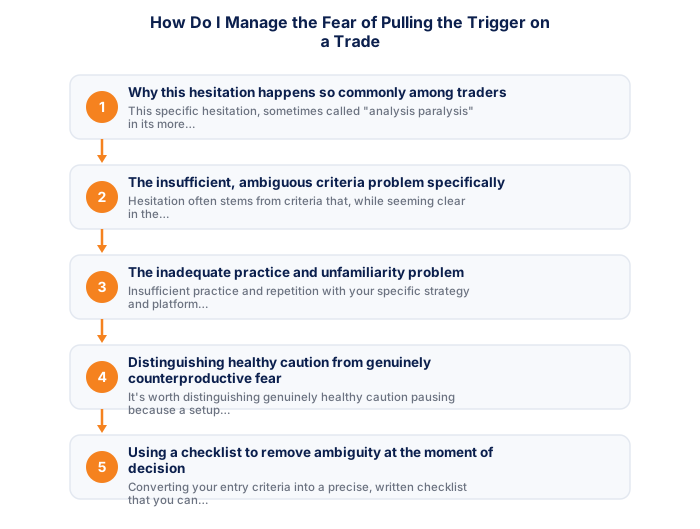
- Why this hesitation happens so commonly among traders
- The insufficient, ambiguous criteria problem specifically
- The inadequate practice and unfamiliarity problem
- Distinguishing healthy caution from genuinely counterproductive fear
- Using a checklist to remove ambiguity at the moment of decision
- Building execution confidence through deliberate repetition
1. Why this hesitation happens so commonly among traders
This specific hesitation, sometimes called "analysis paralysis" in its more severe form, is genuinely common, particularly among newer traders, reflecting the real psychological weight of committing real capital to a decision under inherent uncertainty.
It's worth normalising this experience for yourself explicitly, recognising that this hesitation is a genuinely common, well-documented pattern rather than a sign of unique unsuitability for trading helps reduce the additional layer of anxiety that comes from feeling like the hesitation itself is somehow abnormal.
2. The insufficient, ambiguous criteria problem specifically
Hesitation often stems from criteria that, while seeming clear in the abstract, become genuinely ambiguous in the actual moment of decision. If your entry criteria aren't precisely, objectively defined, the resulting uncertainty about whether a specific setup "genuinely" qualifies naturally produces hesitation, since you're effectively making an additional, undefined judgement call at the worst possible moment for clear thinking.
It's worth stress-testing your own written criteria specifically for this kind of ambiguity, reading through your entry rules and asking honestly whether each one could be checked as a simple yes-or-no, rather than requiring subjective judgement, reveals exactly where this hesitation-producing ambiguity is likely to surface.
- Emotional state is neutral
- Yesterday's results not influencing today
- Trading plan is open and reviewed
- Loss limit for today defined and accepted
- Phone notifications silenced
- Backup connectivity confirmed
- Written rules eliminate in-the-moment decisions
- Journalling creates a feedback loop for improvement
- Pre-session checks reduce emotionally-driven entries
- Regular breaks prevent compounding mistakes
- Building discipline requires active daily effort
- Losses immediately test emotional stability
- No external accountability in retail trading
- Social pressure to perform can override rules
Write your trading plan
Entry rules, risk rules, and conditions to NOT trade, all in writing.
Pre-session check
Check your emotional state before opening your platform. Skip if not neutral.
Execute only plan setups
Take only positions that fully match your written criteria.
Journal after each trade
Record rationale, emotion at entry, and outcome immediately after closing.
Weekly rules review
Assess rule adherence weekly. Adjust strategy based on evidence, not emotion.
3. The inadequate practice and unfamiliarity problem
Insufficient practice and repetition with your specific strategy and platform, before your first real trades on a demo account, can leave the actual mechanical act of placing a trade feeling unfamiliar and effortful, adding an additional layer of friction and hesitation beyond the underlying analytical decision itself.
It's worth being honest with yourself about whether this specific gap describes your situation, if you can articulate your strategy clearly but still hesitate specifically at the mechanical moment of clicking to execute, that points toward needing more platform-specific practice rather than more strategy refinement.
4. Distinguishing healthy caution from genuinely counterproductive fear
It's worth distinguishing genuinely healthy caution, pausing because a setup doesn't quite meet your predetermined criteria, from counterproductive fear, where you hesitate and miss genuinely qualifying setups specifically because of generalised anxiety about committing capital, rather than any genuine, specific concern about that particular setup.
It's worth applying a simple test here: healthy caution has a specific, articulable reason tied to your criteria not being met, while counterproductive fear tends to persist even when you can't identify a concrete reason beyond a general, anxious reluctance to act.
5. Using a checklist to remove ambiguity at the moment of decision
Converting your entry criteria into a precise, written trading checklist that you can mechanically verify item by item removes much of the in-the-moment ambiguity above. If every item is genuinely checked, the decision to execute becomes a more straightforward, almost mechanical confirmation rather than a fresh, anxiety-inducing judgement call each time.
It's worth treating this checklist as your actual decision-making authority in the moment, rather than a reference you consult alongside your own judgement, when every item is genuinely satisfied, the checklist itself effectively makes the decision, removing much of the space where hesitation and second-guessing otherwise creep in.
6. Building execution confidence through deliberate repetition
Deliberately practising the actual mechanical act of executing trades repeatedly on a demo account, specifically focusing on building comfort and fluency with this execution step itself, separately from the broader analytical decision, helps reduce the friction and hesitation that unfamiliarity with this mechanical process can otherwise introduce.
Fear-driven hesitation means freezing even when criteria are met.
It's worth distinguishing genuinely healthy caution, pausing because a setup doesn't quite meet your criteria, from fear-driven hesitation that persists even when the criteria are met.
★ Why It Matters
Worth testing: place ten consecutive demo trades the instant your criteria are met, with a hard rule against any hesitation. Traders often discover the fear fades faster through repeated, deliberate exposure than through more analysis or more confidence-building reading.
✕ Common mistakes
- Waiting for more certainty than any strategy can realistically provide. No setup, however good, offers complete certainty.
- Avoiding live trades while only ever practising on demo. Repeated, deliberate live exposure tends to reduce this fear faster than analysis alone.
- Treating hesitation as a sign the trade is wrong. Hesitation often reflects insufficiently practiced rules, not a flawed setup.
- Not reviewing how often hesitation actually cost a good outcome. This comparison can be a clarifying, motivating exercise.
Is this a mindset problem or a method problem?
A method problem shows up when you follow the rules and still lose. A mindset problem shows up when you stop following them. Telling the two apart covers it in full.
Is it normal to feel anxious before placing trades?
Some performance awareness is normal. Anxiety that causes deviation from your plan - exiting early, moving stops, avoiding valid setups - indicates a psychological issue worth addressing through structured journaling or a trading coach.
Key Takeaways
- Hesitation to execute often stems from insufficient predetermined criteria or inadequate practice, both addressable through clearer rules and demo repetition.
- Hesitation to actually execute a trade, even with a genuine setup, often stems from insufficient predetermined entry criteria or inadequate practice.
- Both are directly addressable through clearer rules and deliberate demo repetition.
- Why this hesitation happens so commonly among traders.
- The insufficient, ambiguous criteria problem specifically.
See also: What Is Loss Aversion and How Does It Affect Trading Decisions? and What Is the Endowment Effect, and Does It Apply to Trading? and What Is Outcome Bias and How Does It Distort Self-Assessment?.
Frequently asked follow-up questions
Is some hesitation before trading always a bad sign?
Not necessarily. Brief, genuine consideration before committing capital is reasonable, though persistent hesitation specifically preventing execution of genuinely qualifying setups warrants attention.
Can this hesitation affect experienced traders too?
Yes, though it often diminishes with accumulated experience and repetition, as both criteria clarity and execution familiarity naturally develop over time.
Should I force myself to trade even when I feel hesitant?
Forcing execution against genuine, criteria-based caution isn't advisable. The goal is addressing the underlying ambiguity or unfamiliarity, not overriding legitimate caution.
