i Short answer
Momentum trading targets instruments already showing strong directional price movement, betting on continuation rather than anticipating a reversal.
It's commonly used within day trading, though the concept can also apply to longer-term swing trading.
📋 ON THIS PAGE
- The core premise behind momentum trading
- How momentum traders identify potential opportunities
- Momentum versus mean-reversion: a key strategic distinction
- Why momentum suits day trading specifically
- The genuine risks specific to momentum trading
- Combining momentum signals with broader market context
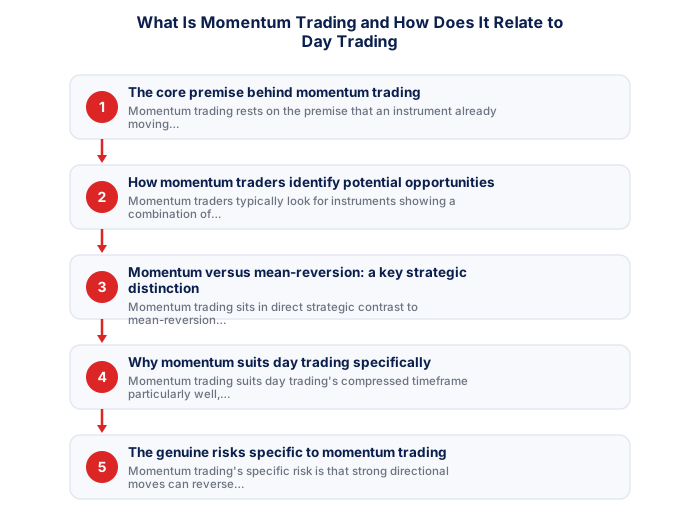
1. The core premise behind momentum trading
Momentum trading rests on the idea that an instrument already moving strongly in one direction is statistically more likely to keep going, at least in the near term, than to suddenly reverse. Strong directional moves tend to attract more participants and capital flow that reinforce the existing direction for a while before eventually running out of steam.
This differs meaningfully from approaches looking for reversal points around support and resistance, where the trader is betting a move has become overextended and is due to reverse. Momentum trading takes essentially the opposite bet, riding an existing move rather than anticipating its end.
It's worth understanding this as a probabilistic tendency rather than a reliable law of market behaviour, in the same way any trading edge discussed throughout this site represents a statistical tilt rather than a certainty. A momentum trade can still reverse immediately after entry, the premise simply suggests continuation is somewhat more likely than not over a large enough sample, not that it's guaranteed on any individual trade.
2. How momentum traders identify potential opportunities
Momentum traders typically look for instruments showing strong recent price movement, often confirmed by volume and momentum oscillator readings that show the move is still strong rather than running out of steam. A breakout above a significant resistance level accompanied by strong volume is a commonly cited setup.
This usually means scanning across multiple instruments to find which ones are currently showing strong momentum, rather than focusing on one predetermined instrument regardless of its current state, a meaningfully different workflow from some other strategy approaches.
This scanning workflow is worth building deliberately rather than relying on whatever instruments happen to catch your attention casually. Many charting platforms include built-in scanning or screening tools that can filter for specific momentum characteristics automatically, worth exploring if this approach genuinely fits your trading style, rather than manually checking instruments one by one.
3. Momentum versus mean-reversion: a key strategic distinction
Momentum trading sits in direct contrast to mean-reversion approaches, which bet that an instrument's price will revert toward some average or typical level after becoming unusually extended in one direction, essentially the opposite thesis to momentum's continuation bet.
Neither approach is universally better. Different conditions favour each: momentum tends to do better in sustained trending markets, mean-reversion tends to do better in choppier, range-bound ones, so being aware of the market's current character matters when choosing which approach actually suits it.
- Economic calendar checked for high-impact events
- Key levels marked for target instruments
- Maximum trades per session defined
- Stop-losses set on overnight positions
- Backup connectivity available
- Eskom schedule checked
- Post-session journal time scheduled
Recognising which of these two conditions currently describes the market you're trading is worth treating as a genuine analytical step in its own right, not an afterthought. A momentum strategy applied during genuinely choppy, range-bound conditions, or a mean-reversion strategy applied during a strongly trending period, tends to produce considerably weaker results than the identical strategy applied to conditions that actually suit its underlying premise.
4. Why momentum suits day trading specifically
Momentum trading suits day trading's compressed timeframe well, since strong intraday momentum moves, even if they eventually reverse over a longer period, can produce meaningful, rapid price movement within a single session, which fits day trading's no-overnight-positions rule.
That compatibility is why momentum-based approaches come up so often in day trading and scalping education, even though the underlying momentum concept isn't limited to these short-term styles.
| Session | SAST | Instruments | Liquidity |
|---|---|---|---|
| Pre-market | 07:00-09:00 | Any | Low |
| JSE morning | 09:00-12:00 | JSE shares | High |
| Midday lull | 12:00-15:00 | Any | Low |
| London-NY overlap | 15:00-17:00 | Major forex | Very high |
| NY afternoon | 17:00-21:00 | Major forex | Medium |
It's worth being clear that this compatibility describes fit with the trading style's structure and timeframe, not a guarantee of easier profitability. Momentum trading within a single session still requires the same disciplined entry criteria, risk management, and honest self-assessment that any trading approach demands, the compressed timeframe doesn't make sound execution any less important.
5. The genuine risks specific to momentum trading
The specific risk with momentum trading is that strong directional moves can reverse suddenly and without clear warning, especially once a move becomes extended enough that early participants start taking profits, triggering a rapid reversal that can catch late entrants with sharp, swift losses.
That risk is exactly why disciplined stop-loss use matters with particular force here. Entering a strong move without a predetermined exit plan leaves you fully exposed to this kind of sudden reversal.
This risk is worth watching for through a specific behavioural lens too, entering a momentum trade later in its move, purely because it looks compelling after already extending significantly, is a common way this risk actually plays out in practice, closely related to the FOMO-driven entries discussed elsewhere on this site.
6. Combining momentum signals with broader market context
Many momentum traders combine their short-term signals with awareness of the broader, higher-timeframe trend, specifically to avoid taking a momentum trade that, while showing short-term strength, actually runs against a bigger longer-term trend that could eventually reassert itself and overwhelm the shorter-term move.
This reflects a broader principle: using multiple, complementary analytical perspectives together tends to work better than relying on any single signal type, momentum included, in isolation from the wider market context.
Momentum in day trading often shows strongest at the market open and around news events. It tends to fade later in sessions, making momentum setups front-loaded in the early part of a trading session.
★ Why It Matters
Worth checking in your own results: whether your momentum trades perform differently depending on the session they're taken in. Momentum strategies rely on real volume and participation, which varies considerably between the Asian, London, and New York sessions.
✕ Common mistakes
- Not tracking your own momentum trade results by session. This segmentation often reveals which session conditions actually suit the approach.
- Treating momentum trading as exclusively a day trading technique. The same underlying concept can apply to longer-term swing trading too.
- Chasing momentum that's already exhausted by the time of entry. Late entries into an already-extended move carry meaningfully more risk.
How often should I do this?
There is no target. Frequency should follow the setups the market offers, not a quota. Trade frequency covers the cost of forcing it.
Key Takeaways
- Momentum trading targets instruments showing strong directional movement, often used within day trading specifically to capture continuation moves.
- Momentum trading targets instruments already showing strong directional price movement, betting on continuation rather than anticipating a reversal.
- It's commonly used within day trading, though the concept can also apply to longer-term swing trading.
- The core premise behind momentum trading.
- How momentum traders identify potential opportunities.
Frequently asked follow-up questions
Can momentum trading be used for longer-term swing trading too?
Yes, the underlying concept applies across timeframes, though it comes up most often in day trading given the compatibility covered above.
How do I know if current market conditions favour momentum over mean-reversion?
Broader trend analysis across multiple timeframes can help show whether conditions are sustained and trending (favouring momentum) or choppier and range-bound (favouring mean-reversion).
Is momentum trading riskier than other day trading approaches?
It carries its own risk profile, particularly around sudden reversals, rather than being universally riskier or safer than other day trading approaches.
