i Short answer
A typical day trading routine follows a structured pattern: pre-market preparation, focused execution during the session's highest-liquidity window, and a structured post-session review.
This contrasts with the misconception that day trading means continuous, unstructured activity all day.
📋 ON THIS PAGE
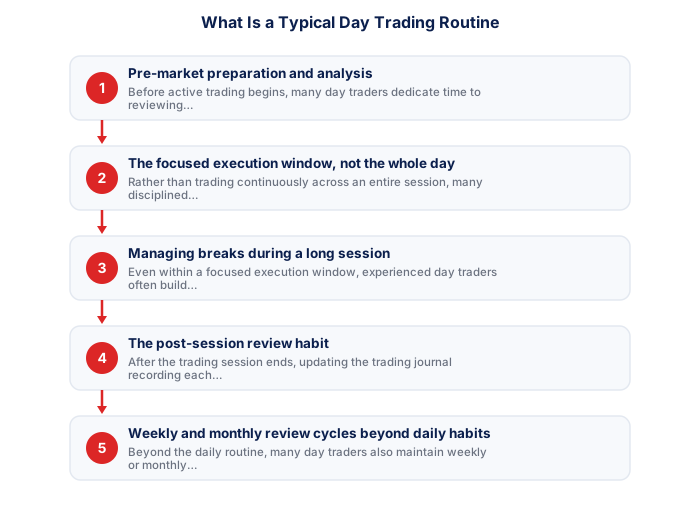
1. Pre-market preparation and analysis
Before active trading begins, many day traders spend time reviewing overnight developments, checking the economic calendar for scheduled news during the upcoming session, and marking specific support and resistance levels worth watching for the day ahead. Doing this calmly before the pressure of live trading starts supports predetermined, rather than reactive, decision-making.
Skipping this preparation and reacting purely to in-the-moment price action instead tends to produce less disciplined, less consistent decisions, since the trader lacks the calmly-considered context this phase is meant to provide.
It's worth treating this preparation window with the same discipline as the actual trading session itself, a rushed or skipped preparation phase tends to show up later as poorly-timed or poorly-reasoned trades during the actual execution window.
2. The focused execution window, not the whole day
Rather than trading continuously across an entire session, many disciplined day traders concentrate their actual execution within the highest-liquidity window. For major forex pairs that's often the London-New York overlap, which typically offers the best combination of liquidity, tight spreads, and the price movement day trading strategies depend on.
Trading outside that concentrated window, during quieter periods, often means worse conditions for day trading specifically, which makes this kind of time-window discipline a practical choice, not just a stylistic one.
3. Managing breaks during a long session
Even within a focused execution window, experienced day traders often build in short breaks to manage fatigue and keep decision quality up, since the sustained concentration day trading requires genuinely degrades over time without periodic rest.
Trading continuously without any break, especially during a demanding multi-hour session, raises the risk of fatigue-driven errors and impulsive decisions that undermine the disciplined, criteria-based approach essential to sound trading practice.
- Economic calendar checked for high-impact events
- Key levels marked for target instruments
- Maximum trades per session defined
- Stop-losses set on overnight positions
- Backup connectivity available
- Eskom schedule checked
- Post-session journal time scheduled
4. The post-session review habit
After the session ends, updating your trading journal, recording each trade's reasoning, outcome, and any emotional or behavioural notes while it's still fresh in memory, tends to produce more accurate, useful records than trying to reconstruct it later.
This post-session review is also your chance to honestly check whether the day's trades actually followed your predetermined criteria, or whether any overtrading or discipline lapses crept in, information that's much easier to capture accurately right after the session than days later.
| Session | SAST | Instruments | Liquidity |
|---|---|---|---|
| Pre-market | 07:00-09:00 | Any | Low |
| JSE morning | 09:00-12:00 | JSE shares | High |
| Midday lull | 12:00-15:00 | Any | Low |
| London-NY overlap | 15:00-17:00 | Major forex | Very high |
| NY afternoon | 17:00-21:00 | Major forex | Medium |
It's worth completing this review before moving on to other activities, rather than deferring it, a review conducted immediately while the session's specific details are still fresh tends to be more accurate and genuinely useful than one attempted from memory later.
5. Weekly and monthly review cycles beyond daily habits
Beyond the daily routine, many day traders also keep weekly or monthly review cycles, examining accumulated patterns across multiple sessions, calculating expectancy over the larger sample, and spotting broader patterns tied to specific times of day, instruments, or market conditions.
This longer-cycle review complements the daily habit by providing the larger sample size needed for reliable statistical conclusions about strategy performance, something a single day's results can't give you on their own.
6. Avoiding the 'always on' trap many beginners fall into
A common mistake among newer day traders is treating the whole trading day as one continuous opportunity requiring constant attention and frequent trading, rather than a structured, time-bounded approach. This "always on" mindset tends to produce exactly the overtrading pattern covered above, since it strips away the natural discipline a structured routine with defined preparation, execution, and review phases provides.
Recognising that even day trading, already a more time-intensive style than swing or position trading, benefits from a structured, bounded routine over unstructured, continuous activity is one of the more important practical lessons for trading it sustainably over time.
A typical day trading routine involves 45-60 minutes of pre-market preparation, an active trading window of 1-3 hours, and a structured post-session journal review within the hour of finishing.
★ Why It Matters
Worth scheduling explicitly, as important as the trading itself: a fixed post-session review block. Traders who skip this on busy days tend to lose the compounding benefit of journaling exactly when a difficult session would have taught them the most.
✕ Common mistakes
- Treating day trading as requiring continuous activity all day. A structured routine with focused windows tends to outperform unstructured, all-day engagement.
- Skipping pre-market preparation in favour of reacting once the session starts. Preparation tends to improve decision quality once the session is genuinely active.
- Not building in a structured post-session review as a standard step. Skipping this on busy or difficult days loses the most valuable learning opportunity.
- Assuming a routine that works for one trader will suit everyone equally. Personal schedule and strategy should shape the specific routine.
Key Takeaways
- A typical day trading routine includes pre-market analysis, focused execution during peak liquidity, and a structured post-session review. Learn the pattern.
- A typical day trading routine follows a structured pattern: pre-market preparation, focused execution during the session's highest-liquidity window, and a structured post-session review.
- This contrasts with the misconception that day trading means continuous, unstructured activity all day.
- Pre-market preparation and analysis.
- The focused execution window, not the whole day.
See also: What Is the Best Time of Day to Trade Forex? and Should I Trade Every Day or Only on Certain Days? and What Is Fading the Move and Is It a Sound Day Trading Approach?.
Frequently asked follow-up questions
How long should a typical day trading session last?
This varies by individual strategy and capacity, but many disciplined day traders concentrate their most active execution within a few focused hours rather than an entire extended session.
Is it bad to trade every single day as a day trader?
Not inherently, given the style's nature, but "no trade" discipline, waiting for genuine setups, still applies within each session, even for active day traders.
Should I review my trades immediately or wait until the next day?
Reviewing immediately after the session, while details remain fresh, generally produces more accurate and useful journal entries than delayed review.
