i Short answer
Momentum trading targets short-term price acceleration and continuation, often using indicators like RSI to gauge strength, while trend following targets broader, more sustained directional moves over longer periods.
📋 ON THIS PAGE
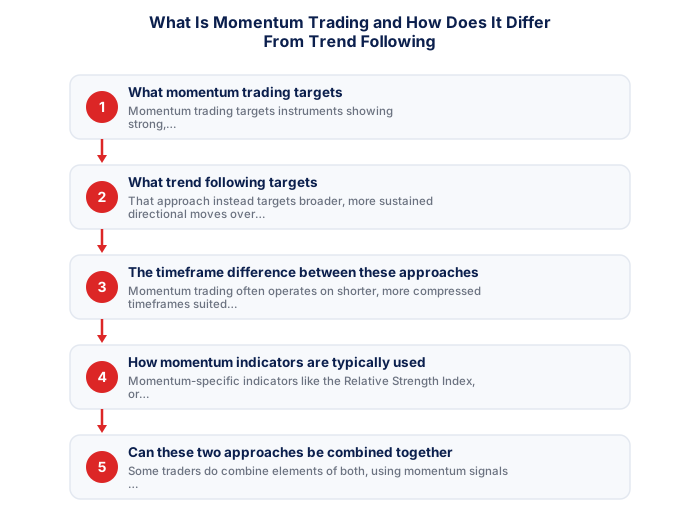
1. What momentum trading specifically targets
Momentum trading targets instruments showing strong, accelerating short-term price movement, on the premise that this acceleration tends to continue briefly before naturally slowing, allowing traders to capture this continuation over a relatively compressed timeframe.
It's worth understanding 'acceleration' as the specific thing being measured here, not simply direction. A trend-following approach might happily hold through periods where movement slows or pauses, provided the broader direction remains intact, while momentum trading is specifically interested in the rate of change itself, entering when that rate is strong and typically exiting once it noticeably decelerates, regardless of whether the broader direction has actually reversed.
2. What trend following specifically targets
That approach instead targets broader, more sustained directional moves over considerably longer periods, focusing less on short-term acceleration and more on identifying and riding an established, ongoing directional move.
This patience is worth appreciating as the defining trade-off against momentum trading's faster pace: a trend follower accepts giving back some profit during normal pullbacks within an ongoing trend, in exchange for capturing the full extent of genuinely large, sustained moves that a shorter-term, acceleration-focused approach would likely have exited well before completion.
- FSCA-regulated broker verified at fsca.co.za
- Demo account tested for minimum 60 days
- Trading plan written: entry, exits, position sizing
- Risk per trade defined (1-2% of account)
- Backup internet connection tested for load shedding
- Tax implications understood
3. The timeframe difference between these approaches
Momentum trading often operates on shorter, more compressed timeframes suited to day trading, while trend following more typically operates across longer swing or position trading timeframes.
It's worth matching this timeframe distinction to your own realistic schedule and temperament, discussed in more detail elsewhere on this site regarding trading style and lifestyle fit, since attempting genuine momentum trading without the sustained attention it requires, or genuine trend following without the patience to hold through normal pullbacks, tends to produce a mismatched, frustrating experience regardless of how sound either approach is in principle.
4. How momentum indicators are typically used
Momentum-specific indicators like the Relative Strength Index, or rate-of-change measures help traders identify and quantify the specific acceleration this approach targets, distinct from simply identifying an established directional trend.
It's worth using these indicators to confirm rather than generate your trading ideas in isolation, since a strong RSI reading alone, without broader context about the instrument and current market conditions, can be genuinely misleading. Combining momentum indicators with the broader confluence principle discussed throughout this site's strategy content tends to produce more reliable signals than relying on any single indicator alone.
| Item | Detail |
|---|---|
| Regulator | FSCA, fsca.co.za |
| Exchange control | SARB, resbank.co.za |
| Tax authority | SARS, sars.gov.za |
| JSE hours | 09:00-17:00 SAST Mon-Fri |
| Best forex session | 15:00-17:00 SAST |
| CGT annual exclusion | R50,000 (individuals) |
5. Can these two approaches be combined together
Some traders do combine elements of both, using momentum signals specifically to time entries within a broader, already-established trend identified through trend-following analysis.
This combined approach is worth considering seriously, since it addresses a specific weakness each style has on its own: pure trend following can mean entering at a less optimal moment within an established trend, while pure momentum trading without broader trend context risks chasing short-term acceleration that's actually moving against the larger prevailing direction.
6. Which approach might suit your own trading style
Momentum trading's faster pace might suit traders specifically drawn to day trading's concentrated attention, while trend following might suit traders preferring a more patient, less frequently-monitored approach.
For a trader in South Africa, the late afternoon carries the heaviest volume, because that is when the two largest sessions overlap. liquidity
Trend following enters after a trend is established, safer but later.
Momentum trading tries to capture a move early, requiring faster entry decisions. Trend following enters after a trend is established, accepting a later entry in exchange for a more confirmed, lower-risk position.
★ Why It Matters
Something worth backtesting : momentum strategies and trend-following strategies often perform best in different market regimes, testing both against the same recent period for your traded instrument reveals which one your current market conditions actually favour.
✕ Common mistakes
- Not backtesting both approaches against the same recent data. This comparison reveals which regime has actually been dominant recently for your instrument.
- Treating these two related but distinct approaches as interchangeable. They differ meaningfully in timeframe and underlying logic.
- Switching between the two reactively rather than based on tested conditions. Reactive switching tends to underperform a disciplined, tested approach.
Key Takeaways
- Momentum trading specifically targets short-term price acceleration, while trend following targets broader, sustained directional moves over longer periods.
- Momentum trading targets short-term price acceleration and continuation, while trend following targets broader, more sustained directional moves over longer periods.
- What momentum trading specifically targets.
- What trend following specifically targets.
- The timeframe difference between these approaches.
Frequently asked follow-up questions
Is momentum trading riskier than trend following?
Risk profiles differ rather than one being uniformly riskier; momentum trading's shorter timeframe can mean faster, more concentrated outcomes either way.
Does momentum trading work on instruments beyond forex?
Yes, this approach applies across various instrument categories, wherever genuine short-term price acceleration can be identified and measured.
Can a trend reverse while momentum indicators still show strength?
Yes, this divergence between price action and momentum indicators is itself sometimes used as a potential reversal warning signal.
Is momentum trading more suited to beginners or experienced traders?
Given its faster pace and quicker decision-making requirements, many educators suggest building foundational skill with simpler approaches before specifically tackling momentum trading.
Does South Africa's JSE show genuine momentum trading opportunities?
JSE-listed instruments can show momentum characteristics similar to other markets, though liquidity and volatility specifics vary by individual instrument.
