Home โ€บ Day Trading & Scalping โ€บ What Is Gap Trading and Does It Apply to Forex Day Trading?

What Is Gap Trading and Does It Apply to Forex Day Trading?

i Short answer

Gap trading targets the price difference between one session's close and the next session's open.

This is more directly relevant to shares and indices, though forex still experiences weekend gaps.

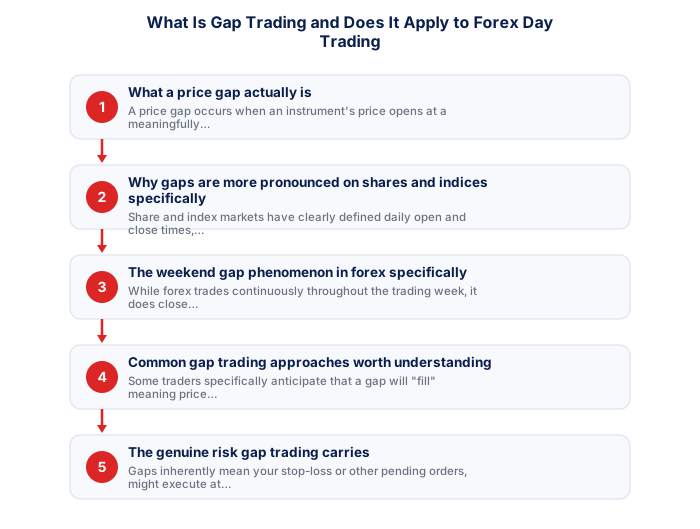
1. What a price gap actually is

A price gap occurs when an instrument's price opens at a meaningfully different level than where it closed during the previous session, without trading through the intermediate prices in between, typically reflecting new information or developments that emerged while that specific market was closed.

It's worth understanding why gaps occur mechanically, they typically reflect genuine trading activity or news developing while a specific market was closed, once trading resumes, price adjusts immediately to reflect this new information, creating the visible jump rather than a gradual transition.

0.00011 pip for major currency pairs
100,000units in a standard lot
~R1/pipUSD/ZAR standard lot (approx)
5-8%annual overnight financing cost
100,000units in a standard lot
10,000units in a mini lot
1,000units in a micro lot
0.00011 pip for major currency pairs

2. Why gaps are more pronounced on shares and indices specifically

Share and index markets like the JSE have clearly defined daily open and close times, creating a genuine overnight period during which news and developments can accumulate before the next session's opening price reflects this accumulated information, often producing a visible, sometimes significant gap from the previous close.

It's worth connecting this directly to the OTC market structure discussed elsewhere on this site, forex's near-continuous trading across global sessions means genuinely significant gaps are considerably less common than on markets with clearly defined daily open and close times.

Lot Size Quick Reference
Lot typeSizeUSD/ZAR pip valueMin recommended account
Standard100,000 units~R1.00R100,000+
Mini10,000 units~R0.10R10,000+
Micro1,000 units~R0.01R1,000+
Nano100 units~R0.001R100+
Pip Value Formula
V = (1 pip รท E) ร— L
  • V = Pip value in account currency
  • E = Current exchange rate of quote vs account currency
  • L = Lot size (100,000 standard / 10,000 mini / 1,000 micro)
  • USD/ZAR example = 1 pip = R1 per standard lot
CFD trading
  • Leveraged instrument
  • Long and short available
  • Overnight financing applies
  • No ownership of asset
Spot exchange
  • Typically unleveraged
  • Physical currency received
  • No daily financing
  • Currency ownership

3. The weekend gap phenomenon in forex specifically

While forex trades continuously throughout the trading week, it does close over the weekend, meaning significant weekend news or developments can produce a genuine, visible gap when forex markets reopen on Monday compared to where they closed the previous Friday. This weekend gap is the most directly relevant gap phenomenon for forex traders.

It's worth checking your open positions specifically before the weekend closure if you know significant news is expected over the weekend, discussed elsewhere on this site regarding trading around major events, since weekend gaps represent forex's primary genuine gap risk worth planning around.

Example
Spread cost: 1 mini lot USD/ZAR at 4 pip spread = 4 x R0.10 = R0.40 per entry. Overnight finance: 1 mini lot at 6% annual = 6% / 365 x R10,000 = R1.64/day. After just one week, financing (R11.48) exceeds the spread cost (R0.40) by 28x.
Forex Lot Reference
Standard
100,000 units, ~R1/pip per R1 move
Mini
10,000 units, ~R0.10 per pip
Micro
1,000 units, ~R0.01 per pip
USD/ZAR 3 pip spread
R300 per standard lot
Overnight finance
~5-8% p.a. on notional
Margin at 1:30
~3.33% of notional

4. Common gap trading approaches worth understanding

Some traders specifically anticipate that a gap will "fill", meaning price eventually retraces back to close the gap and trade through the previously skipped price levels, while others trade in the direction of the gap, anticipating that whatever significant news caused it will continue driving price further in that same direction, essentially the same momentum-versus-mean-reversion philosophical divide seen elsewhere in trading.

It's worth backtesting whichever specific gap trading approach interests you, discussed elsewhere on this site regarding backtesting generally, before committing real capital, confirming through your own historical analysis whether these general patterns genuinely hold for your specific traded instruments.

!
Overnight financing applies to the full notional value

A R2,000 deposit at 1:30 leverage controls R60,000 notional. Overnight financing is charged on R60,000, not R2,000. This makes holding leveraged positions for days or weeks significantly more expensive than it first appears.

5. The genuine risk gap trading carries

Gaps inherently mean your stop-lossA stop-loss automatically closes a losing position at a predetermined level; a take-profit does the same for winning positions.Click to read more โ†’ or other pending orders might execute at a significantly different price than intended, since the gap itself represents exactly the kind of discontinuous price movement that creates elevated slippageSlippage tolerance sets the maximum acceptable price deviation before an order is rejected rather than executed at a significantly different price..Click to read more โ†’ risk during high-volatilityVolatility measures how much and how quickly an instrument's price fluctuates.Click to read more โ†’ periods.

It's worth being especially cautious about position sizing for any genuine gap-trading strategy, given how quickly and unpredictably gaps can move, a stop-loss order can't protect you from a gap that jumps straight past your specified level, worth respecting this elevated risk accordingly.

6. Is gap trading relevant to typical day traders

For most forex day traders, weekend gaps are the primary relevant consideration, mainly affecting positions held open over a weekend, since day trading by definition avoids holding positions overnight or over weekends. Gap trading as a dedicated strategy is generally more relevant to share and index traders than to forex day traders specifically.

For South African-based day traders, the window from roughly 15:00 to 17:00 SAST, when London and New York sessions overlap, tends to offer the most reliable liquidity and movement for major forex pairs, worth factoring into any intraday routine.

CFD and forex instruments give South African traders access to global markets from a single ZAR-denominated account without needing separate international brokerage relationships. This accessibility comes with structural characteristics that traders must understand clearly. CFDs are derivative instruments, you never own the underlying asset, and profit or loss is purely the mark-to-market difference between entry and exit prices multiplied by position size. The overnight financing charge applies to the full notional value of leveraged positions, not just the deposited margin. For traders holding positions for multiple days or weeks, this financing cost compounds and can meaningfully reduce the profitability of otherwise successful trades. Understanding the exact financing rates your broker applies to each instrument class before trading is fundamental preparation, not an optional detail.

CFD and forex instruments give South African traders access to global markets from a single ZAR-denominated account without needing separate international brokerage relationships. This accessibility comes with structural characteristics that traders must understand clearly. CFDs are derivative instruments, you never own the underlying asset, and profit or loss is purely the mark-to-market difference between entry and exit prices multiplied by position size. The overnight financing charge applies to the full notional value of leveraged positions, not just the deposited margin. For traders holding positions for multiple days or weeks, this financing cost compounds and can meaningfully reduce the profitability of otherwise successful trades. Understanding the exact financing rates your broker applies to each instrument class before trading is fundamental preparation, not an optional detail.

โ˜… Why It Matters

Worth checking if you trade ZAR pairs over weekends: the Sunday open gap size relative to Friday's close has at times been noticeably larger for emerging-market pairs than for major currency pairs, given their typically thinner weekend liquidityLiquidity describes how easily an instrument can be bought or sold without significantly affecting its price.Click to read more โ†’.

Equity markets
Gaps common
Closed overnight, reopen with a gap
Forex markets
Gaps rare
Nearly 24/5, gaps mainly Monday open
When forex gaps occur
Weekend gap
Friday close to Monday open
Major news over weekend
causes larger gaps
Equity CFDs
gaps apply fully
Forex gap strategy
Monday open specifically

Equity markets close overnight and frequently reopen with gaps. Forex trades nearly continuously, so gaps are rare and mainly seen at the Monday open, or after significant news events over the weekend.

โœ• Common mistakes

  • Assuming forex gaps behave identically to share market gaps. Forex gaps occur specifically over weekends, a distinct dynamic from intraday equity gaps.
  • Trading immediately at the Sunday open without checking the gap size first. A wide gap warrants extra caution before committing to a position.
  • Treating gap trading strategies built for shares as directly transferable to forex. The underlying mechanics and frequency of gaps differ between these markets.
What is the best trading session for South African traders?

The London-New York overlap from 15:00 to 17:00 SAST provides the highest liquidity for major forex pairs. The JSE regular session from 09:00 to 17:00 SAST is best for SA shares and the JSE Top 40 index.

How many trades per day should a day trader target?

Selective day traders typically place two to five high-quality trades per session. Placing more trades does not improve results - overtrading is a leading cause of day trader account drawdown.

Key Takeaways

  1. Gap trading targets the price difference between one session's close and the next open, more relevant to share and index trading than continuous forex markets.
  2. Gap trading targets the price difference between one session's close and the next session's open.
  3. This is more directly relevant to shares and indices, though forex still experiences weekend gaps.
  4. What a price gap actually is.
  5. Why gaps are more pronounced on shares and indices specifically.

Frequently asked follow-up questions

Should I always expect weekend gaps to fill?

Not always. This is one possible pattern among others, rather than a guaranteed, reliable rule applicable to every specific gap.

Can I avoid weekend gap risk entirely as a day trader?

Yes, since day trading by definition closes positions before the trading day ends, day traders generally avoid holding positions through the weekend entirely.

Are gaps more common during certain times of year?

Gaps can occur around any significant unexpected news, though periods with major scheduled events or holidays can sometimes see more pronounced gap activity.

๐Ÿ“š Sources & further reading

This article draws on general information published by the South African regulators and established financial education resources listed below. Always check each source directly for the most current detail.

Explore more South African trading guides on TradeAnswers.

๐Ÿ›ก๏ธ
Practice without risk

Sharpen Your Timing, Risk-Free

Practise fast-paced entries and exits on a free demo account before putting real capital on the line.

Start Demo Trading
  • FSCA RegulatedTrade with confidence
  • Practice Risk FreeReal market conditions
  • Beginner FriendlyPerfect for learning

79% of retail CFD accounts lose money. Demo accounts do not guarantee future profits.