Home โ€บ Day Trading & Scalping โ€บ How Does Day Trading Differ Between Forex and JSE Shares?

How Does Day Trading Differ Between Forex and JSE Shares?

i Short answer

Day trading forex offers continuous global liquidityLiquidity describes how easily an instrument can be bought or sold without significantly affecting its price.Click to read more โ†’ around the clock during the trading week.

Day trading JSE shares directly is instead bound by specific exchange hours and settlement rules.

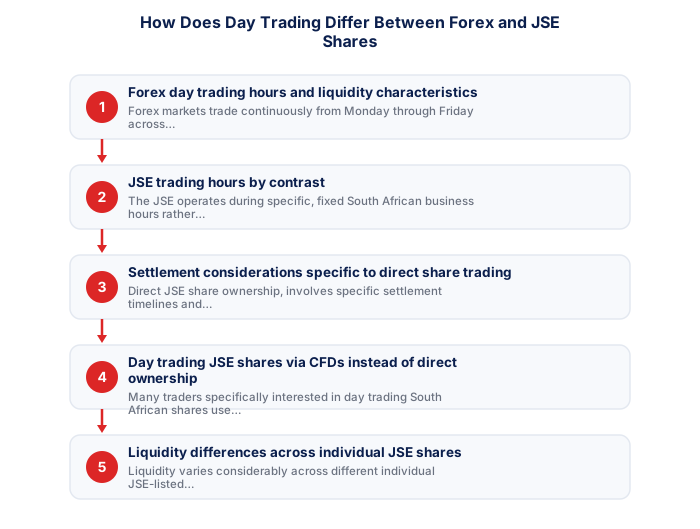
1. Forex day trading hours and liquidity characteristics

Forex markets trade continuously from Monday through Friday across overlapping global sessions, giving day traders flexible timing options and generally deep liquidity, particularly during major session overlaps.

South African traders accessing forex and CFD markets should understand that the instruments they trade through FSCA-regulated brokers are derivative contracts rather than ownership of the underlying asset. This means that all profits and losses are settled in cash, position sizes can be adjusted to suit any account size, and the same trading infrastructure provides access to global markets from a ZAR-denominated account. Understanding this fundamental structure helps traders make better decisions about instrument selection, position sizing, and account management.

6/yrSARB MPC meetings affecting ZAR
3credit agencies reviewing SA annually
Februarybudget speech month
3-5 pipstypical USD/ZAR retail spread
ZA
SA market context: USD/ZAR is moved by both global EM risk appetite and SA-specific drivers. Separating these two components produces more precise ZAR analysis than treating the pair as one signal.

2. JSE trading hours by contrast

The JSE operates during specific, fixed South African business hours rather than the continuous structure forex offers, meaning day trading JSE shares directly is constrained to this specific, bounded daily window rather than the more flexible scheduling forex day trading allows.

Weekly SA Market Monitoring Checklist
  • SARB economic calendar checked for the week
  • Next Eskom load shedding schedule reviewed
  • GNU stability news reviewed
  • Stats SA data releases noted
  • Credit agency review dates checked
  • US/global events that move EM risk noted
SA Market Calendar Reference
SARB MPC
6 meetings/year, rate decision
Budget Speech
Late February, fiscal signal
Moody's review
Typically October/November
S&P Fitch review
Typically October/November
Stats SA CPI
3rd week of each month
Eskom stages
Real-time, check eskomsepush.com
~R16-22USD/ZAR trading range 2022-2025
6/yearSARB MPC meetings
3rating agencies reviewing SA annually
Februaryhighest SA market volatility month

3. Settlement considerations specific to direct share trading

Direct JSE share ownership, distinct from CFD trading, involves specific settlement timelines and processes distinct from the immediate, continuous position adjustment CFD trading allows. These settlement mechanics can introduce additional considerations relevant to genuinely rapid, same-day buying and selling of actual shares rather than CFDs tracking their price.

SA ZAR Event Calendar
EventFrequencyZAR impactSource
SARB MPC6x per yearHighresbank.co.za
Budget SpeechAnnual (February)Very hightreasury.gov.za
Credit reviewsAnnual each agencyVery highAgency sites
Stats SA CPIMonthlyMediumstatssa.gov.za
Eskom stageAs neededLow-mediumeskomsepush.com
Pros
  • SA context provides genuine informational edge
  • ZAR pairs accessible via FSCA brokers in ZAR accounts
  • Rand volatility creates larger intraday ranges
  • 6 SARB meetings/year create regular macro setups
Cons
  • Higher geopolitical risk than G10 pairs
  • Load shedding creates unique operational disruptions
  • SA rand liquidity thinner than major G10 pairs
  • SA-specific news requires constant local monitoring

4. Day trading JSE shares via CFDs instead of direct ownership

Many traders interested in day trading South African shares use CFD products tracking individual JSE shares or the JSE Top 40 index rather than direct share ownership, since CFD trading avoids the settlement complexity above while still giving exposure to JSE-listed company price movement.

!
Load shedding during 15:00-17:00 SAST is a specific risk

This peak forex liquidity window coincides with common afternoon load shedding slots. Pre-set stop-losses and a tested mobile data backup are standard operating procedure, not optional extras.

5. Liquidity differences across individual JSE shares

Liquidity varies considerably across different individual JSE-listed companies, with day trading favouring the more liquid, actively traded shares where spreadsThe spread is the gap between an instrument's buy and sell price, and the most fundamental trading cost.Click to read more โ†’ stay tighter and execution stays more reliable, similar to liquidity considerations that apply to forex pair selection too.

6. Which approach suits which kind of day trader

Traders interested in continuous, flexible-timing day trading with deep global liquidity generally find forex day trading more naturally suited to this style, while traders with specific interest in South African company-level analysis might find JSE share CFD day trading more personally engaging, despite its more bounded trading hours and the liquidity considerations above.

For South African-based day traders, the window from roughly 15:00 to 17:00 SAST, when London and New York sessions overlap, tends to offer the most reliable liquidity and movement for major forex pairs, worth factoring into any intraday routine.

South African traders who approach their trading activity with the same rigour they would apply to any skilled professional discipline typically develop more durable results than those who treat trading as primarily intuitive. This means maintaining written records of every trade and its rationale, reviewing performance at regular intervals with specific metrics, and updating trading rules based on accumulated evidence rather than gut feeling. The structured approach separates traders who improve continuously from those who repeat the same errors across extended periods without identifying the underlying cause.

For South African traders operating within the FSCA-regulated environment, the combination of clear regulatory oversight, ZAR account access, and the unique analytical opportunities provided by rand-specific market drivers creates a well-structured foundation for developing a professional trading practice. The key to converting this foundation into consistent results is not finding the perfect strategy or the perfect instrument but developing the discipline to execute a sound strategy consistently across a large enough sample of trades to allow the strategy's statistical edge to express itself.

South Africa's financial markets reward traders who develop genuine familiarity with the country's specific economic and political drivers rather than applying global frameworks without local adaptation. The JSE's heavy concentration in resources companies means it behaves differently from broad international equity indices during commodity cycles. USD/ZAR's sensitivity to domestic political events, SARB policy signals, and the decisions of credit rating analysts creates analytical opportunities for traders who follow SA-specific news closely. SARB MPC decisions are made against a backdrop of structural inflation and current account pressures that differ from the developed market central banking environment that most global frameworks assume. Traders who invest time in understanding these SA-specific layers develop informational advantages that remain relevant across multiple market cycles.

South Africa's financial markets reward traders who develop genuine familiarity with the country's specific economic and political drivers rather than applying global frameworks without local adaptation. The JSE's heavy concentration in resources companies means it behaves differently from broad international equity indices during commodity cycles. USD/ZAR's sensitivity to domestic political events, SARB policy signals, and the decisions of credit rating analysts creates analytical opportunities for traders who follow SA-specific news closely. SARB MPC decisions are made against a backdrop of structural inflation and current account pressures that differ from the developed market central banking environment that most global frameworks assume. Traders who invest time in understanding these SA-specific layers develop informational advantages that remain relevant across multiple market cycles.

South African traders who build systematic habits around preparation, execution, and review consistently outperform those who rely on instinct and informal processes. Preparation involves a written analysis before each session. Execution means following predefined rules regardless of emotional state. Review means recording every trade and assessing performance against the rules, not against the monetary outcome alone. This three-part structure converts trading from a reactive activity into a repeatable professional practice, and it is accessible to any trader willing to invest the consistent daily effort it requires.

โ˜… Why It Matters

Worth knowing: this is one of the few genuine structural advantages forex CFD trading has over direct JSE share day trading for a South African retail trader, the absence of a minimum-equity day-trading rule that exists in some other markets.

US PDT rule versus South African situation
US PDT rule
South Africa
Applies to
US-regulated brokers
Not applicable
What it requires
Minimum $25,000 for 4+ day trades/week
NIA
FSCA-regulated brokers
Not subject to PDT rule
Correct
Offshore US brokers
May apply
Verify with the broker
Practical implication
Irrelevant for most SA traders
NIA
The US pattern day trader rule doesn't apply to FSCA-regulated brokers.
South African traders using offshore US-regulated brokers should verify.

The US pattern day trader rule, requiring a $25,000 minimum for frequent day trading, doesn't apply to FSCA-regulated brokers. Most South African traders are entirely unaffected by it.

โœ• Common mistakes

  • Assuming forex day trading and JSE share day trading share identical structural rules. Forex offers continuous liquidity without the same minimum-equity day-trading rule.
  • Not checking exchange-specific settlement rules before day trading JSE shares directly. These genuinely differ from forex CFD trading's structure.
  • Treating all day trading markets as operating under the same regulatory framework. Rules genuinely differ between asset classes and jurisdictions.
  • Assuming this advantage applies equally to every account type. It's worth confirming for your specific account structure.
What is the best trading session for South African traders?

The London-New York overlap from 15:00 to 17:00 SAST provides the highest liquidity for major forex pairs. The JSE regular session from 09:00 to 17:00 SAST is best for SA shares and the JSE Top 40 index.

How many trades per day should a day trader target?

Selective day traders typically place two to five high-quality trades per session. Placing more trades does not improve results - overtrading is a leading cause of day trader account drawdown.

South Africa's financial markets have structural characteristics that differentiate them from the global trading environment covered in most international trading education resources. The JSE's significant weighting toward resources and mining companies means it responds differently to global commodity cycles than more diversified international indices. USD/ZAR's dual sensitivity to global EM risk appetite and domestic SA fundamentals creates a richer analytical environment for traders who are willing to develop both dimensions of analysis, rather than relying solely on technical charts that ignore the fundamental context entirely.

The difference between traders who improve systematically and those who plateau for extended periods is typically not natural talent or market insight but the quality of their record-keeping and review process. Traders who maintain a detailed journal, review every trade against their original rationale, and update their trading plan based on accumulated evidence rather than gut feeling develop a feedback loop that continuously improves their decision quality. This structured approach is available to every trader regardless of experience level and costs nothing except the discipline to apply it consistently.

Understanding how South African market conditions differ from the global trading environment covered in most textbooks gives local traders a genuine analytical edge. The JSE's resources weighting, the rand's dual sensitivity to global EM flows and domestic fundamentals, and the specific calendar of SA market events, SARB MPC dates, budget speeches, credit rating reviews, create a richer analytical environment than pure technical analysis alone captures. Building awareness of these SA-specific layers alongside standard trading principles produces more sound analysis for ZAR instruments and JSE-listed products.

Key Takeaways

  1. Day trading forex offers continuous global liquidity around the clock, while JSE share day trading is bound by specific exchange hours and settlement rules.
  2. Day trading forex offers continuous global liquidity around the clock during the trading week.
  3. Day trading JSE shares directly is instead bound by specific exchange hours and settlement rules.
  4. Forex day trading hours and liquidity characteristics.
  5. JSE trading hours by contrast.

Frequently asked follow-up questions

Can I day trade JSE shares outside normal JSE hours?

No, JSE share price movement and trading activity follows the exchange's own operating hours, unlike the continuous forex market structure.

Is JSE Top 40 CFD trading the same as day trading actual shares?

No, this tracks the index's overall movement through a CFD structure, rather than involving direct ownership or trading of the individual underlying shares themselves.

Does day trading discipline differ between forex and JSE shares?

The core discipline principles apply similarly across both, though awareness of each market's particular hours and liquidity characteristics remains important for either approach.

๐Ÿ“š Sources & further reading

This article draws on general information published by the South African regulators and established financial education resources listed below. Always check each source directly for the most current detail.

Explore more South African trading guides on TradeAnswers.

๐Ÿ›ก๏ธ
Practice without risk

Sharpen Your Timing, Risk-Free

Practise fast-paced entries and exits on a free demo account before putting real capital on the line.

Start Demo Trading
  • FSCA RegulatedTrade with confidence
  • Practice Risk FreeReal market conditions
  • Beginner FriendlyPerfect for learning

79% of retail CFD accounts lose money. Demo accounts do not guarantee future profits.