i Short answer
Currency correlation measures how closely two currency pairs tend to move together, helping traders understand combined exposure and avoid unintended duplicate risk. Our Currency Strength Calculator offers a related but distinct view, ranking individual currencies rather than pairs.
📋 ON THIS PAGE
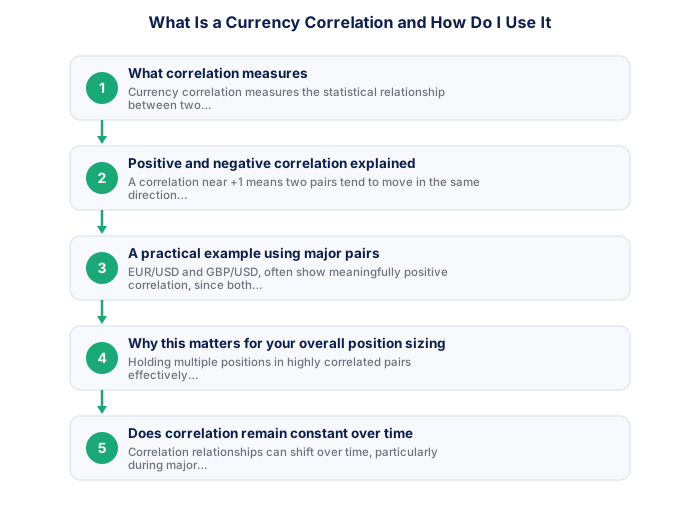
1. What correlation specifically measures
Currency correlation measures the statistical relationship between two currency pairs' price movements, typically expressed as a coefficient between -1 and +1, indicating how closely and in what direction these two pairs tend to move relative to each other over a given period.
It's worth thinking of this coefficient as describing a tendency, not a guarantee. A correlation of 0.8 between two pairs means they've historically moved together closely and consistently, but it doesn't mean they'll move identically on any single given day, individual days can and do diverge even between pairs with genuinely strong historical correlation.
| Correlation Type | What It Means | Example |
|---|---|---|
| Positive | Pairs tend to move in the same direction | EUR/USD and GBP/USD |
| Negative | Pairs tend to move in opposite directions | EUR/USD and USD/CHF |
2. Positive and negative correlation explained
A correlation near +1 means two pairs tend to move in the same direction together, while a correlation near -1 means they tend to move in opposite directions, and a correlation near zero suggests little meaningful relationship between their respective movements.
A correlation close to zero is worth treating with a little more caution than it might initially seem to deserve. It doesn't necessarily mean the two pairs are unrelated in every sense, it means their price movements, over the specific period measured, haven't shown a consistent statistical tendency to move together in either direction, which itself can shift as market conditions change.
- FSCA-regulated broker verified at fsca.co.za
- Demo account tested for minimum 60 days
- Trading plan written: entry, exits, position sizing
- Risk per trade defined (1-2% of account)
- Backup internet connection tested for load shedding
- Tax implications understood
3. A practical example using major pairs
EUR/USD and GBP/USD, often show meaningfully positive correlation, since both pairs share the US Dollar and often respond similarly to broader Dollar strength or weakness, even though the Euro and British Pound themselves are distinct currencies.
This shared-Dollar dynamic is worth generalising beyond just this specific pair combination: any two pairs that both include USD as one half of the pair will tend to show at least some correlation purely from that shared component, simply because broad Dollar strength or weakness affects both pairs simultaneously, even before considering anything specific to the Euro or Pound individually.
4. Why this matters for your overall position sizing
As, holding multiple positions in highly correlated pairs effectively concentrates your risk more than the number of separate positions might initially suggest, since they're likely to move together rather than providing genuine independent diversification.
This is worth making concrete with a specific scenario: a trader who opens what feels like three separate, diversified long positions on EUR/USD, GBP/USD, and AUD/USD, all of which happen to be strongly positively correlated with each other through their shared Dollar exposure, hasn't actually diversified their risk the way three genuinely independent positions would. A single strong Dollar move against all three positions simultaneously can produce a combined loss considerably larger than any individual position's stated risk would suggest in isolation.
| Item | Detail |
|---|---|
| Regulator | FSCA, fsca.co.za |
| Exchange control | SARB, resbank.co.za |
| Tax authority | SARS, sars.gov.za |
| JSE hours | 09:00-17:00 SAST Mon-Fri |
| Best forex session | 15:00-17:00 SAST |
| CGT annual exclusion | R50,000 (individuals) |
5. Does correlation remain constant over time
Correlation relationships can shift over time, particularly during major economic or geopolitical developments, meaning historical correlation data provides useful context rather than a permanently fixed, guaranteed relationship.
This is precisely why relying on correlation data from years ago, without checking whether it still holds under current conditions, can be misleading. A relationship that held reliably during one period of relatively stable global monetary policy can shift meaningfully once conditions change, interest rate divergence between central banks, a major geopolitical shock, or a shift in global risk sentiment can all alter how closely two pairs actually track each other going forward.
6. Checking correlation data for your specific pairs
Various free online tools and some trading platforms directly provide updated correlation data, allowing you to check the current relationship between your specific traded pairs before assuming any particular correlation pattern.
Building a habit of checking this figure periodically, rather than assuming a correlation you learned about once remains permanently accurate, matters most specifically before opening multiple simultaneous positions. A quick check before adding a third or fourth open position, confirming it isn't simply duplicating risk you already hold elsewhere in your account, is a small habit that meaningfully supports genuine risk diversification.
A positive correlation between two pairs means they tend to move together, doubling your effective exposure if you're long both. A negative correlation can be used as a partial hedge.
★ Why It Matters
Something worth testing rather than assuming a textbook correlation figure still applies: recalculate the actual correlation between your specific traded pairs over just the past month, correlations between currency pairs can shift meaningfully, and sometimes even invert, during periods of unusual market stress.
✕ Common mistakes
- Trusting a textbook correlation figure without checking if it still applies. Correlations can shift meaningfully, recalculating recent data gives a more accurate current picture.
- Assuming correlated pairs always move together in the same proportion. The relationship can vary in strength even when the general direction holds.
- Ignoring correlation when assessing your combined account-wide risk. This is precisely where correlation analysis adds the most practical value.
Key Takeaways
- Currency correlation measures how closely two pairs move together, helping traders understand combined exposure and avoid unintended duplicate risk.
- Currency correlation measures how closely two currency pairs tend to move together, helping traders understand combined exposure and avoid unintended duplicate risk.
- What correlation specifically measures.
- Positive and negative correlation explained.
- A practical example using major pairs.
Frequently asked follow-up questions
Is there an ideal correlation level I should aim for across my positions?
There's no universal target; this depends on whether you're deliberately seeking diversification, or intentionally expressing a broader thematic view across correlated pairs.
Does USD/ZAR correlate with major USD pairs like EUR/USD?
There can be some relationship given the shared US Dollar component, though emerging-market currencies like the Rand also respond to their own distinct, additional factors.
Can correlation help me hedge one position with another?
Yes, negatively correlated pairs can sometimes be used this way, though this requires careful, deliberate analysis of the specific relationship.
Should I check correlation before every single new trade I consider?
This is particularly worth checking when you already hold open positions, to understand your genuine combined exposure rather than assuming full independence.
Does correlation apply only to forex pairs or other instruments too?
This concept applies broadly across instrument types, wherever statistical relationships between different instruments' price movements can be measured and analysed.
