i Short answer
Managing this stress comes down to always setting predetermined exit orders, sizing positions to your actual risk tolerance, and limiting how often you check them.
Frequent checking tends to amplify stress without improving outcomes.
📋 ON THIS PAGE
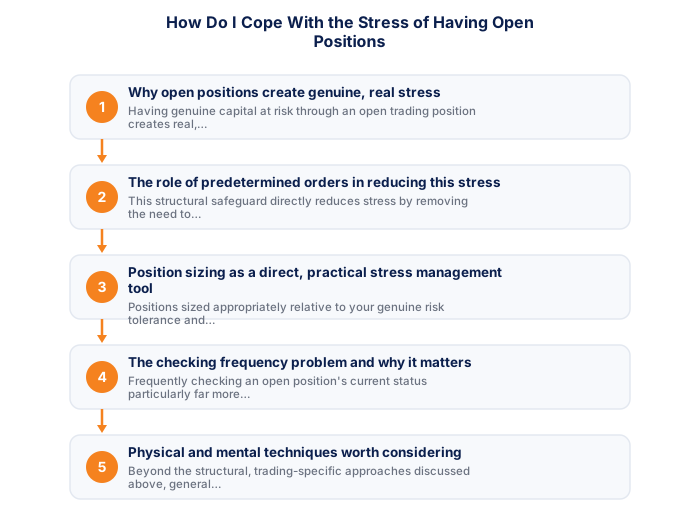
- Why open positions create genuine, real stress
- The role of predetermined orders in reducing this stress
- Position sizing as a direct, practical stress management tool
- The checking frequency problem and why it matters
- Physical and mental techniques worth considering
- When stress signals a deeper issue worth addressing directly
1. Why open positions create genuine, real stress
Having real capital at risk in an open position creates legitimate psychological stress. It isn't a sign of poor discipline or that you're unsuited to trading, it's a natural human response to financial uncertainty with real consequences. Accepting this as a normal part of trading with real money, rather than expecting yourself to be immune to it, is the starting point for managing it well instead of feeling distressed about being stressed.
This ties into the well-known gap between demo and live trading: the stress of real positions is exactly the dimension that demo trading can't prepare you for, which makes it a genuinely new skill to build once you go live.
It's worth normalising this feeling explicitly for yourself rather than treating it as a problem to eliminate entirely, some baseline awareness of genuine risk is a healthy, appropriate response that keeps you engaged and careful, the goal is managing this stress to a productive level, not chasing complete indifference toward real financial risk.
2. The role of predetermined orders in reducing this stress
Setting predetermined stop-loss and take-profit orders on every open position means the range of possible outcomes is already bounded and decided in advance, rather than requiring your ongoing attention while the position is open. That structural safeguard reduces stress directly by removing the need to actively monitor and intervene in real time, since the position executes according to plan whether or not you're watching.
Traders who skip this step, planning instead to manage positions through active manual monitoring, tend to experience considerably more stress throughout the trade's duration, since every price movement now demands a real-time judgement call instead of simply playing out according to a decision already made.
- FSCA-regulated broker verified at fsca.co.za
- Demo account tested for minimum 60 days
- Trading plan written: entry, exits, position sizing
- Risk per trade defined (1-2% of account)
- Backup internet connection tested for load shedding
- Tax implications understood
It's worth noticing the specific relief that comes from genuinely trusting these predetermined orders will execute as set, rather than second-guessing them, building that trust takes some accumulated experience watching your own orders work reliably, worth being patient with yourself if this confidence takes time to develop fully.
3. Position sizing as a direct, practical stress management tool
A position sized appropriately to your actual risk tolerance and financial circumstances should, by design, represent a manageable level of risk both financially and psychologically. If the potential loss at your stop-loss level still produces real distress, that's useful diagnostic information: your position size is probably too big for your actual comfort level, whether or not it technically follows a standard risk-percentage rule.
Some traders find that even after sizing positions by the standard 1-2% risk guideline, the result still feels more stressful than it should. In that case, deliberately sizing smaller than the standard guideline, at least while you build comfort with live trading, is a reasonable adjustment.
It's worth treating this stress level as genuine, useful feedback about your position sizing, rather than something to simply push through, if a properly calculated position still produces disproportionate anxiety, that's valuable information suggesting your risk percentage, however textbook-standard it might be, doesn't yet match your own personal risk tolerance.
4. The checking frequency problem and why it matters
Checking an open position far more often than your trading style actually requires tends to amplify stress without any real benefit, since most of those extra checks just reveal normal short-term price fluctuation that doesn't call for any action given your orders are already set.
Deliberately limiting checks to your style's genuine monitoring cadence, for a swing trader, maybe once or twice a day rather than continuously, cuts this self-inflicted stress while still keeping the oversight you actually need.
| Item | Detail |
|---|---|
| Regulator | FSCA, fsca.co.za |
| Exchange control | SARB, resbank.co.za |
| Tax authority | SARS, sars.gov.za |
| JSE hours | 09:00-17:00 SAST Mon-Fri |
| Best forex session | 15:00-17:00 SAST |
| CGT annual exclusion | R50,000 (individuals) |
It's worth setting a specific, deliberate checking schedule for yourself and treating it with the same discipline as your entry criteria, deciding in advance exactly when you'll check removes the ongoing, moment-to-moment temptation to check impulsively whenever anxiety happens to spike.
5. Physical and mental techniques worth considering
Beyond the structural approaches above, general stress management techniques help too: exercise, mindfulness or breathing exercises, adequate sleep, and keeping up meaningful activities outside of trading all build overall resilience that carries over into how you handle trading stress specifically.
Treating psychological wellbeing as part of your broader approach to trading, rather than something to fix only through trading-specific techniques in isolation, is the more sustainable way to manage this over the long run.
6. When stress signals a deeper issue worth addressing directly
If the stress from open positions feels consistently overwhelming, disrupts your sleep, mood, or day-to-day functioning, or doesn't improve despite the structural steps above, that may be a signal that your current approach, whether it's position sizing, the capital at stake, or trading itself, genuinely isn't a fit for your risk tolerance and psychological makeup right now.
Recognising that honestly, and being willing to scale back, pause, or rethink your approach, reflects the same self-aware discipline this site covers elsewhere on trading psychology. Trading shouldn't come at the cost of ongoing psychological distress, and adjusting course in response is a reasonable response, not a sign of failure.
This connects to the behavioural finance concept of loss aversion, the well-documented tendency for losses to feel roughly twice as painful as equivalent gains feel good, which helps explain why this particular mental trap is so persistent even among experienced traders.
A defined stop-loss set in advance removes that uncertainty.
Not knowing a position's worst case adds unnecessary stress. A defined stop-loss set in advance removes that uncertainty, regardless of how the position eventually plays out.
★ Why It Matters
Worth testing on yourself: log how many times a day you check an open position versus how many of those checks actually changed a decision. For most traders the ratio is wildly lopsided, which is good evidence that the checking itself, not the position, is the source of the stress.
✕ Common mistakes
- Leaving a position without a predetermined stop-loss set. Uncertainty about the worst case adds unnecessary stress.
- Sizing positions too large relative to comfort level. Oversized positions are inherently more stressful regardless of strategy quality.
- Treating stress itself as a sign something is wrong with the trade. Some discomfort is normal; the size and stop-loss matter more than the feeling.
Key Takeaways
- Predetermined exit orders, appropriate position sizing, and limiting how often you check open trades all help manage the stress of active positions.
- Managing this stress comes down to always setting predetermined exit orders, sizing positions to your actual risk tolerance, and limiting how often you check them.
- Frequent checking tends to amplify stress without improving outcomes.
- Why open positions create genuine, real stress.
- The role of predetermined orders in reducing this stress.
Frequently asked follow-up questions
Is it normal to think about open positions outside of trading hours?
Some degree of this is common, especially for newer traders. If it becomes consistently intrusive or distressing, the position sizing and checking-frequency adjustments above are worth trying.
Does stress decrease naturally with more trading experience?
Many traders report this. Familiarity and a track record of positions resolving according to plan build real confidence over time, though it typically develops gradually rather than overnight.
Should I avoid trading entirely if I find it consistently stressful?
That's a reasonable, personal call if the stress genuinely outweighs what you get from it. Trading isn't an activity everyone needs to pursue, and stepping back is a legitimate choice if that's honestly how you feel.
