i Short answer
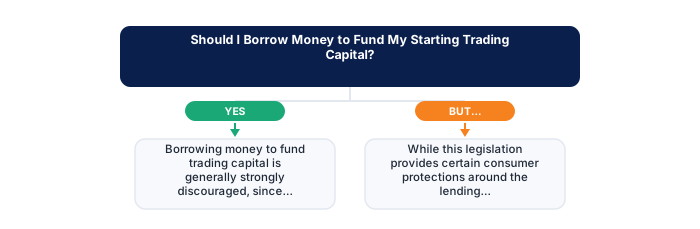
Borrowing money to fund trading capital is generally strongly discouraged, since guaranteed debt repayment costs compound with the genuine uncertainty and risk of loss inherent to trading.
📋 ON THIS PAGE
1. Why this is generally discouraged so strongly
Trading capital should genuinely reflect money you can afford to lose without meaningfully affecting your broader financial wellbeing. Borrowed funds, by definition, create an obligation you must repay regardless of how trading performs, fundamentally violating this core principle.
It's worth checking your own reasoning honestly if you're considering this route, if the underlying motivation is impatience to start trading sooner rather than a genuinely sound financial calculation, that impatience itself is worth examining, since it's the same kind of urgency that tends to produce poor decisions in trading generally.
2. The mathematics of guaranteed cost versus uncertain return
Borrowing involves a guaranteed cost, interest payments owed regardless of outcome, while trading returns remain genuinely uncertain creates a mathematically unfavourable starting position before any trading activity even begins.
It's worth calculating this specific gap concretely for any borrowing option you're considering, comparing your loan's actual interest rate against your strategy's realistic, verified expected return, discussed elsewhere on this site regarding realistic profit targets, makes the unfavourable mathematics considerably harder to overlook than accepting the general principle abstractly.
- 100+ demo trades completed with consistent rules
- Positive expectancy over full demo sample
- Every demo trade documented in journal
- Written trading plan: entry, exit, position sizing
- FSCA-regulated broker chosen and FSP verified
- Starting capital is genuinely disposable
- Backup connectivity tested
Open a demo
Choose an FSCA-regulated broker. Start with R50,000-R100,000 virtual capital.
Write trading rules
Define entry criteria, stop-loss method, and position sizing in writing.
Trade 2-3 months
Complete at least 50-100 trades across varied market conditions.
Journal everything
Record rationale, emotion, and outcome for every trade.
Evaluate objectively
Move to live only when consistent rule-following meets your benchmark.
3. The psychological pressure borrowed capital creates
Trading with borrowed money tends to create genuine additional psychological pressure, since losses now carry the compounding weight of also representing an unfulfilled debt obligation, potentially pushing toward exactly the undisciplined, desperate decision-making patterns associated with revenge trading.
It's worth connecting this directly to the broader discussion elsewhere on this site regarding trading with money you can't afford to lose, borrowed capital is, by definition, capital you're obligated to repay regardless of trading outcome, placing it squarely in exactly the category of pressure-inducing capital that undermines sound decision-making.
4. Common forms this borrowing can take
This can take various forms, including personal loans specifically taken out for trading purposes, credit card debt used to fund deposits, or borrowing against other assets, each carries the same fundamental concern, regardless of the specific borrowing mechanism or stated interest rate involved.
It's worth being especially wary of the less obviously labelled forms of this borrowing, using an overdraft facility or delaying other bill payments to free up cash for trading can feel less like 'borrowing' than an explicit loan, but functionally creates the same underlying pressure and risk.
5. The National Credit Act connection
While the National Credit Act provides certain consumer protections around the lending relationship itself, it doesn't address or mitigate the underlying risk of combining debt obligations with speculative trading activity.
One of the most common mistakes among new traders in South Africa is underestimating the learning period required before live trading becomes appropriate. Most successful retail traders report spending six months to two years on education, demo trading, and small-account live trading before reaching any form of consistency. This investment of time before scaling up capital is not a barrier to entry but a risk management practice that protects capital from being lost during the steepest part of the learning curve.
6. A sounder alternative approach to building capital
Gradually building genuinely discretionary savings specifically allocated for trading, rather than seeking to accelerate this process through borrowed funds, supports a considerably sounder financial foundation for your trading activity.
It's worth treating this gradual accumulation period as valuable in its own right, not simply an obstacle delaying your actual trading, the discipline of saving deliberately toward a specific goal builds exactly the patience and delayed-gratification capacity that disciplined trading itself also depends on.
The transition from demo to live trading is one of the most psychologically significant steps in a trader's development, and the gap between demo performance and early live performance is a well-documented phenomenon. The primary driver is emotional: real capital at risk changes decision-making in ways that are invisible during demo trading. Common manifestations include premature exit from winning positions to lock in profit, reluctance to enter valid setups due to fear, and difficulty accepting losses that felt mechanical on demo but feel painful with real money. The practical solution is to start live trading with an amount small enough that the monetary amounts do not produce strong emotional reactions while still requiring genuine real-money decision-making. Starting with one to three months of discretionary income is a useful benchmark for calibrating this initial live capital.
A loan doesn't disappear if the trade loses. The debt obligation persists regardless of outcome, adding repayment pressure that fundamentally compromises decision quality.
★ Why It Matters
Worth calculating precisely before considering this: your loan's guaranteed monthly interest cost against your strategy's actual historical average monthly return, if the loan cost exceeds what your strategy has genuinely demonstrated it can produce, the math simply doesn't work regardless of confidence in the strategy.
✕ Common mistakes
- Comparing the loan's interest rate to your hoped-for return rather than your verified average. Hoped-for returns and demonstrated historical returns are very different numbers.
- Ignoring the certainty of loan repayments versus the uncertainty of trading returns. One is guaranteed; the other is not, regardless of strategy confidence.
- Treating borrowed capital the same psychologically as savings. Debt-funded trading often carries added pressure that affects decision quality.
- Not calculating the genuine break-even return needed just to cover loan costs. This number is often higher than expected once calculated properly.
Key Takeaways
- Borrowing to fund trading capital is generally strongly discouraged, since guaranteed debt costs compound with genuine trading uncertainty and risk of loss.
- Borrowing money to fund trading capital is generally strongly discouraged, since guaranteed debt repayment costs compound with the genuine uncertainty and risk of loss inherent to trading.
- Why this is generally discouraged so strongly.
- The mathematics of guaranteed cost versus uncertain return.
- The psychological pressure borrowed capital creates.
See also: Can I Retire Early in South Africa? and How Do I Actually Make Money Online in South Africa?.
Frequently asked follow-up questions
Is there ever a reasonable exception to this general guidance?
This is generally discouraged across virtually all circumstances, given the fundamental mismatch between guaranteed debt cost and uncertain trading returns.
Does a low-interest loan change this calculation meaningfully?
Even at relatively low interest rates, the fundamental issue of guaranteed cost combined with uncertain returns and genuine risk of loss remains.
Can I use a portion of an existing loan meant for something else?
This carries the same fundamental concerns regardless of the loan's original stated purpose, since the underlying mismatch between obligation and uncertain return remains unchanged.
What should I do if I've already borrowed money and am currently trading with it?
Consider whether repaying this debt and rebuilding trading capital through genuinely discretionary savings instead might better align with sound financial practice.
Does this guidance apply to using a margin facility within my trading account?
Margin operates somewhat differently from external borrowing, though it carries its own genuine risks requiring separate, careful consideration.
