i Short answer
A trading checklist formalises your strategy's entry criteria into a concrete, step-by-step list you deliberately review before every trade.
This reduces the chance of impulsive trades that skip important steps your strategy actually requires.
📋 ON THIS PAGE
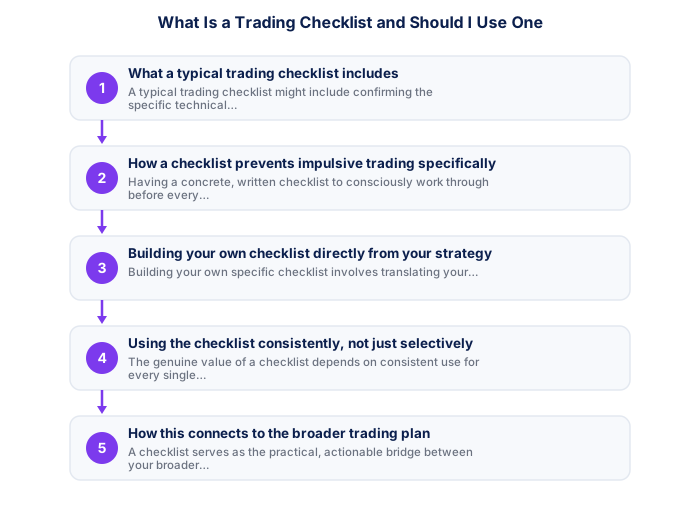
- What a typical trading checklist includes
- How a checklist prevents impulsive trading specifically
- Building your own checklist directly from your strategy
- Using the checklist consistently, not just selectively
- How this connects to the broader trading plan
- Refining your checklist as you gain experience over time
1. What a typical trading checklist includes
A typical trading checklist might include confirming the specific technical setup matches your strategy's defined criteria, checking the economic calendar for any upcoming high-impact news, calculating appropriate position size position size, and confirming your risk-reward ratio meets your minimum threshold, essentially a concrete checklist version of your broader strategy and risk management process.
The specific items matter less than the underlying principle: whatever your strategy already requires you to check before entering a trade deserves an explicit line on this list, rather than being trusted to memory. If a factor genuinely matters enough to influence your decision, it's worth writing down rather than assuming you'll reliably remember to consider it every single time.
2. How a checklist prevents impulsive trading specifically
Having a concrete, written checklist to consciously work through before every trade creates a deliberate pause and structured review process, guarding against overtrading and impulsive decisions, making it considerably harder to act impulsively on a trade that doesn't genuinely satisfy all your predetermined criteria compared to relying purely on memory or in-the-moment judgement.
This pause is worth thinking of as the checklist's core mechanism, more than the specific content of any individual item on it. Even a few seconds of deliberate, structured review before clicking to open a position creates a natural moment for genuine hesitation to surface if something about the trade doesn't actually fit, a moment that simply doesn't exist when acting purely on impulse.
- FSCA-regulated broker verified at fsca.co.za
- Demo account tested for minimum 60 days
- Trading plan written: entry, exits, position sizing
- Risk per trade defined (1-2% of account)
- Backup internet connection tested for load shedding
- Tax implications understood
3. Building your own checklist directly from your strategy
Building your own specific checklist involves translating your already-developed trading plan and strategy into a concrete, ordered list of specific checks, essentially making explicit and reviewable what might otherwise remain only implicit knowledge in your head, which is considerably easier to skip or forget during moments of excitement or pressure.
It helps to actually write this list down physically or digitally, rather than keeping it as a mental checklist you intend to run through. A checklist that exists only in your head is vulnerable to exactly the same memory lapses and in-the-moment shortcuts that a written, externally-referenced list is specifically designed to prevent.
4. Using the checklist consistently, not just selectively
The genuine value of a checklist depends on consistent use for every single trade, rather than selectively applying it only when you remember or feel like it. A checklist used inconsistently gives considerably less protective benefit than one genuinely integrated as a mandatory, routine step before any trade execution, regardless of how confident or rushed you might feel in any specific moment.
It's worth being honest with yourself about which specific situations tempt you to skip the checklist, a particularly compelling-looking setup, time pressure, or a string of recent wins building overconfidence are common culprits. Naming these specific triggers for yourself makes it easier to recognise and resist the urge to skip the process precisely when skipping it would be most risky.
| Item | Detail |
|---|---|
| Regulator | FSCA, fsca.co.za |
| Exchange control | SARB, resbank.co.za |
| Tax authority | SARS, sars.gov.za |
| JSE hours | 09:00-17:00 SAST Mon-Fri |
| Best forex session | 15:00-17:00 SAST |
| CGT annual exclusion | R50,000 (individuals) |
5. How this connects to the broader trading plan
A checklist serves as the practical, actionable bridge between your broader trading plan and actual trade execution, translating your overall goals and risk parameters into a specific, repeatable, step-by-step process applied consistently to each individual trading decision.
Without this concrete translation step, even an excellent, well-reasoned trading plan can remain largely aspirational, understood in principle but not consistently applied in the pressure of an actual live trading moment. A checklist is what makes the plan's good intentions actually operational on a trade-by-trade basis.
6. Refining your checklist as you gain experience over time
As your trading journal reveals patterns in your own specific mistakes or oversights over time, refining your checklist to specifically address these recurring issues, adding a check for whatever specific oversight keeps recurring in your own actual trading history, makes your checklist an evolving, increasingly personalised tool rather than a static, one-time document.
A checklist makes entry criteria explicit and consistently applied.
Trading without a checklist relies on memory, which is unreliable under emotional pressure. A written checklist makes entry criteria explicit, consistent, and reviewable, building discipline faster.
★ Why It Matters
Worth testing: track your win rate on trades where you genuinely completed every checklist item versus trades where you skipped one or more "just this once." Many traders discover a meaningful performance gap here that's a strong personal argument for treating the checklist as non-negotiable.
✕ Common mistakes
- Skipping checklist items 'just this once' under time pressure. This is exactly when checklists provide the most protective value.
- Not tracking whether completed-checklist trades actually perform differently. This comparison in your own journal makes a compelling, personal case either way.
- Treating the checklist as optional once you feel experienced enough. Experienced traders often benefit from this discipline just as much as beginners.
- Writing a checklist once and never revising it based on experience. A checklist should evolve as your understanding of your own mistakes deepens.
How much capital do I need for this?
Enough that a correctly sized position is still meaningful after costs, and little enough that losing it changes nothing. Starting capital covers the arithmetic.
Which skill matters most here?
Position sizing, because it decides whether a run of losses is survivable. The skill to build first covers why it outranks entry selection.
Key Takeaways
- A trading checklist formalises your strategy's entry criteria into a step-by-step list, reducing the chance of impulsive trades that skip important steps.
- A trading checklist formalises your strategy's entry criteria into a concrete, step-by-step list you deliberately review before every trade.
- This reduces the chance of impulsive trades that skip important steps your strategy actually requires.
- What a typical trading checklist includes.
- How a checklist prevents impulsive trading specifically.
See also: How Do I Build Discipline as a New Trader? and What Is a Golden Cross and Death Cross in Trading? and What Is MACD and How Do Traders Use It?.
Frequently asked follow-up questions
Should my checklist be the same for every trading style?
The general structure applies broadly, though specific items should reflect your own particular strategy's actual criteria, which naturally varies between different trading styles.
Can a checklist slow down execution too much for fast-paced styles like scalping?
Experienced scalpers often internalise an abbreviated checklist that can be reviewed very quickly, though the underlying discipline principle still applies even at this faster pace.
Where should I keep my trading checklist for easy access?
Many traders keep it visibly displayed near their trading setup or as a readily accessible note within their trading platform or journal, ensuring it's genuinely consulted rather than forgotten.
