i Short answer
Systematic trading follows precisely defined, mechanical rules that could theoretically be coded and automated.
Discretionary trading involves genuine human judgement applied within a broader analytical framework.
📋 ON THIS PAGE
1. What makes a strategy genuinely systematic
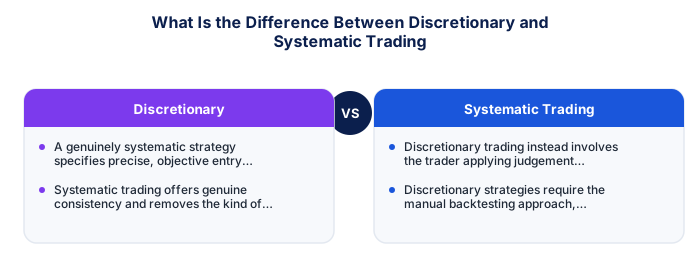
A genuinely systematic strategy specifies precise, objective entry and exit criteria that don't need subjective interpretation, for example, "enter long when the 20-period moving average crosses above the 50-period moving average" is a fully systematic rule, since two different people applying it to the same chart would reach the identical conclusion about whether the signal fired.
It's worth testing this genuinely by trying to write your own rules precisely enough that someone else could execute them identically without any additional judgement calls, if this proves genuinely possible, your approach qualifies as authentically systematic.
2. What discretionary trading actually involves
Discretionary trading instead means the trader applies judgement within a broader analytical framework, perhaps weighing support and resistance, broader market context, and several technical signals together according to experience and intuition, rather than following a single, precisely codified rule that would produce identical conclusions regardless of who's applying it.
It's worth appreciating that discretionary doesn't mean undisciplined, discussed elsewhere on this site regarding building genuine trading discipline, a skilled discretionary trader still operates within clear boundaries and principles, simply with more room for contextual judgement within those boundaries.
- FSCA-regulated broker verified at fsca.co.za
- Demo account tested for minimum 60 days
- Trading plan written: entry, exits, position sizing
- Risk per trade defined (1-2% of account)
- Backup internet connection tested for load shedding
- Tax implications understood
3. The genuine trade-offs between these two approaches
Behavioural research calls this overconfidence, and it explains why holding a losing position feels easier than closing it.
It's worth being honest with yourself about which trade-off genuinely suits your own strengths, systematic approaches offer easier backtesting and consistency at the cost of flexibility, while discretionary approaches offer adaptability at the cost of harder verification and greater vulnerability to emotional interference.
| Dimension | Discretionary | Systematic |
|---|---|---|
| Decision-making | Human judgement on each trade | Rules executed consistently |
| Adaptability | High: can respond to unusual conditions | Low: only changes when rules are updated |
| Emotional risk | High: biases affect every decision | Low: emotions removed from execution |
| Backtesting | Difficult to backtest accurately | Straightforward to backtest on historical data |
| Development time | Lower upfront, ongoing refinement | Higher upfront to build and test rules |
| Suitable for | Experienced traders with strong self-discipline | Traders comfortable with rule-based frameworks |
| Performance attribution | Harder to isolate what drove returns | Clear: outcomes directly tied to rules |
4. How this affects your backtesting approach
Systematic strategies can be backtested with full automation, since their precise rules translate directly into code. Discretionary strategies need a manual backtesting approach instead, since the human-judgement component can't be fully captured in automated, programmatic testing.
It's worth appreciating why systematic strategies are considerably easier to rigorously backtest, discussed elsewhere on this site regarding backtesting and walk-forward testing specifically, a genuinely discretionary approach can't be mechanically tested in the same precise, repeatable way.
| Item | Detail |
|---|---|
| Regulator | FSCA, fsca.co.za |
| Exchange control | SARB, resbank.co.za |
| Tax authority | SARS, sars.gov.za |
| JSE hours | 09:00-17:00 SAST Mon-Fri |
| Best forex session | 15:00-17:00 SAST |
| CGT annual exclusion | R50,000 (individuals) |
5. Hybrid approaches combining elements of both
Many traders use a hybrid approach: systematic rules to identify potential setups, combined with discretionary judgement for final entry timing or position sizing adjustments based on broader context the systematic rules alone don't capture, trying to get benefits from both rather than committing entirely to one extreme.
It's worth experimenting with where you personally want to draw this line, many experienced traders settle somewhere along this spectrum rather than at either pure extreme, worth finding your own genuine balance through actual trading experience rather than assuming one pure approach is correct.
6. Which approach might suit different kinds of traders
Traders who find themselves especially susceptible to psychological biases may benefit from leaning toward systematic approaches, which reduce the scope for in-the-moment emotional interference, while traders with extensive experience and genuine demonstrated skill in nuanced market reading might find discretionary approaches capture their accumulated expertise better than rigid, purely mechanical rules would.
Systematic trading applies predefined rules consistently and automatically.
Discretionary trading applies human judgement to every decision, offering flexibility at the cost of consistency. Systematic trading applies predefined rules mechanically, offering consistency and backtestability.
★ Why It Matters
Worth testing on yourself: try documenting your discretionary decisions in enough detail that another trader could follow your exact reasoning. Traders sometimes find their "discretionary" process is actually more systematic than they realised, or the reverse, once they try writing it down precisely.
✕ Common mistakes
- Assuming your own approach is more systematic than it actually is. Writing decisions out in enough detail for someone else to follow often reveals more discretion than expected.
- Treating systematic approaches as automatically more disciplined. A poorly designed systematic approach can still produce poor results consistently.
- Not being honest about how much judgement is actually involved in your process. Mislabeling this affects how the approach should be evaluated and tested.
- Assuming discretionary trading can't be tested or evaluated rigorously. Detailed journaling can still provide meaningful evaluation of a discretionary approach.
Key Takeaways
- Systematic trading follows precisely defined, mechanical rules, while discretionary trading involves human judgement applied within a broader framework.
- Systematic trading follows precisely defined, mechanical rules that could theoretically be coded and automated.
- Discretionary trading involves genuine human judgement applied within a broader analytical framework.
- What makes a strategy genuinely systematic.
- What discretionary trading actually involves.
See also: What Is a Trading Strategy and Do I Need One?.
Frequently asked follow-up questions
Is systematic trading always more profitable than discretionary trading?
Neither approach is universally better. Success depends on the underlying strategy's genuine edge and the trader's discipline in executing it consistently.
Can a beginner start with discretionary trading?
Many beginners benefit from starting with more systematic, clearly defined rules, since that gives clearer structure while foundational skill and judgement are still developing.
Does discretionary trading mean I don't need a trading plan?
No. Discretionary trading still benefits significantly from a broader trading plan, even though the entry and exit decisions themselves involve more judgement than a fully systematic approach would.
