What this page covers
Quick answer: Several charges land on a JSE trade and only one of them is the broker's commission. Key figures: securities transfer tax 0.25%; VAT on services 15%; who pays the STT Buy side; where the minimum stops biting R15,000. Figures current at 27 September 2026, from JSE Limited.
Several charges land on a JSE trade and only one of them is the broker's commission. Together they set the price move a position needs before it is worth anything.
Key findings
- Securities transfer tax of 0.25% applies to every purchase of JSE shares, but not to sales.
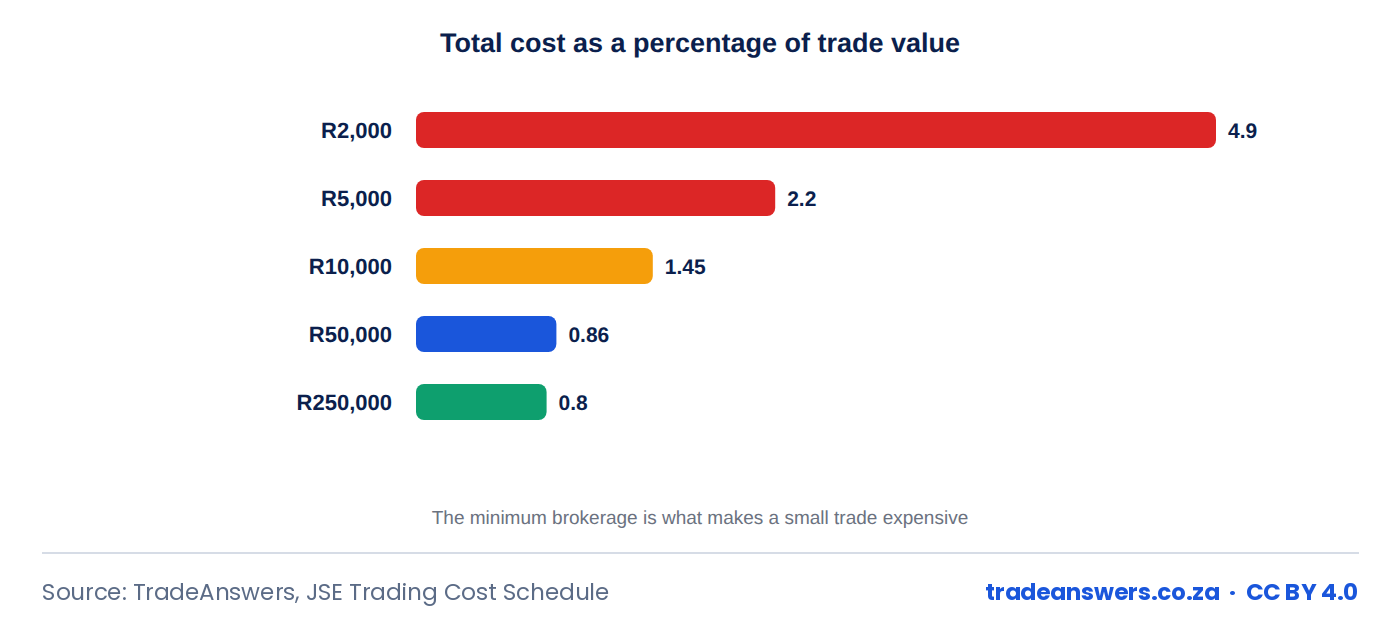
- On a R2,000 purchase total costs are about 4% to 5%, mainly because of the minimum brokerage.
- Above roughly R15,000 the minimum stops dominating and costs fall below about 1% per trade.
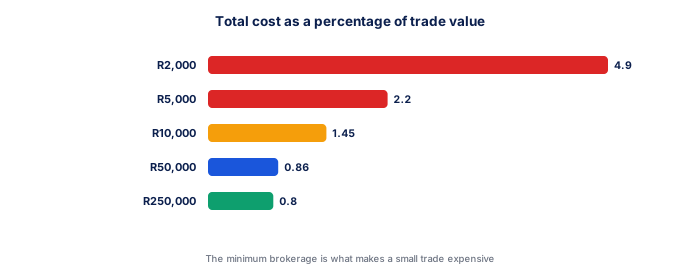
⬇ Download this chart (PNG) · Free to reuse with the credit “Source: TradeAnswers, JSE Trading Cost Schedule” (CC BY 4.0).
| Charge | Rate | Paid on |
|---|---|---|
| Securities transfer tax | 0.25% of the value | Purchases only |
| Brokerage | Set by the broker, with a minimum | Both sides |
| Strate settlement | Per transaction, usually with a minimum and a cap | Both sides |
| Investor protection levy | 0.0002% of the value | Both sides |
| VAT | 15% on brokerage and Strate, not on STT | Both sides |
Source: TradeAnswers, JSE Trading Cost Schedule. Free to reuse with attribution (CC BY 4.0).
| Trade value | Typical total cost | Round trip breakeven |
|---|---|---|
| R2,000 | Around 4% to 5% | Roughly 9% |
| R10,000 | Around 1.2% | Roughly 2.4% |
| R50,000 | Around 0.85% | Roughly 1.7% |
| R250,000 | Around 0.8% | Roughly 1.6% |
TradeAnswers · CC BY 4.0
| Trade value | Buy cost | Sell cost | Round trip | Move needed |
|---|---|---|---|---|
| R2,000 | R98 | R85 | R183 | 9.2% |
| R5,000 | R110 | R92 | R202 | 4.0% |
| R10,000 | R145 | R110 | R255 | 2.6% |
| R50,000 | R429 | R304 | R733 | 1.5% |
| R250,000 | R2,000 | R1,380 | R3,380 | 1.4% |
TradeAnswers · CC BY 4.0
How these figures work
Five separate charges land on a JSE trade, and only one of them is negotiable. Securities transfer tax is set by statute at 0.25% and applies to purchases. Strate charges for settlement. The investor protection levy funds the regulatory framework. VAT applies to the services, not to the tax. Brokerage is the only piece the broker sets.
Because brokerage carries a minimum, the total as a percentage falls steeply with trade size. That single fact determines whether small, frequent trading is viable at all.
★ A worked example
A R5,000 purchase with a 0.5% brokerage rate and a R70 minimum.
Brokerage would be R25 at the percentage rate, but the minimum applies, so it is R70. Securities transfer tax is R12.50. Strate is about R14.50. VAT on brokerage and Strate is R12.68. The total is about R110, which is 2.2% of the trade.
The same trade at R50,000 costs about R429, which is 0.86%. The round trip needs 4.4% at the small size and 1.7% at the larger one before the position is worth anything.
✕ Common mistakes
- Ignoring the minimum brokerage. Below roughly R15,000 the minimum, not the percentage, is what you are paying. It dominates everything else.
- Forgetting the round trip. Costs apply on the way in and on the way out. The breakeven move is roughly double the one-way cost.
- Assuming STT applies to sales. It applies to purchases only, which is why a round trip carries it once.
- Comparing brokers on brokerage alone. The minimum, the Strate handling and the platform fee often matter more than the headline rate.
Notes on reading these figures
- The minimum brokerage is what makes a small trade expensive. Below roughly R15,000 the minimum, rather than the percentage, is what you are paying.
- Securities transfer tax applies to the buy side only, so a round trip carries it once. It is levied under the Securities Transfer Tax Act and collected by the broker.
- A CFD on a JSE share carries no STT, because no share transfers. The cost appears instead as spread and overnight financing, which is larger for a long hold.
To put these figures to work, the Trading Cost Calculator runs the arithmetic on your own numbers. The JSE vs trading CFDs and Break-Even Price Calculator go into the detail this table only summarises. When the money and the shares actually change hands is covered in the JSE Settlement Cycle.
Terms used on this page
See also: What Is a Trading Cost Comparison Calculator? and What Is Opportunity Cost and How Does It Apply to Trading Capital? and FSCA Debarment Register Reference and JSE Listing Requirements.
Spotted an outdated figure? If a figure or rate on this page no longer matches its source, email us the page and the source. A material correction is dated on the Updates Log.
How these figures are compiled, checked and corrected: our data methodology.
Cite this page
Barosso, G. (2026, September 27). JSE Trading Cost Schedule. TradeAnswers. https://www.tradeanswers.co.za/jse-trading-cost-schedule.htmlBarosso, G (2026) JSE Trading Cost Schedule, TradeAnswers, figures current at 27 September 2026, https://www.tradeanswers.co.za/jse-trading-cost-schedule.htmlThe tables and the CSV on this page are free to reuse under a CC BY 4.0 licence: attribution with a link to this page. See the Press & Data Licence page.
See also: The Annual Cost of Trading in South Africa: 2026 Study.
Frequently asked questions
What is securities transfer tax?
A statutory 0.25% on the purchase of listed securities, collected by the broker rather than paid to SARS directly.
Is VAT charged on the STT?
No. VAT applies to brokerage and settlement fees, which are services, not to the transfer tax.
Why is a small trade so expensive?
The minimum brokerage. On a R2,000 trade a R70 minimum is 3.5% before anything else, and the round trip needs about 9%.
Do ETFs carry the same costs?
A JSE-listed ETF is a listed security, so yes, including securities transfer tax on purchase.
Do CFDs carry STT?
No, because no share transfers. The cost appears as spread and overnight financing, which grows with holding period.
Can I negotiate brokerage?
The rate and the minimum vary by broker and by account size. It is the only component that is not fixed by statute or by the infrastructure.
 Download this data