What this page covers
A JSE trade and the movement of shares and cash are separate events. The trade happens instantly; settlement happens three business days later, and that gap matters for anything time sensitive.
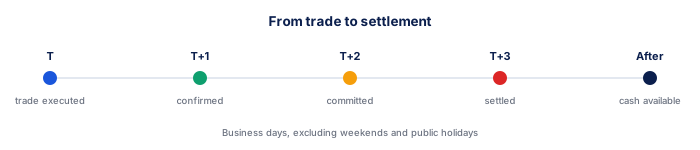
| Day | What happens |
|---|---|
| T | Trade executed on the exchange |
| T+1 | Confirmation and matching between the parties |
| T+2 | Commitment; the obligation is locked in |
| T+3 | Settlement; shares and money change hands through Strate |
| Situation | Consequence |
|---|---|
| Dividend entitlement | You must settle before the record date to receive it |
| Withdrawing sale proceeds | Cash is available after settlement, not on the trade date |
| Corporate action eligibility | Determined by the settled position |
| Failed settlement | Penalties apply and the trade may be bought in |
| Day | Date | What happens |
|---|---|---|
| T | Monday | Trade executed |
| T+1 | Tuesday | Confirmation and matching |
| T+2 | Wednesday | Commitment |
| T+3 | Thursday | Settlement; shares and cash move |
| Before a long weekend | Shifts later | Business days exclude holidays |

Download this data
Every table on this page as a spreadsheet, with the source and the date it was checked in the header rows.
⬇ Download CSVHow these figures work
Trading and settlement are separate processes. The exchange matches buyer and seller instantly; Strate, the central securities depository, moves the shares and the money three business days later against confirmed instructions from both sides.
The gap exists because settlement is a legal transfer of ownership with finality. The intervening days are used to confirm, match and commit, so that when settlement occurs it cannot be reversed.
★ A worked example
A trader buys a share on Monday that goes ex-dividend on Wednesday.
The trade settles on Thursday, T+3. The register on the record date does not show the buyer, because settlement had not occurred. The dividend goes to the seller.
Buying on the preceding Friday instead would have settled on Wednesday and made the register in time. This is why the price typically falls by roughly the dividend on the ex-dividend morning: from that date, a buyer no longer receives it.
✕ Common mistakes
- Expecting sale proceeds on the trade date. Cash is available after settlement, three business days later, not when the trade executes.
- Buying on the ex-dividend date for the dividend. A buyer on or after the ex date does not settle in time to be on the register.
- Counting calendar days. Business days exclude weekends and public holidays, so a trade before a long weekend settles later.
- Assuming a CFD settles the same way. A CFD never settles in shares. There is no transfer, which is also why no securities transfer tax applies.
Notes on reading these figures
- Business days exclude weekends and South African public holidays, so a trade before a long weekend settles later than three calendar days.
- Strate is the central securities depository that runs the settlement. The small Strate fee on a trade confirmation is for this.
- The ex-dividend date is set so that a buyer on or after it does not settle in time to be on the register. That is why the price typically drops by roughly the dividend on that morning.
To put these figures to work, the JSE Trading Cost Schedule runs the arithmetic on your own numbers, and JSE Trading Hours and Holidays covers the same ground in ordinary language. Buying shares on the JSE and Dividend withholding tax go into the detail this table only summarises. The tax and the fees that settle alongside the shares are set out in the Securities Transfer Tax Calculator.
Terms used on this page
Put this table on your own site
The table below can sit on your own page and stays current without you editing anything.
- Preview the embeddable table as it will appear on your site
Place this snippet on your page and the table is embedded live, rather than copied and left to age.
<iframe src="https://www.tradeanswers.co.za/embed/ref-jse-settlement-cycle.html" width="100%" height="620" style="border:0" title="JSE Settlement Cycle"></iframe>Free to use with attribution. The link back to this page is built into the embed.
Frequently asked questions
What does T+3 mean?
Settlement occurs three business days after the trade date. T is the trade date itself.
Who is Strate?
The central securities depository that runs settlement for South African securities. The small Strate fee on a confirmation is for this.
When can I withdraw sale proceeds?
After settlement, three business days later. Some brokers advance the cash, but the underlying settlement date does not change.
What is the ex-dividend date?
The first date on which a buyer does not receive the declared dividend, set so that a buyer from that date cannot settle before the record date.
What happens if settlement fails?
Penalties apply and the trade may be bought in at the defaulting party's cost.
Does the cycle apply to ETFs?
Yes. A JSE-listed ETF is a listed security and settles on the same cycle.