i Short answer
News trading specifically targets price movement around scheduled economic announcements and unexpected events.
This requires different skills and risk management than chart-pattern-focused technical trading.
📋 ON THIS PAGE
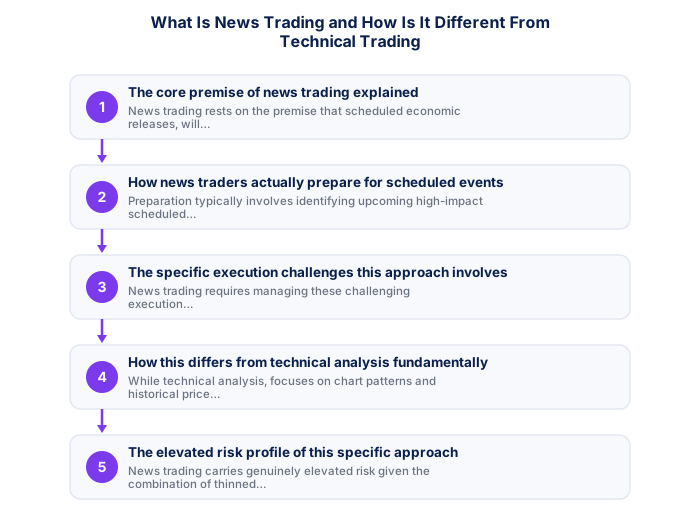
- The core premise of news trading explained
- How news traders actually prepare for scheduled events
- The specific execution challenges this approach involves
- How this differs from technical analysis fundamentally
- The elevated risk profile of this specific approach
- Is news trading suitable for beginners
1. The core premise of news trading explained
News trading rests on the premise that scheduled economic releases, will produce significant, tradeable price movement, particularly when the actual result significantly surprises prior market expectations. News traders specifically position themselves to capitalise on this anticipated volatility.
It's worth understanding this as fundamentally a different information source from technical analysis, discussed elsewhere on this site, rather than analysing historical price patterns, news trading bets specifically on how markets will interpret and react to genuinely new, forward-looking information.
2. How news traders actually prepare for scheduled events
Preparation typically involves identifying upcoming high-impact scheduled events through the economic calendar, understanding prior market expectations or consensus forecasts for that specific release, and sometimes preparing pending orders, designed to trigger automatically in either direction depending on how the actual result compares to these expectations.
It's worth building genuine expertise in reading and interpreting specific data releases relevant to your traded instruments, this preparation work happens well before the actual release, discussed elsewhere on this site regarding economic calendar usage, not in the compressed moments immediately following it.
- Quantifiable rules remove subjectivity
- Backtestable on historical data
- Works consistently when edge is genuine
- Clear entry/exit criteria reduce hesitation
- Past performance does not guarantee future results
- Risk of overfitting to historical data
- Market regimes change, edges decay
- Requires discipline through drawdown periods
- Price and volume patterns
- Works on any liquid instrument
- Faster to learn basics
- Ignores fundamental context
- Economic and financial data
- Better for longer timeframes
- Deeper knowledge required
- Ignores entry precision
3. The specific execution challenges this approach involves
News trading specifically requires managing these challenging execution conditions deliberately, often requiring particularly fast decision-making or pre-planned automated orders given how rapidly conditions can change in the moments immediately surrounding a major release.
It's worth practising your execution specifically around lower-stakes releases before attempting this approach around genuinely major, high-impact events, building comfort with the speed and pressure this style demands gradually rather than starting with your most significant intended trades.
- Written entry/exit rules with zero ambiguity
- Backtested on minimum 3 years of data
- Walk-forward tested on out-of-sample data
- SA-specific events included in test period
- Maximum drawdown within personal tolerance
- 100+ live demo trades with consistent performance
4. How this differs from technical analysis fundamentally
While technical analysis, focuses on chart patterns and historical price behaviour to anticipate future movement, news trading focuses specifically on anticipating and reacting to discrete, scheduled fundamental events, representing a genuinely different analytical foundation, though the two approaches aren't mutually exclusive and some traders combine both.
It's worth being honest with yourself about which approach genuinely suits your own analytical strengths and temperament, some traders find fundamental, news-driven analysis genuinely more intuitive, while others connect more naturally with the visual, pattern-based nature of technical analysis.
| Win rate | 1:1 RR | 1.5:1 RR | 2:1 RR |
|---|---|---|---|
| 40% | Losing | Break even | Profitable |
| 50% | Break even | Profitable | Profitable |
| 55% | Profitable | Profitable | Profitable |
| 60% | Profitable | Profitable | Profitable |
5. The elevated risk profile of this specific approach
News trading carries genuinely elevated risk given the combination of thinned liquidity, widened spreads, and rapid, sometimes discontinuous price movement that these scheduled events characteristically produce, making disciplined risk management particularly important for this specific approach.
It's worth respecting this elevated risk through correspondingly more conservative position sizing specifically for news-driven trades, discussed throughout this site's risk management content, given the genuinely compressed decision-making window and heightened volatility this approach involves.
6. Is news trading suitable for beginners specifically
Given the elevated risk and execution challenges, many experienced traders and educators suggest news trading is generally better suited to traders who have already developed solid foundational risk management discipline, rather than representing an ideal starting point for complete beginners still developing these foundational skills.
Technical trading reads chart patterns without calendar dependency.
News trading reacts to economic data releases and requires understanding consensus expectations. Technical trading reads chart patterns and can be applied at any time, without calendar dependency.
★ Why It Matters
Something worth testing : compare your results trading the same instrument around scheduled news versus during technically-driven, news-quiet periods, many traders discover they're genuinely better suited to one of these two distinct skill sets and inadvertently weaker at the other.
✕ Common mistakes
- Assuming success at technical trading transfers directly to news trading. These draw on genuinely different specific skills.
- Treating all scheduled news events as equally tradeable. Genuine opportunity and risk vary considerably by event type and current market context.
- Combining a technical strategy with major news trading without adjusting risk parameters. News-driven volatility often warrants different risk treatment than purely technical setups.
Key Takeaways
- News trading specifically targets price movement around scheduled announcements, requiring different skills and risk management than chart-based technical trading.
- News trading specifically targets price movement around scheduled economic announcements and unexpected events.
- This requires different skills and risk management than chart-pattern-focused technical trading.
- The core premise of news trading explained.
- How news traders actually prepare for scheduled events.
Frequently asked follow-up questions
Can I combine news trading with technical analysis?
Yes, some traders use technical levels, to inform entry and exit decisions even within a broader news-trading approach, rather than treating these as entirely separate, incompatible methodologies.
Does news trading require special tools beyond a standard platform?
An economic calendar is the main specific tool required, alongside standard order types and platform functionality.
Is news trading more stressful than technical trading?
Many traders find it more intense given the rapid pace and elevated stakes around specific scheduled moments, though individual experience varies based on personal temperament and preparation.
