i Short answer
A trading system is the complete, precisely defined set of rules covering entry, exit, and money management together.
This implies greater mechanical rigidity than the broader concept of a strategy, which can incorporate more discretionary judgement.
📋 ON THIS PAGE
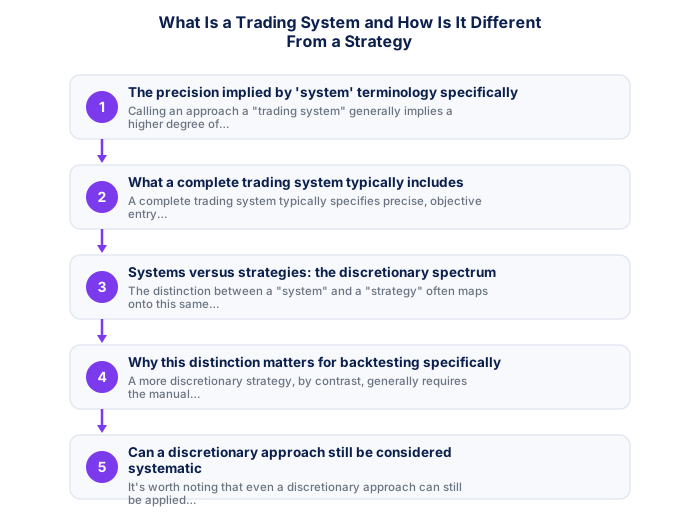
- The precision implied by 'system' terminology specifically
- What a complete trading system typically includes
- Systems versus strategies: the discretionary spectrum
- Why this distinction matters for backtesting specifically
- Can a discretionary approach still be considered systematic
- Choosing where your own approach sits on this spectrum
1. The precision implied by 'system' terminology specifically
Calling an approach a "trading system" generally implies a higher degree of mechanical precision and objectivity than the broader, sometimes looser term "trading strategy" might suggest, a genuine system should, in principle, be precise enough that two different traders following its exact rules would make essentially identical decisions given the same market data, leaving little room for subjective interpretation.
It's worth appreciating why this precision distinction genuinely matters beyond mere vocabulary, a genuinely systematic approach can be tested, replicated, and evaluated objectively in a way a more loosely defined strategy simply can't, worth understanding this practical implication rather than treating the terms as interchangeable synonyms.
| Feature | System | Strategy |
|---|---|---|
| Precision | Fully defined, mechanical rules | Can include discretionary judgement |
| Backtesting ease | Easier, rules are exact | Harder if discretionary |
| Flexibility | Lower | Higher |
2. What a complete trading system typically includes
A complete trading system typically specifies precise, objective entry criteria (exact conditions that must be met), precise exit criteria (both for profit-taking and loss-cutting), and precise position sizing and money management rules, all defined clearly enough to remove significant subjective judgement from the actual moment-to-moment trading decision process.
It's worth writing out your own system this explicitly, even if you consider your approach more discretionary, the exercise of trying to specify each element precisely often reveals gaps or ambiguities in your thinking that remained hidden while the approach stayed only loosely defined in your head.
- Quantifiable rules remove subjectivity
- Backtestable on historical data
- Works consistently when edge is genuine
- Clear entry/exit criteria reduce hesitation
- Past performance does not guarantee future results
- Risk of overfitting to historical data
- Market regimes change, edges decay
- Requires discipline through drawdown periods
- Price and volume patterns
- Works on any liquid instrument
- Faster to learn basics
- Ignores fundamental context
- Economic and financial data
- Better for longer timeframes
- Deeper knowledge required
- Ignores entry precision
3. Systems versus strategies: the discretionary spectrum
The distinction between a "system" and a "strategy" often maps onto the same broader discretionary-versus-systematic spectrum: a fully systematic approach with completely objective, precise rules aligns closely with the "system" terminology, while an approach incorporating more discretionary judgement, even while still following general principles, sits more comfortably under the broader "strategy" terminology.
It's worth identifying honestly where your own approach genuinely sits on this spectrum, rather than assuming you're more systematic than you actually are, an honest self-assessment here matters for setting appropriate expectations about how precisely you can backtest and verify your own edge.
- Written entry/exit rules with zero ambiguity
- Backtested on minimum 3 years of data
- Walk-forward tested on out-of-sample data
- SA-specific events included in test period
- Maximum drawdown within personal tolerance
- 100+ live demo trades with consistent performance
4. Why this distinction matters for backtesting specifically
A genuinely precise trading system, with its objective, codifiable rules, lends itself well to automated backtesting and even automated live execution through bots or Expert Advisors, since its rules can be translated directly into executable code. A more discretionary strategy, by contrast, generally requires manual backtesting, since its judgement-based elements resist straightforward automated codification.
It's worth being honest about this limitation if your approach leans genuinely discretionary, discussed elsewhere on this site regarding manual backtesting, a more subjective approach can still be tested and refined, just through somewhat different, less mechanically precise means than a fully systematic one.
| Win rate | 1:1 RR | 1.5:1 RR | 2:1 RR |
|---|---|---|---|
| 40% | Losing | Break even | Profitable |
| 50% | Break even | Profitable | Profitable |
| 55% | Profitable | Profitable | Profitable |
| 60% | Profitable | Profitable | Profitable |
5. Can a discretionary approach still be considered systematic
note that that even a discretionary approach can still be applied systematically in the sense of being consistently, disciplined applied every time. "Systematic" in this behavioural sense (consistent application) differs from "systematic" in the more technical sense of fully objective, codifiable rules discussed above.
It's worth aiming for this kind of consistent discretionary application specifically, even if full mechanical precision isn't your goal, the genuine value of systematic thinking, repeatability and honest evaluation, remains available even within an approach that retains meaningful subjective judgement.
6. Choosing where your own approach sits on this spectrum
Neither a fully mechanical system nor a more discretionary strategy is inherently superior. The right choice depends on your own personal preference for rule-based precision versus incorporating broader judgement, your specific analytical skills, and whether you're interested in eventually pursuing automation, which favours the more precisely defined system end of this spectrum.
A trading system adds risk rules, execution rules, and review processes.
A trading strategy focuses on entry and exit rules for specific setups. A full trading system adds position sizing rules, execution processes, review schedules, and conditions for stopping, making it more complete.
★ Why It Matters
Worth being honest with yourself about: if your "system" actually requires judgement calls at several decision points, it functions more like a discretionary strategy with structure than a genuine mechanical system. The label matters less than understanding which one you're actually running.
✕ Common mistakes
- Calling a discretionary approach a 'system' without genuine mechanical rules. If judgement calls are still required, it functions more like a structured strategy.
- Assuming systems are inherently superior to discretionary approaches. Each has genuine trade-offs depending on the trader and market conditions.
- Not being honest about how much discretion is actually involved. Mislabeling this affects how the approach should be evaluated and tested.
- Treating system rigidity as automatically safer. A poorly designed rigid system can still produce poor results consistently.
Key Takeaways
- A trading system is the complete, precisely defined set of rules covering entry, exit, and money management, often implying greater mechanical rigidity than a strategy.
- A trading system is the complete, precisely defined set of rules covering entry, exit, and money management together.
- This implies greater mechanical rigidity than the broader concept of a strategy, which can incorporate more discretionary judgement.
- The precision implied by 'system' terminology specifically.
- What a complete trading system typically includes.
See also: What Is the Difference Between Discretionary and Systematic Trading? and What Is the Best Trading Strategy for a Beginner?.
Frequently asked follow-up questions
Do I need a fully mechanical system to trade successfully?
No, many successful traders use more discretionary strategies, provided they're applied with consistent discipline.
Can I convert a discretionary strategy into a precise system over time?
Yes, some traders do gradually formalise and codify their discretionary judgement into increasingly precise, objective rules as their approach matures and proves itself through experience.
Does using the word 'system' guarantee genuine precision?
No, the term is sometimes used loosely in casual conversation or marketing. Genuinely assessing whether an approach's rules are truly objective and precise matters more than the specific terminology used to describe it.
