i Short answer
Trade only with discretionary capital you could genuinely afford to lose entirely without it affecting your essential financial security.
This excludes emergency savings, money for essential living expenses, and retirement savings you'll depend on later.
📋 ON THIS PAGE
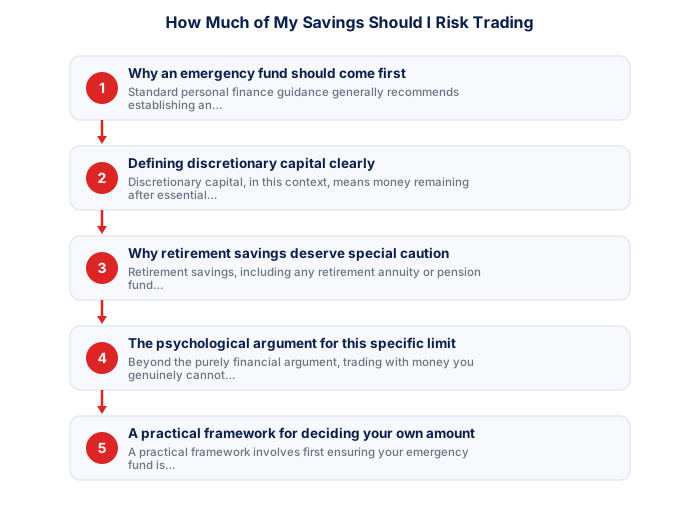
1. Why an emergency fund should come first
Standard personal finance guidance generally recommends establishing an emergency fund, typically covering three to six months of essential living expenses, held in an easily accessible, low-risk account, before allocating any money toward higher-risk activities like trading. This isn't trading-specific advice; it's foundational financial planning that exists specifically to ensure unexpected expenses or income disruption don't force you into financial distress.
Trading with money that should genuinely be part of this emergency buffer creates a dangerous double exposure: if a trading loss occurs at the same time as an unexpected financial need arises (job loss, medical expense, urgent repair), you face compounding financial stress precisely when you can least afford it, which is exactly the scenario an emergency fund is meant to protect against.
It's worth calculating your own current emergency fund status honestly before allocating any capital to trading at all, if this buffer isn't yet genuinely adequate, building it first, even if that means delaying your trading start, protects you from exactly the compounded vulnerability this section describes.
2. Defining discretionary capital clearly
Discretionary capital, in this context, means money remaining after essential living expenses, debt obligations, and emergency fund contributions are accounted for, funds you have genuine flexibility over, where losing them would be disappointing but wouldn't threaten your essential financial stability or force changes to your basic standard of living. This is a deliberately conservative definition, and intentionally so, given the documented reality that most retail traders experience losses, particularly while building genuine skill.
Calculating your own specific discretionary capital amount requires honest assessment of your actual financial situation, income, essential expenses, existing debt, and current emergency fund status, rather than an arbitrary percentage figure applied without reference to your specific circumstances.
- D = Drawdown as decimal (e.g. 0.25 = 25%)
- 25% drawdown = needs 33% to recover
- 50% drawdown = needs 100% to recover
- 75% drawdown = needs 300% to recover
It's worth writing this specific figure down explicitly once calculated, rather than keeping it as a loose mental estimate, having a concrete, documented discretionary capital amount gives you something definite to reference whenever you're deciding on deposits or considering the recurring deposits discussed elsewhere on this site.
3. Why retirement savings deserve special caution
Retirement savings, including any retirement annuity or pension fund contributions, deserve particular caution specifically because they're intended to support you over a very long future time horizon, often with limited realistic opportunity to rebuild this capital if significantly depleted later in life. Trading with these specific funds, even if technically possible through certain self-directed retirement product structures, generally isn't advisable given both the leveraged, high-risk nature of CFD and forex trading and the long-term, capital-preservation-oriented purpose retirement savings are meant to serve.
This isn't to say all forms of investing for retirement should be conservative, equity investing within a retirement context is standard and often appropriate, but the specific leveraged, short-to-medium-term speculative trading covered on this site is generally a poor fit for funds specifically earmarked for long-term retirement security.
- Position size calculated before every entry
- Stop-loss defined from chart structure before entry
- Total open risk below 5% of account at any time
- No adding to losing positions under any circumstances
- Trading paused if monthly drawdown reaches 10%
- Stops never moved further away once position is open
It's worth keeping this distinction between appropriate long-term equity investing and short-term speculative trading clearly separate in your own financial planning, conflating the two, treating retirement funds as available trading capital simply because they're technically invested in similar underlying markets, is precisely the mistake this caution is meant to prevent.
4. The psychological argument for this specific limit
Beyond the purely financial argument, trading with money you genuinely cannot afford to lose creates psychological pressure that actively undermines sound trading decision-making, connecting directly to why trading psychology matters so much. Trading with appropriately discretionary capital, money whose loss, while undesirable, wouldn't create genuine financial distress, supports the kind of calm, disciplined decision-making that trading actually requires to be executed well.
This means the discretionary capital limit isn't simply a conservative financial planning recommendation in isolation. It's directly connected to giving yourself the best realistic chance of executing your trading strategy with the discipline and emotional regulation that genuinely improves your actual trading outcomes.
| Drawdown | Recovery needed | At 20%/yr | At 10%/yr |
|---|---|---|---|
| 10% | 11.1% | 7 months | 14 months |
| 25% | 33.3% | 19 months | 38 months |
| 50% | 100.0% | 4+ years | 7+ years |
| 75% | 300.0% | Never at 10%/yr | Never at 10%/yr |
It's worth recognising this psychological connection as more than a secondary consideration, the discretionary capital limit isn't purely about financial prudence in isolation, it's a genuine, practical mechanism for protecting the calm, disciplined decision-making that good trading actually depends on.
5. A practical framework for deciding your own amount
A practical framework involves first ensuring your emergency fund is genuinely adequate and separate from any trading capital consideration, then assessing what amount beyond this, alongside your essential expenses and other financial goals, you could allocate to trading specifically while being honestly comfortable with the realistic possibility of losing it entirely. This figure will be different for every individual based on their specific income, expenses, and broader financial goals, making generic percentage rules of limited practical use compared to this kind of personalised assessment.
If you find yourself unable to identify any amount that genuinely meets this "could afford to lose entirely without distress" standard, this is itself useful, important information suggesting that demo trading, or simply delaying live trading until your broader financial position strengthens, is the more appropriate current path rather than trading with capital that doesn't genuinely meet this standard.
6. Revisiting this decision as your circumstances change
Your appropriate discretionary trading capital isn't a fixed, one-time decision. It should be revisited periodically as your broader financial circumstances change, whether through income changes, shifting expense patterns, progress toward other financial goals, or changes in your emergency fund adequacy. A figure that was appropriately discretionary at one point in your financial life may no longer be appropriate if your circumstances shift, in either direction.
Building this periodic review into your broader financial planning routine, rather than setting an initial trading capital amount and never reconsidering it regardless of changing circumstances, reflects the same kind of disciplined, deliberate approach to capital management that sound risk management consistently emphasises.
Non-discretionary capital, any money you actually need, does not.
Only capital you could genuinely afford to lose entirely without it affecting your life belongs in a trading account. Any capital you actually need is non-discretionary and shouldn't be traded.
★ Why It Matters
Worth doing as a gut-check: imagine the specific amount you're considering is already gone, permanently. Would this change your near-term financial plans or stress levels in any concrete way? If the honest answer is yes, that amount is genuinely too large regardless of any percentage-based rule.
✕ Common mistakes
- Including emergency savings in your trading risk calculation. This capital should remain entirely separate regardless of trading conviction.
- Treating a percentage rule as universally appropriate regardless of total savings size. The same percentage means very different things on a small versus large savings base.
- Underestimating how risk tolerance changes after a string of early losses. What felt acceptable in theory can feel very different in practice.
Key Takeaways
- Most financial guidance suggests trading only with discretionary capital you could lose entirely, never emergency savings or essential living funds.
- Trade only with discretionary capital you could genuinely afford to lose entirely without it affecting your essential financial security.
- This excludes emergency savings, money for essential living expenses, and retirement savings you'll depend on later.
- Why an emergency fund should come first.
- Defining discretionary capital clearly.
Frequently asked follow-up questions
Is there a standard percentage of net worth I should risk trading?
There's no universally appropriate fixed percentage; the right amount depends on your specific financial circumstances, emergency fund adequacy, and other financial goals, making personalised assessment more useful than a generic rule.
Can I increase my trading capital once I'm consistently profitable?
Many traders do gradually increase trading capital as demonstrated, consistent skill and discipline accumulate, though this should still remain within the bounds of genuinely discretionary capital relative to your evolving broader financial situation.
Should I pay off debt before allocating money to trading?
Generally, paying off high-interest debt is usually a more financially sound priority than allocating funds to speculative trading, given that guaranteed debt interest costs typically exceed the realistic expected returns from trading.
Should retirement savings ever be touched to fund trading capital?
This is generally strongly discouraged; retirement savings serve a fundamentally different, long-term purpose and typically carry tax and penalty consequences for early withdrawal that make this an especially costly source of trading capital.
What if I genuinely don't have any spare money to allocate to trading right now?
This is a perfectly reasonable situation; building your emergency fund and addressing more pressing financial priorities first, then revisiting trading once you have genuine discretionary capital, is a sound, patient approach.
