i Short answer
Setting realistic, process-based milestones rather than purely outcome-based goals, and keeping perspective on the genuine learning timeline, helps sustain motivation through difficult periods.
📋 ON THIS PAGE
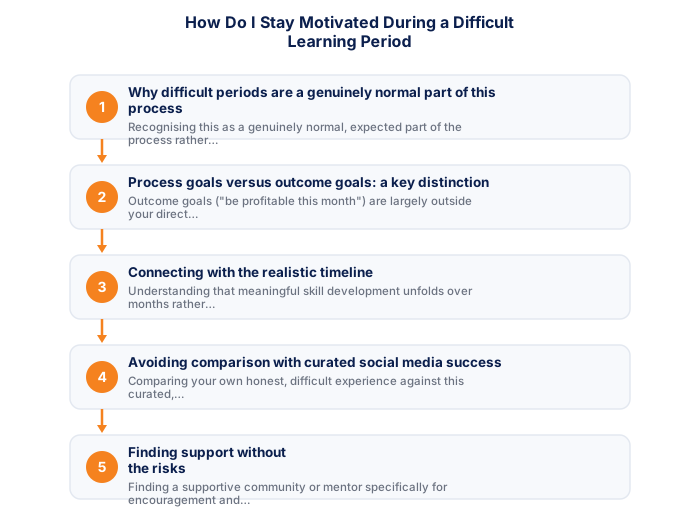
- Why difficult periods are a genuinely normal part of this process
- Process goals versus outcome goals: a key distinction
- Connecting with the realistic timeline
- Avoiding comparison with curated social media success
- Finding support without the risks
- Recognising genuine progress even when results lag behind effort
1. Why difficult periods are a genuinely normal part of this process
Developing genuine trading skill is a gradual process involving inevitable setbacks, confusion, and periods where progress feels slow or even absent. Recognising this as a genuinely normal, expected part of the process, rather than a sign of personal inadequacy or that trading simply isn't for you, supports more resilient persistence through these difficult stretches.
It's worth normalising this experience for yourself explicitly during exactly these difficult stretches, reminding yourself that a plateau or a period of confusion is a genuinely expected part of skill development, not evidence you're somehow uniquely unsuited to trading, helps you push through rather than concluding prematurely that the difficulty means you should quit.
2. Process goals versus outcome goals: a key distinction
Outcome goals ("be profitable this month") are largely outside your direct control given normal market variance, while process goals ("follow my predetermined strategy criteria consistently," "complete my journal entry after every trade") are entirely within your control and directly reflect the genuine skill-building. Anchoring your sense of progress to process goals specifically supports more sustainable motivation than purely outcome-focused measures.
It's worth actively rewriting your own goals in process terms if you notice yourself primarily tracking outcome-based measures, converting 'be profitable this month' into something like 'follow my checklist on every trade this month' gives you a goal genuinely within your control, which matters considerably more for sustained motivation during a difficult stretch.
- FSCA-regulated broker verified at fsca.co.za
- Demo account tested for minimum 60 days
- Trading plan written: entry, exits, position sizing
- Risk per trade defined (1-2% of account)
- Backup internet connection tested for load shedding
- Tax implications understood
3. Connecting with the realistic timeline
Understanding that meaningful skill development unfolds over months rather than days or weeks helps reframe a difficult week or month as a normal point along an extended journey, rather than evidence that something has gone fundamentally wrong with your specific approach or capability.
It's worth revisiting this realistic timeline specifically whenever motivation feels particularly low, reminding yourself where you genuinely are within a multi-month developmental process, rather than judging your progress against an unrealistic, compressed expectation, helps recalibrate a difficult moment into proper perspective.
4. Avoiding comparison with curated social media success
The success stories prominently featured in trading-related social media content are often selectively curated, sometimes substantially exaggerated, and rarely show the genuine struggles and setbacks that even successful traders experienced along their own specific journey. Comparing your own honest, difficult experience against this curated, unrepresentative picture tends to produce unfairly discouraging conclusions.
It's worth considering a deliberate, temporary reduction in exposure to this kind of content specifically during a difficult learning period, since comparing your genuine, honest struggle against someone else's curated highlight reel tends to worsen exactly the motivation dip you're trying to work through.
| Item | Detail |
|---|---|
| Regulator | FSCA, fsca.co.za |
| Exchange control | SARB, resbank.co.za |
| Tax authority | SARS, sars.gov.za |
| JSE hours | 09:00-17:00 SAST Mon-Fri |
| Best forex session | 15:00-17:00 SAST |
| CGT annual exclusion | R50,000 (individuals) |
5. Finding support without the risks
Weighing communities' genuine benefits and risks, finding a supportive community or mentor specifically for encouragement and shared understanding during difficult periods, while maintaining the independent decision-making and critical engagement, can provide valuable emotional support without the herd-behaviour and signal-following risks that less careful community engagement might introduce.
It's worth being selective and deliberate about which specific community or individual you turn to for this support, applying the same evaluation criteria discussed elsewhere on this site for trading communities generally, genuine, honest support looks different from a community that only celebrates wins and avoids discussing genuine struggle.
6. Recognising genuine progress even when results lag behind effort
Reviewing your trading journal specifically for evidence of genuine skill development, improved discipline, more consistent criteria adherence, better emotional regulation during difficult moments, even during periods when financial results themselves remain disappointing, helps reveal real progress that purely outcome-focused assessment might otherwise miss entirely.
The transition from demo to live trading is one of the most psychologically significant steps in a trader's development, and the gap between demo performance and early live performance is a well-documented phenomenon. The primary driver is emotional: real capital at risk changes decision-making in ways that are invisible during demo trading. Common manifestations include premature exit from winning positions to lock in profit, reluctance to enter valid setups due to fear, and difficulty accepting losses that felt mechanical on demo but feel painful with real money. The practical solution is to start live trading with an amount small enough that the monetary amounts do not produce strong emotional reactions while still requiring genuine real-money decision-making. Starting with one to three months of discretionary income is a useful benchmark for calibrating this initial live capital.
Outcome goals like monthly profitability sit largely outside your direct control, while process goals like discipline and journaling adherence stay genuinely within it.
★ Why It Matters
Worth tracking explicitly rather than relying on memory: a simple log of specific skills you've added each month (a new risk rule applied consistently, a pattern you can now identify reliably), reviewed when motivation dips, tends to counter the feeling that no progress is happening even when it genuinely is.
✕ Common mistakes
- Measuring progress only by profit, ignoring skill development. Skills like rule-adherence are real progress even during unprofitable periods.
- Comparing your current stage to other traders' more advanced results. This comparison tends to discourage rather than motivate.
- Not keeping any record of specific skills gained over time. Without a record, progress is easy to underestimate during difficult stretches.
- Expecting linear, steady improvement throughout the learning process. Plateaus and apparent regressions are a normal part of skill development.
How much capital do I need for this?
Enough that a correctly sized position is still meaningful after costs, and little enough that losing it changes nothing. Starting capital covers the arithmetic.
What is the most important skill for a new trader to develop?
Discipline - consistently following a defined plan regardless of emotional state - is the most frequently cited factor separating traders who improve from those who do not. Technical knowledge develops over time; discipline must be practised from the first demo trade.
Key Takeaways
- Set realistic, process-based milestones rather than outcome-based goals, and connect with the broader learning timeline discussed elsewhere for perspective.
- Setting realistic, process-based milestones rather than purely outcome-based goals, and keeping perspective on the genuine learning timeline, helps sustain motivation through difficult periods.
- Why difficult periods are a genuinely normal part of this process.
- Process goals versus outcome goals: a key distinction.
- Connecting with the realistic timeline.
See also: How Long Does It Take to Learn to Trade Properly? and How Do I Deal With Losing Streaks Without Losing Confidence?.
Frequently asked follow-up questions
How do I know if a difficult period is normal versus a sign I should stop?
Reviewing whether you're maintaining genuine discipline and process adherence despite difficult results helps distinguish a normal difficult period from a situation genuinely warranting reconsideration.
Should I take a break if I'm feeling discouraged?
A deliberate, planned pause can be a reasonable, healthy response rather than continuing to trade while feeling significantly discouraged.
Does everyone experience difficult periods during this learning process?
Yes, this is a near-universal experience rather than something unique to your own specific situation.
