i Short answer
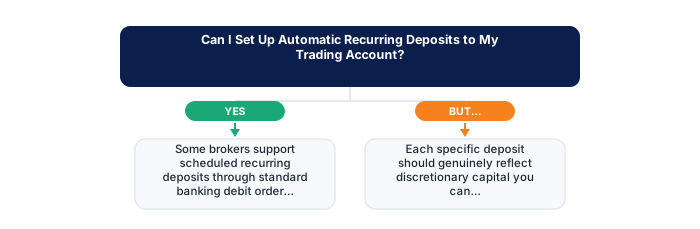
Some brokers support scheduled recurring deposits through standard banking debit order arrangements. Most South African traders fund accounts manually on an as-needed basis instead.
📋 ON THIS PAGE
1. How recurring deposits would typically work
Where it's supported, a recurring deposit works through a standard debit order with your bank, automatically transferring a set amount to your trading account at a defined interval. The mechanism is similar to any recurring payment: the instruction is set once and executes automatically until you cancel or modify it.
It's worth understanding that this mechanism, wherever it's available, generally only handles the funding side automatically. It doesn't deploy capital into any trade or investment automatically: it simply moves money from your bank account to your trading balance on a schedule. What you do with that deposited capital remains entirely under your own discretion each time.
The availability of this feature varies considerably by broker. Some FSCA-regulated brokers operating in South Africa support it natively through their client portal; others require you to set up an equivalent arrangement directly with your bank through their debit order system, with the broker's account details as the recipient.
Confirming whether your specific broker supports this and how they recommend setting it up: through their system or through your bank, is the practical first step before making any decision about whether to use it.
2. Why most traders prefer manual deposit decisions instead
Most traders prefer deciding each deposit manually, weighing their current financial situation and trading plans in that moment before committing additional capital. This preference reflects a sound instinct: the decision to deploy capital into a trading account is worth making deliberately each time, not delegating to an automatic schedule.
This instinct is worth appreciating as a genuinely sound approach rather than simple inconvenience-avoidance. Trading capital is by definition capital you can afford to risk, and whether that remains true each month depends on your financial circumstances, which can change. An automatic recurring deposit doesn't pause to check that.
- South African ID or valid passport
- Proof of residential address dated within 3 months
- Proof of bank account ownership
- Selfie or photo for biometric verification (some brokers)
- Source of funds declaration if depositing above threshold
Choose an FSCA-regulated broker
Verify the FSP number is current at fsca.co.za.
Submit FICA documents
SA ID or passport, recent proof of address, and bank account proof.
Fund via EFT
Make the initial deposit from your South African bank account in ZAR.
Open demo first
Practice on demo until you are confident in the platform and strategy.
Start with minimum capital
Begin with an amount you can afford to lose while building experience.
Manual deposits also provide a natural moment to review your current trading performance and account status before adding more capital. If the previous period produced significant losses, or if your strategy is in a period of review, the manual deposit decision is an opportunity to reassess whether more capital is the right response to that context.
There's also a discipline dimension to the deliberate deposit decision. Taking a moment to consciously commit additional capital to trading, rather than having it happen automatically, reinforces the intentionality of the activity. Traders who treat capital allocation as a deliberate decision tend to manage it more carefully than those who treat funding as an administrative background process.
3. The discretionary capital principle
Every deposit should reflect money you can genuinely afford to risk right now. An automated recurring deposit doesn't pause to check whether this month's financial situation is consistent with your intended capital deployment: it executes the same instruction regardless of what's changed in your life since you set it up.
This is worth taking seriously as the core risk that recurring deposit automation introduces. A debit order set up during a period of genuine financial stability will continue executing during periods of financial stress unless you remember to cancel it, and the point of maximum financial stress is precisely when you're least likely to be thinking clearly about discretionary trading capital.
The principle that every unit of trading capital should be genuinely discretionary: money whose loss would not affect your essential financial obligations, is one of the most consistently stated pieces of guidance in retail trading risk management. An automated recurring deposit that bypasses the mental check-in on whether that principle still holds is an architectural decision worth thinking through carefully.
South African traders should also consider how recurring deposits interact with SARB exchange control rules for offshore brokers. Automated recurring transfers to an offshore trading account involve the same compliance considerations as any other foreign payment: including the use of your annual discretionary allowance, and automating the frequency of those transfers doesn't change the regulatory requirements that apply to each one.
4. Potential risks of automating this specific decision
Beyond the discretionary capital issue, automation removes a natural checkpoint. Manual deposits force a brief moment of reflection: an implicit review of whether adding capital to the account makes sense right now. Automating the process removes that checkpoint entirely and replaces it with frictionless, schedule-driven capital deployment.
It's worth treating this reflective pause as a genuine feature rather than friction to be optimised away. The moment of deciding 'yes, I want to put more money into trading this month' is also the moment of asking whether the account is performing well enough to justify more capital, whether your strategy is working as intended, and whether your broader financial position is appropriate for additional deployment.
| Rejection reason | Fix |
|---|---|
| Address proof older than 3 months | Get a recent utility bill or bank statement |
| Name mismatch between documents | Use documents with exactly matching full name |
| Poor quality scan | Retake with good lighting, all corners visible |
| PO Box address | Brokers require physical residential address only |
Automation can also create a gradual accumulation effect that isn't always obvious in the moment. A modest monthly recurring deposit, continued for a year or two without active monitoring, can result in substantially more capital committed to trading than you'd have consciously chosen to deploy if you'd assessed the decision at each step.
There's an operational risk as well: if you change brokers, encounter account issues, or decide to pause trading, an automated debit order continues executing until specifically cancelled. Remembering to cancel the debit order at the bank level (not just stopping new trades at the broker) is easy to overlook during a period of transition.
5. When a recurring approach might genuinely make sense
This approach can make sense for traders with a genuinely stable financial position and an already-validated strategy, who want to implement a disciplined capital-building plan on a systematic basis. Dollar-cost-averaging capital into a trading account that's consistently performing: treating it as a structured savings and investment programme, is a specific use case where the automation serves the goal.
Even in this more favourable scenario, building in a periodic manual review: checking every few months that the recurring amount is still appropriate to your financial position and that the account's performance continues to justify systematic capital addition, maintains the intentionality that makes the approach sound rather than mechanical.
The scenario where recurring deposits make the most clear sense is when you're building up to a target capital level systematically, rather than when you're funding day-to-day trading activity. Separating these contexts (building capital versus deploying capital) makes it easier to assess whether automation serves the actual goal.
If you do set up a recurring deposit, treating it as a provisional arrangement that you actively review rather than a permanent instruction you set and forget preserves the optionality to adjust as circumstances change. A recurring deposit that's been running unchanged for two years is almost certainly either too high or too low relative to your current situation.
6. Checking availability with your specific broker
Not every broker supports recurring deposits directly through their platform. If yours doesn't, the same practical effect can usually be achieved by setting up a bank-side debit order or scheduled payment to your broker's deposit bank account: achieving the recurring schedule without requiring the broker to offer a specific feature for it.
Local EFT deposits and withdrawals run through the infrastructure overseen by PASA, the Payments Association of South Africa, which sets standards for payment timing, reversals, and dispute resolution. Understanding how your deposit method interacts with this infrastructure (including realistic processing times) is part of planning any systematic funding approach.
Manual, deliberate funding forces a small moment of reflection before each deposit. Automating this removes that built-in self-check, which for most traders is a genuine feature of the manual process rather than unnecessary friction. Whether removing that checkpoint serves your specific discipline and trading approach is worth honestly assessing before implementing any automation.
✕ Common mistakes
- Automating deposits without a predetermined upper limit. This removes a natural checkpoint that helps keep deposits proportionate.
- Not revisiting the recurring amount as circumstances change. A figure that made sense months ago may no longer be appropriate.
- Treating automated funding as separate from your overall risk budget. It should be planned within your total risk tolerance, not in isolation.
- Forgetting to pause deposits during a planned break from trading. An active debit order can continue even if you've stepped back.
How long does verification take?
Most accounts clear within a working day once the documents are complete. The delay comes from an address proof that is too old or a source of funds question. Switching brokers covers it in full.
Key Takeaways
- Some brokers support scheduled recurring deposits, though most South African traders fund accounts manually given the risk considerations this approach introduces.
- Some brokers support scheduled recurring deposits through standard banking debit order arrangements.
- Most South African traders fund accounts manually on an as-needed basis instead.
- How recurring deposits would typically work.
- Why most traders prefer manual deposit decisions instead.
See also: How Much of My Savings Should I Risk Trading?.
Frequently asked follow-up questions
Can I set up a recurring deposit through my own bank instead of my broker?
Yes, this is possible through standard banking facilities, achieving a similar effect even without direct broker-side support for this specific feature.
Is automatic deposit riskier than manual deposit?
Not inherently riskier in terms of trading risk itself, though it does remove the deliberate, periodic financial reflection manual decisions naturally encourage.
Can I cancel a recurring deposit arrangement at any time?
Yes, standard banking debit order arrangements can typically be cancelled through your own bank at any time you choose.
