i Short answer
Forward points represent the specific adjustment, expressed in pips, added to or subtracted from the spot rate to calculate a forward contract's settlement rate.
This reflects the interest rate differential between the two currencies involved.
📋 ON THIS PAGE
1. The basic forward points calculation
A forward contract's agreed rate equals the current spot rate adjusted by a specific number of forward points, which can be either positive (added to spot) or negative (subtracted from spot), depending on the interest rate relationship between the two currencies and the length of the forward contract.
It's worth understanding these points as simply an adjustment mechanism, discussed elsewhere on this site regarding spot and forward pricing generally, rather than a genuinely separate pricing concept, they specifically quantify the gap between today's spot rate and the corresponding forward rate.
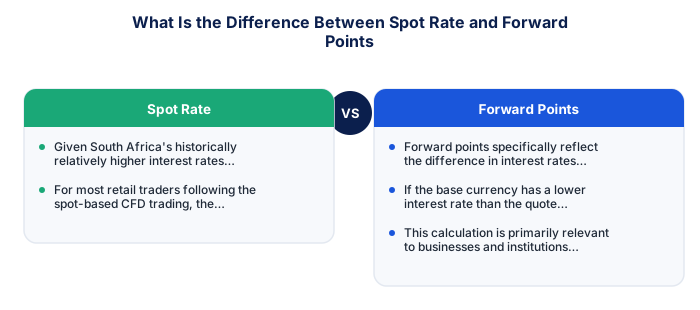
| Feature | Spot Rate | Forward Points |
|---|---|---|
| What it represents | Current exchange rate | Adjustment applied to spot for a forward date |
| Driven by | Current supply and demand | Interest rate differential between currencies |
| Expressed as | A price level | A premium or discount in pips |
| Used by | Retail and institutional traders | Mostly institutional/business hedgers |
2. Why forward points exist: the interest rate connection
Forward points reflect the difference in interest rates between the two currencies involved, ensuring the forward contract doesn't create a risk-free arbitrage opportunity purely from this interest rate difference over the contract's time period.
It's worth connecting this directly to the interest rate differential discussion found throughout this site, forward points essentially translate the interest rate gap between two currencies into a concrete pricing adjustment applied to the spot rate.
- FSCA-regulated broker verified at fsca.co.za
- Demo account tested for minimum 60 days
- Trading plan written: entry, exits, position sizing
- Risk per trade defined (1-2% of account)
- Backup internet connection tested for load shedding
- Tax implications understood
4. A worked example using ZAR specifically
Given South Africa's historically relatively higher interest rates compared to many major developed economies, USD/ZAR forward contracts would typically reflect this differential through their forward points calculation, with the exact adjustment depending on the current interest rate gap and the contract's time horizon.
It's worth working through this calculation with current, actual rate figures if you're genuinely interested in the mechanics, rather than relying on outdated figures, since interest rates shift over time and affect this calculation directly.
| Item | Detail |
|---|---|
| Regulator | FSCA, fsca.co.za |
| Exchange control | SARB, resbank.co.za |
| Tax authority | SARS, sars.gov.za |
| JSE hours | 09:00-17:00 SAST Mon-Fri |
| Best forex session | 15:00-17:00 SAST |
| CGT annual exclusion | R50,000 (individuals) |
5. Who actually uses this calculation in practice
This calculation is primarily relevant to businesses and institutions hedging specific future currency exposure, or to financial professionals calculating implied interest rate differentials from observed forward pricing, rather than being a routine calculation most retail CFD traders need to perform themselves.
It's worth appreciating that this remains a genuinely specialised, institutional-level calculation, similar to the forward contracts discussion elsewhere on this site, rather than something typical retail CFD traders need to calculate themselves in everyday trading.
6. The relevance to retail CFD traders
For most retail traders following spot-based CFD trading, the overnight financing charges known as rollover serve a conceptually similar function to forward points, reflecting the same underlying interest rate differential, without requiring direct engagement with formal forward contract pricing or calculation.
Forward points are an adjustment added to or subtracted from the spot rate based on the interest rate differential between the two currencies. Retail CFD traders encounter this effect as overnight rollover credits or debits.
★ Why It Matters
Worth understanding: forward points can be positive or negative depending on the interest rate differential direction between the two currencies. A currency pair can trade at a forward discount or premium to its spot rate, and knowing which applies to your pair matters for any forward-related calculation.
✕ Common mistakes
- Assuming forward points are always positive regardless of the currency pair. They can be positive or negative depending on the interest rate differential direction.
- Treating forward points as a minor technical detail rather than a meaningful pricing component. This figure directly affects any forward-related calculation.
- Confusing forward points with simple spread or commission costs. These reflect interest rate differentials, a genuinely different underlying mechanism.
Key Takeaways
- Forward points represent the adjustment added to or subtracted from the spot rate to calculate a forward contract's specific agreed future rate.
- Forward points represent the specific adjustment, expressed in pips, added to or subtracted from the spot rate to calculate a forward contract's settlement rate.
- This reflects the interest rate differential between the two currencies involved.
- The basic forward points calculation.
- Why forward points exist: the interest rate connection.
Frequently asked follow-up questions
Do I need to understand forward points to trade USD/ZAR CFDs?
Not directly. This calculation is more relevant to formal forward contracts than spot-based CFD trading, though understanding the underlying interest rate logic remains useful broader context.
Can forward points be negative?
Yes, when the base currency has a higher interest rate than the quote currency, forward points are typically subtracted, producing what's called a forward discount.
Is there a simple formula for calculating forward points?
Yes, though it involves the specific interest rates of both currencies and the contract's time horizon. This calculation is typically performed using specialised financial tools rather than manual computation.
