i Short answer
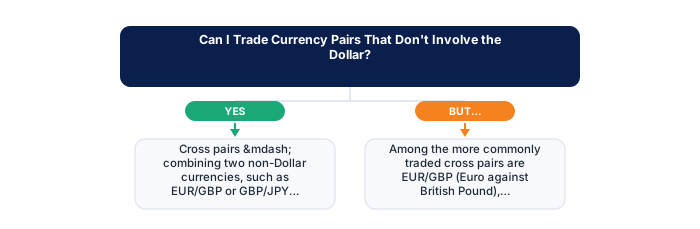
Yes. Cross pairs, combining two non-Dollar currencies such as EUR/GBP or GBP/JPY, are widely available through most FSCA-regulated brokers, alongside the Dollar-based majors.
These pairs typically carry somewhat wider spreads than the most heavily-traded Dollar pairs, given their generally lower trading volume, but remain genuinely tradeable, liquid instruments.
📋 ON THIS PAGE
- Why cross pairs exist and trade directly, not just as a calculation
- Popular cross pairs worth knowing about
- Why spreads typically differ from Dollar-based pairs
- What drives cross pair movement specifically
- When cross pairs might suit your specific strategy
- Checking availability with your specific broker
1. Why cross pairs exist and trade directly, not just as a calculation
You can calculate a cross pair's rate from its two corresponding Dollar pairs, EUR/GBP from EUR/USD and GBP/USD, for instance, but that's not how you actually trade it. Cross pairs are genuinely independently-traded instruments with their own bid/ask spread, their own order book, and their own intraday behaviour. The broker quotes it directly rather than computing it in real time from two separate positions.
That matters practically: you open EUR/GBP through your broker the same way you'd open any major pair, without manually running two simultaneous Dollar trades and managing the combined exposure. The instrument exists as its own entity in the market, not just as a mathematical derivative of two others.
This distinction between a derived calculation and a genuinely independently-traded instrument is worth appreciating fully, since it clarifies why cross pairs are useful trading instruments rather than just an arithmetic trick. When EUR/GBP moves, it's because the relative economic positions of the Eurozone and UK are shifting relative to each other, not just because of Dollar dynamics.
For South African traders, USD/ZAR is technically a cross pair (neither currency is the US Dollar... wait, USD is, so it's a major), but the broader point applies to pairs like EUR/ZAR or GBP/ZAR that a locally-focused trader might consider. These pairs express a direct view on South Africa's economic position relative to the Eurozone or UK without Dollar dynamics muddying the signal.
| Pair | Currencies | Typical Liquidity |
|---|---|---|
| EUR/GBP | Euro / British Pound | High |
| EUR/JPY | Euro / Japanese Yen | High |
| GBP/JPY | British Pound / Japanese Yen | Moderate to high |
| EUR/AUD | Euro / Australian Dollar | Moderate |
| AUD/JPY | Australian Dollar / Japanese Yen | Moderate |
2. Popular cross pairs worth knowing about
The most commonly traded crosses pair the major currencies against each other rather than the Dollar: EUR/GBP, EUR/JPY, GBP/JPY, EUR/AUD, and AUD/JPY are among the most liquid. These pairs attract genuine institutional flow and maintain tighter spreads than more exotic crosses precisely because of that volume.
It's worth getting genuinely familiar with just one or two crosses thoroughly rather than spreading attention thinly across many of them. Each cross has its own typical volatility profile, its own sensitivity to specific economic data releases, and its own characteristic intraday behaviour. EUR/JPY behaves differently from GBP/JPY despite both involving JPY, reflecting the distinct economic dynamics of each underlying currency.
| Lot type | Size | USD/ZAR pip value | Min recommended account |
|---|---|---|---|
| Standard | 100,000 units | ~R1.00 | R100,000+ |
| Mini | 10,000 units | ~R0.10 | R10,000+ |
| Micro | 1,000 units | ~R0.01 | R1,000+ |
| Nano | 100 units | ~R0.001 | R100+ |
- V = Pip value in account currency
- E = Current exchange rate of quote vs account currency
- L = Lot size (100,000 standard / 10,000 mini / 1,000 micro)
- USD/ZAR example = 1 pip = R1 per standard lot
- Leveraged instrument
- Long and short positions both available
- Overnight financing charges apply
- No underlying asset ownership
- No leverage (typically)
- Physical currency received
- No daily financing charges
- Actual currency ownership
GBP/JPY is worth mentioning specifically because it's known for its volatility, the combination of sterling's sensitivity to UK political events and yen's sensitivity to risk sentiment and Bank of Japan policy produces a pair that can move sharply and quickly. This isn't necessarily a reason to avoid it, but it is a reason to understand its character before trading it actively.
For traders interested in adding cross exposure to their approach, starting with the most liquid crosses before exploring less common ones is a practical approach. EUR/JPY and EUR/GBP have the deepest order books among the non-Dollar crosses, which means tighter spreads and more reliable execution during normal market hours.
3. Why spreads typically differ from Dollar-based pairs
Cross pairs generally have wider spreads than the Dollar majors because a smaller share of global forex flow runs through pairs that don't involve the Dollar. The Dollar remains the global reserve currency and the dominant vehicle for international trade settlement, which means EUR/USD, USD/JPY, and GBP/USD attract considerably more volume than any cross pair.
For the popular crosses, that spread gap tends to be modest rather than dramatic during core London and New York trading hours when liquidity is highest. EUR/JPY and EUR/GBP typically show spreads only marginally wider than their Dollar-based counterparts during peak sessions.
It's worth checking your specific broker's actual spread on your cross of interest directly rather than assuming a generic figure. Spreads on crosses vary more between brokers than spreads on majors, partly because less standardised liquidity across providers creates more variation in the rates they can offer. The published spread you see during London hours may also look quite different from what you'll face in early morning SAST before European markets open.
Overnight financing charges on cross pairs also deserve attention. The swap rate on a cross involves the interest differential between two non-Dollar currencies, and those rates can sometimes be less intuitive than on Dollar pairs. Checking the swap rate specifically for any cross you intend to hold overnight is part of the cost calculation that determines whether a cross position makes economic sense relative to its Dollar-based alternative.
4. What drives cross pair movement specifically
Cross pairs respond to both underlying currencies simultaneously. EUR/GBP moves on ECB and Bank of England policy together, reflecting the shifting relative economic outlooks for the Eurozone and the UK. A surprise Bank of England rate decision moves GBP/USD but also moves EUR/GBP, potentially more sharply, because the UK-Eurozone comparison is the direct subject of that pair.
That means analysing a cross properly requires tracking economic developments on both sides, the same dual-central-bank thinking that applies to any pair, but without the Dollar as a common reference point to simplify the analysis. You're comparing two non-Dollar economies directly, which can create unusual dynamics when both central banks are moving in different directions simultaneously.
This dual-tracking requirement is worth building into your regular research routine if crosses form a meaningful part of your trading approach. Tracking UK and Eurozone data releases, BOE and ECB meeting schedules, and political developments in both regions becomes necessary rather than optional when you're trading EUR/GBP actively.
Cross pairs can also be affected by Dollar-driven risk sentiment through more indirect channels. During periods of broad risk-off Dollar strength, capital flows can affect multiple currency pairs simultaneously in ways that create cross pair movements not obviously explained by the fundamentals of the two underlying currencies. Understanding this broader context improves your ability to distinguish genuine cross pair signals from noise driven by Dollar dynamics.
5. When cross pairs might genuinely suit your specific strategy
Crosses are useful when you want to express a specific view on two non-Dollar currencies directly, without the Dollar's own dynamics muddying the signal. If you have a view on the relative economic outlooks of the Eurozone and Japan, say, you believe ECB policy will diverge from Bank of Japan policy in a specific direction, EUR/JPY expresses that view more cleanly than two separate Dollar pairs.
That's a real practical edge for certain trading theses, not merely an alternative route to currencies you could reach via Dollar pairs. The purity of the expression matters when the Dollar is going through its own independent volatility, a period of Dollar weakness might move EUR/USD and USD/JPY in ways that obscure the Eurozone-Japan relative dynamics you're actually trying to trade.
A useful test for whether cross pairs genuinely suit your current approach: ask whether your actual trading thesis is specifically about the relationship between two non-Dollar currencies, or whether it's primarily about one currency relative to the Dollar with the cross pair being a secondary consideration. If the answer is the former, crosses belong in your toolkit. If the latter, you're probably better served by the corresponding Dollar pair.
Crosses also provide diversification at the strategy level, exposure to economic dynamics that are genuinely distinct from Dollar-centric major pair movements. A portfolio of positions that includes both EUR/USD and EUR/GBP, for instance, has different correlation characteristics than one that only includes Dollar pairs, which can be valuable for managing overall portfolio risk.
6. Checking availability with your specific broker
Crosses are widely available, but not every broker offers the same specific combinations, particularly for pairs involving less common currencies. Checking your broker's full instrument list confirms what's available rather than discovering limitations when you try to place a trade.
A nuance worth understanding: cross pair quotes are typically derived by brokers from their Dollar pair liquidity and the interbank cross market simultaneously. In normal conditions this produces reliable quotes, but in very fast markets or around major news events affecting one of the underlying currencies, cross pair spreads can widen more sharply than the underlying Dollar pair spreads would suggest.
If crosses are going to be a regular part of your approach, testing execution on them in a demo account during different market conditions, not just during core London hours, gives you a realistic picture of how they behave on your specific broker's platform. The difference between crosses and majors is often most apparent at the edges: early morning SAST, news-event conditions, and end-of-week Friday sessions.
✕ Common mistakes
- Assuming cross pairs are less volatile than Dollar pairs. Crosses can inherit volatility from both underlying Dollar relationships.
- Ignoring wider spreads on lower-liquidity crosses. Reduced volume on crosses typically means higher trading costs.
- Not checking whether your broker offers the specific cross you want. Cross-pair availability varies more between brokers than majors do.
- Sizing cross-pair positions the same as majors without adjustment. Different volatility profiles warrant different position sizing.
Does this apply to JSE shares too?
Several local brokers list CFDs on the larger JSE shares. It is exposure to the price rather than ownership, with a financing cost each night. Trading JSE shares through a forex broker covers it in full.
Key Takeaways
- Yes, cross pairs combining two non-Dollar currencies are widely available, though they typically carry somewhat wider spreads than Dollar-based major pairs.
- Cross pairs, combining two non-Dollar currencies such as EUR/GBP or GBP/JPY, are widely available through most FSCA-regulated brokers, alongside the Dollar-based majors.
- These pairs typically carry somewhat wider spreads than the most heavily-traded Dollar pairs, given their generally lower trading volume, but remain genuinely tradeable, liquid instruments.
- Why cross pairs exist and trade directly, not just as a calculation.
- Popular cross pairs worth knowing about.
Frequently asked follow-up questions
Are cross pairs riskier than Dollar-based major pairs?
Not inherently riskier, though their somewhat wider typical spreads and potentially different volatility characteristics warrant the same instrument-specific risk management as any other pair.
Can I trade a cross pair if I only understand one of the two currencies well?
It's generally advisable to understand the fundamental dynamics of both underlying currencies, given that cross pair movement reflects both, rather than relying on familiarity with just one side of the pair.
Do cross pairs follow the same trading session patterns as major pairs?
Generally yes, following the broader global forex session structure, though liquidity for specific cross pairs can vary somewhat by which regional sessions are most active for the specific currencies involved.
