ℹ Short answer
There is no correct number, but there is a usable test: an allocation you could watch fall 80% without changing anything you do. For most people that lands in the low single digits, and for some the right answer is zero.
1. Start with the drawdown, not the return
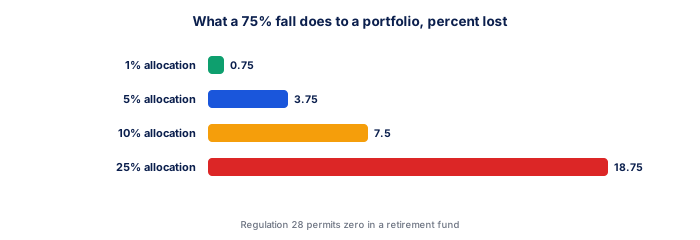
Bitcoin has fallen more than 70% from a peak on four separate occasions, and smaller assets have fallen further and more often. Any sizing question has to begin there rather than with an expected return, because the drawdown is the part that forces decisions. If a 75% fall in the position would make you sell something else, delay something, or stop sleeping, the position is too large whatever you believe about the long run. The allocation that survives is the one you can ignore during the worst month.
2. What formal frameworks conclude
Institutions that allocate to crypto at all generally land between 1% and 5%. That is not a recommendation to copy; it is what entities with explicit risk budgets conclude when they run an asset this volatile through the same process they use for everything else. The number is small because volatility, not conviction, is what sizing responds to. Anyone holding substantially more than that should be able to say why their risk tolerance differs from an institution's, and 'because it will go up' is not an answer to a sizing question.
3. Regulation 28 closes the retirement route entirely
A South African retirement fund may not hold crypto. Regulation 28 lists the asset classes a pension fund, provident fund or retirement annuity may hold, with limits of 75% for equities, 45% offshore and 25% for listed property, and crypto appears with a limit of zero rather than a small allowance. This matters more than it first appears: it means crypto exposure cannot sit in the one wrapper where South Africans get a tax deduction on the way in, so every rand of it is funded from after-tax money and taxed again on disposal.
4. Sizing by volatility rather than by rand
Allocating equal rand amounts across assets treats them as equally risky, which they are not. If crypto moves roughly four times as much as a broad equity index, an equal-risk allocation is roughly a quarter of the size. Running that arithmetic honestly usually produces a smaller number than instinct does, and it is the same arithmetic position sizing uses within a single trade. The volatility figure to use is the realised one over several years, not the calm period you happen to be in.
5. Rebalancing, and the tax it triggers
An asset that can triple will push your allocation far above target without you doing anything, and leaving it there means your risk grew while you were not looking. Rebalancing restores the target and converts volatility into a discipline. In South Africa each rebalance is a disposal: the capital gains annual exclusion is R50,000, the inclusion rate for individuals is 40%, and the maximum effective rate is 18%. Rebalancing a large, appreciated position has a real cost, which is an argument for doing it with new contributions where possible rather than by selling.
6. Several coins is not diversification
Holding five crypto assets is not diversification in the way holding five shares across different sectors is. Crypto assets correlate strongly with each other, and the correlation rises precisely when prices fall, which is when diversification is supposed to help. A crypto allocation is close to a single directional bet however many tickers it contains, and treating it as a diversified sleeve because it has several names in it is a mistake that shows up in exactly one month out of sixty.
7. When zero is the right answer
If you need the money within five years, if losing it would change your plans, if you have not yet funded an emergency reserve, or if you cannot explain in a sentence what the asset does, zero is defensible and common. Nobody is obliged to hold an asset class. The cost of not holding crypto is the return you forgo; the cost of holding too much of it is a forced sale at the bottom, and those two costs are not symmetrical in their effect on a financial plan.
★ Why It Matters
Sizing responds to volatility, not to conviction. The South African constraint that changes the answer is Regulation 28: crypto cannot sit in the one wrapper that gives you a deduction going in, so every rand is after-tax money that gets taxed again on the way out.
Where to take this next: the Crypto Position Size Calculator covers the mechanics in detail.
✕ Common mistakes
- Sizing by rand rather than by volatility. Equal rand amounts are not equal risk when one asset moves four times as much.
- Treating several coins as diversification. They correlate, and most strongly during a fall.
- Letting a winning allocation drift. Your risk grew while you were not looking.
- Forgetting that rebalancing is a disposal. The annual exclusion is R50,000 and the inclusion rate is 40%.
Frequently asked follow-up questions
Is 5% in crypto too much?
It is at the top of the range most formal frameworks use. Whether it is right for you depends on whether you could watch it fall 80% without acting.
Can my retirement annuity hold crypto?
No. Regulation 28 sets the limit at zero, so no South African retirement fund may hold it.
How often should I rebalance?
Annually, or when the allocation drifts a set distance from target. Each rebalance is a disposal, so more frequent is not automatically better.
Does holding several coins reduce risk?
Far less than people expect. Crypto assets correlate strongly, and most strongly during a fall.
Should a beginner hold any crypto at all?
Only after an emergency fund and the tax-advantaged wrappers are used, and only an amount whose complete loss would change nothing.
