ℹ Short answer
On a custodial platform you are a creditor, not an owner. South Africa has the clearest evidence anywhere of what that means: two of the largest crypto failures in the world happened here within five months, and in both the regulator had no power to act.
1. Creditor, not owner
Crypto held on an exchange is almost always pooled rather than segregated per client, and what you hold is a contractual claim against the platform rather than specific coins on a chain. The screen shows a balance; the law sees a debt. When the platform fails, that claim ranks alongside every other customer's, behind secured creditors and behind the cost of the liquidation itself. This is not a crypto peculiarity, it is how custody works, but crypto makes it sharper because there is no deposit insurance, no prudential capital requirement behind the platform, and in most cases no segregation obligation of the kind a licensed broker holding cash has.
2. What South Africa's own collapses returned
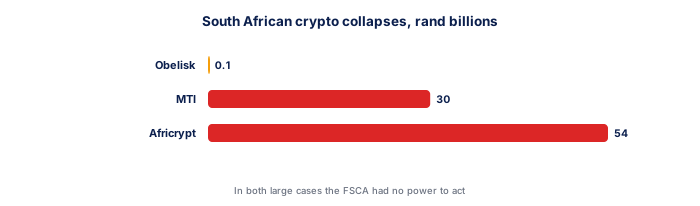
Mirror Trading International collapsed in December 2020 with more than 260,000 members across dozens of countries, marketed as an automated bitcoin trading bot. A South African court declared it an unlawful Ponzi scheme in 2023, and a United States court ordered $1.7 billion in restitution the same year. Africrypt followed in April 2021: the client portal went down, the Cajee brothers left for the United Kingdom, and roughly 69,000 bitcoin were moved through mixing services specifically to make tracing impractical. Obelisk, a smaller bitcoin mining scheme, took about R112 million from roughly 4,000 people. In none of these did holders recover their balance. In the two largest, the FSCA investigated and then stated publicly that crypto was not a regulated financial product and it had no basis to act.
3. Why that cannot happen the same way again
The October 2022 declaration of crypto assets as a financial product under FAIS closed the jurisdictional gap that left the FSCA powerless in 2021. A platform serving South Africans now needs a Category I licence, which brings fit and proper requirements for the people running it, conduct standards, reporting obligations, and a complaints route ending at the FAIS Ombud. That does not make a licensed platform safe. It makes a failure detectable earlier, actionable by a regulator, and compensable up to a limit. Those are real improvements and they are not a guarantee fund.
4. What segregation means in crypto
For a licensed broker holding client cash, segregation is a settled concept: the money sits in a separate account and is not available to the broker's creditors. For crypto the position is less developed. Platforms differ in whether assets are genuinely segregated, whether that segregation is per client or pooled, and whether the terms permit the platform to lend out customer assets. The terms and conditions are where this is answered, and the answer is frequently that the platform may use the assets. A yield paid on a deposit is the clearest possible sign that it does.
5. The warning signs, which repeat
Every collapse of the past decade was preceded by the same small set of signals. Withdrawal delays explained as technical issues, which is the single most reliable one. A yield materially above what anything else offers, which has to be funded from somewhere. A legal entity in a jurisdiction with no meaningful regulator. Marketing that emphasises returns rather than custody. Founders who are unusually young, unusually celebrated, or unusually hard to find. Africrypt had most of these, and so did MTI, and in both cases people noticed and invested anyway because the returns were working.
6. What self-custody actually solves
Coins held in a wallet you control cannot be lost in someone else's insolvency. That removes the entire category of risk this page is about, and replaces it with your own operational risk: a lost recovery phrase, a compromised device, a mistyped address. That trade is worth making above a certain balance and not below it, because for a small holding the probability you lose the keys is higher than the probability a licensed platform fails. The threshold is personal, and it is lower than most people assume.
7. What to do practically
Hold on a platform only what you are actively trading, and move the rest to self-custody. Check the licence on the FSCA register and check which entity the terms name. Read what the terms say about whether the platform may use your assets. Treat any yield on a deposit as a signal that it does. Export your transaction records as you go rather than relying on the platform to have them later, because in two South African cases the platform and its records disappeared together.
★ Why It Matters
Two of the largest crypto failures in the world happened in South Africa within five months of each other, and in both the regulator had no power to act. That gap is closed now, but the structural position has not changed: on a custodial platform you are a creditor, and creditors queue.
Where to take this next: the Choosing a crypto exchange covers the mechanics in detail; Common SA trading scams sets out the rules behind it; and Broker asset protection schemes is the figure to check alongside this.
✕ Common mistakes
- Leaving long-term holdings on an exchange. Convenience is worth custodial risk for a trading balance and not for a holding.
- Reading a yield as a benefit rather than a signal. A platform paying yield on deposits is using the assets.
- Ignoring withdrawal delays. It is the most reliable warning sign and it is always explained as technical.
- Relying on the platform to keep your records. In two South African cases the platform and its records disappeared together.
Frequently asked follow-up questions
Is crypto on an exchange insured?
Almost never in any meaningful way. Some platforms carry limited cover for hot wallet losses, which is a different thing from deposit insurance and does not cover insolvency.
Does an FSCA licence protect my balance?
It brings conduct standards, fit and proper requirements and a complaints route up to R800,000 through the FAIS Ombud. It is not a guarantee fund.
What is the single clearest warning sign?
Withdrawal delays. A platform that cannot return funds on demand has a problem whatever reason it gives.
How much did South Africans recover from MTI and Africrypt?
Very little. A US court ordered $1.7 billion in restitution against MTI in 2023, most of which has not been recovered, and the Africrypt bitcoin was moved through mixers.
Where should long-term holdings sit?
In self-custody on a hardware wallet, with the recovery phrase stored securely and a documented route for your executor.
