ℹ Short answer
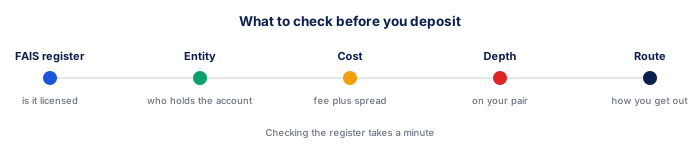
Check the FSCA register first, then which legal entity holds your account, then the total of fee, spread and withdrawal cost. A licensed local platform gives you a complaints route that ends in an enforceable determination. An offshore one gives you nothing.
1. Why the licence exists at all
In April 2021 Africrypt's client portal went down, its founders left for the United Kingdom, and roughly 69,000 bitcoin moved through mixing services. The FSCA investigated and then issued a statement that is worth reading carefully: it had found evidence only of crypto asset transactions, which were not regulated under any financial sector law, and it was therefore not in a position to take regulatory action. The regulator examined one of the largest frauds in South African history and concluded it had no jurisdiction. Four months earlier Mirror Trading International had collapsed with more than 260,000 members worldwide, and the same gap applied. In October 2022 a crypto asset was declared a financial product under FAIS, and platforms serving South Africans were required to apply for a Category I licence by November 2023. Every protection you now have exists because of those two failures.
2. Checking the register, properly
The FSCA publishes the FAIS register publicly and free, and it takes a minute to search. Look for a current FSP number, check that the crypto asset subcategory is listed rather than assuming a licence covers it, and search the company's actual registered name rather than its brand, because they often differ. Then check two more lists while you are there: the debarment register for the names of the people running it, and the public warnings page for the platform itself. A platform that is not on the FAIS register is not necessarily a fraud, but it is operating outside the system that was built specifically because of what happened in 2020 and 2021.
3. Which entity actually holds your account
A platform can market in South Africa, quote in rand, and still book your account with an entity registered somewhere else. That changes which regulator supervises it, which courts have jurisdiction, and whether the FAIS Ombud can consider a complaint. The terms and conditions name the entity; the marketing page almost never does. This is worth the five minutes it takes, because the answer determines what happens in the only scenario where it matters. If the entity is offshore, the South African licence you checked may cover a different part of the group entirely.
4. What it really costs to trade
Advertised trading fees of 0.1% to 1% are only part of the cost. The spread between the best bid and the best offer is a cost you pay on every round trip, and on a thin pair it can exceed the fee several times over. Withdrawal fees are charged per asset and per network, and on a small balance a flat withdrawal fee can be a double-digit percentage. A platform with a 0.1% fee, a wide spread and a high withdrawal charge is more expensive than one with a 0.5% fee and neither. The only comparison that means anything is the rand you end up with after a full round trip at the size you actually trade.
5. Liquidity, and why it is not a detail
A deep order book means a market order fills close to the price you saw. A thin one means it does not, and the difference comes out of your position without appearing on any statement. South African rand pairs on local platforms are generally adequate for retail size and thin by global standards, which is why large orders are often better broken up. Check the depth on the pair you trade rather than the platform's total volume, because a platform can be busy in bitcoin and almost empty in everything else.
6. What proof of reserves does and does not show
Several exchanges publish a proof of reserves demonstrating that they hold the assets customers are owed, usually through a Merkle tree that lets you verify your own balance is included. It is meaningfully better than nothing. It is not an audit: it shows assets at a single moment, says nothing about liabilities held elsewhere, and cannot show whether the assets were borrowed for the snapshot. Treat it as one signal among several rather than as the answer.
7. What a complaint actually looks like
With a licensed South African platform, a complaint goes to the platform first, then to the FAIS Ombud after about six weeks, free of charge, with a determination that binds the firm and can be enforced as a court order up to R800,000. With an offshore platform, there is no South African route at all: not the Ombud, not the FSCA, and in practice not the courts either. That difference costs nothing while everything works and is the entire value of the licence when something stops working.
★ Why It Matters
The FSCA could not act on Africrypt because crypto was not a regulated financial product. That gap closed in October 2022, and the licence is the difference between having a route when something goes wrong and having none. Checking the register takes a minute and is the only step on this page that cannot be skipped.
Where to take this next: the How to buy crypto safely covers the mechanics in detail.
✕ Common mistakes
- Assuming a local brand means a local entity. The terms name the entity; the marketing page rarely does, and the entity decides which regulator applies.
- Comparing headline fees only. The spread and the withdrawal charge frequently exceed the trading fee.
- Treating proof of reserves as an audit. It shows assets at one moment and says nothing about liabilities.
- Skipping the register check. It is free, takes a minute, and is the whole point of the 2022 reform.
Frequently asked follow-up questions
How do I check whether an exchange is licensed?
Search the FSCA FAIS register by the company's registered name, look for a current FSP number, and confirm the crypto asset subcategory is listed rather than assuming.
Are offshore exchanges illegal to use?
No. But you sit outside the FAIS Ombud and outside South African client protections, which is the position Africrypt investors found themselves in.
Which exchange is cheapest?
The one with the lowest total of fee, spread and withdrawal cost on the pair and size you actually trade. That is frequently not the one with the lowest headline fee.
Is proof of reserves enough?
It is a useful signal and not a guarantee. It shows assets at a moment without showing liabilities, and it is not an audit.
Should I keep my crypto on the exchange?
Only what you are actively trading. Anything you intend to hold for years belongs in self-custody, for the reasons 2020 and 2021 demonstrated.
