i Short answer
This disclosure identifies situations where a broker's own commercial interests might diverge from client interests.
It provides transparency around dealing desk structures and other incentive arrangements that could otherwise remain hidden.
📋 ON THIS PAGE
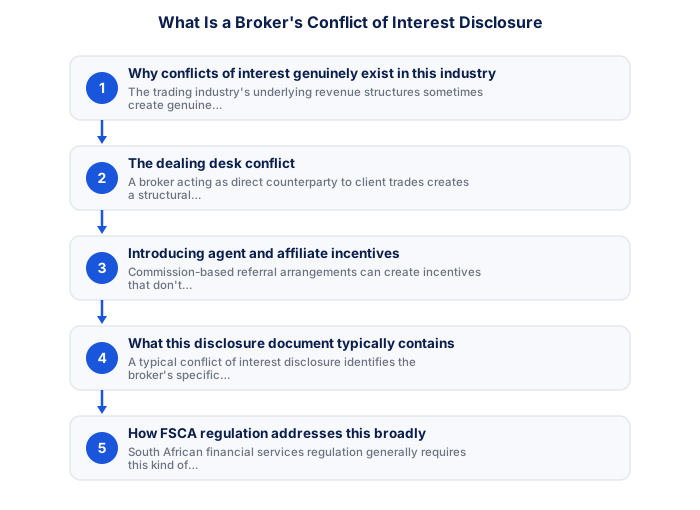
1. Why conflicts of interest genuinely exist in this industry
The trading industry's underlying revenue structures sometimes create genuine situations where a broker's own commercial interest doesn't perfectly align with an individual client's interest. Recognising that this reflects the industry's structural reality, rather than necessarily indicating bad faith from any specific broker, supports more informed, realistic engagement.
It helps to approach this topic the way you might any industry with structurally embedded incentives, real estate, insurance, even medicine in certain contexts, recognising that a conflict existing doesn't automatically mean you're being treated unfairly, but it does mean disclosed transparency and your own independent verification matter more than they would in a business relationship with no such structural tension at all.
2. The dealing desk conflict
A broker acting as direct counterparty to client trades creates a structural conflict, since the broker can profit when client positions lose. Genuinely regulated brokers are expected to disclose this kind of structural conflict explicitly rather than leaving clients to discover it independently.
See also: How Does Trading Real Estate Investment Trusts (REITs) Wo
This is worth understanding alongside the broader market maker versus ECN distinction discussed elsewhere on this site, since it's the same underlying structural dynamic viewed through a disclosure lens specifically. A broker being transparent about operating this model isn't itself a red flag, what matters more is whether their actual conduct, verifiable through reviews, complaint history, and regulatory standing, reflects the fair treatment the disclosure commits to.
- Search FSP name or number at fsca.co.za
- Confirm licence is current and not suspended
- Check scope covers forex and CFD activity
- Confirm client funds in segregated accounts
- Read FSCA enforcement actions history
- Test customer support before depositing
- Client funds legally segregated
- FSCA complaints process available
- SA consumer protections apply
- ZAR account, no FX conversion costs
- Some offshore brokers offer wider instruments
- Regulatory overhead passed on in spreads
- Stricter position limits for retail clients
- FICA verification required before trading
- Client funds segregated
- Formal FSCA complaints process
- SA consumer protections apply
- ZAR account available
- Fund safety not guaranteed
- Overseas disputes only
- SA law does not apply
- Currency conversion costs
3. Introducing agent and affiliate incentives
Commission-based referral arrangements can create incentives that don't always perfectly align with providing the most genuinely suitable broker recommendation. A complete conflict of interest disclosure should address this kind of arrangement where it genuinely applies to that specific broker's business model.
This is worth keeping in mind any time you encounter a broker recommendation online, including on comparison sites or through individual introducing agents, since the same underlying incentive, compensation tied to successful referrals, applies regardless of how personally genuine or well-intentioned the specific recommendation feels.
4. What this disclosure document typically contains
A typical conflict of interest disclosure identifies the broker's business model and revenue sources, any dealing desk or counterparty role, and the broker's general approach to managing these identified conflicts fairly, often referencing broader fair-treatment obligations.
Reading this document specifically, rather than skimming past it during account opening, is worth the modest time investment. It's one of the more direct, broker-specific sources of information about exactly how that particular business is structured and compensated, details that marketing material tends to present far less explicitly.
| Protection | FSCA Regulated | Offshore Unregulated |
|---|---|---|
| Client fund segregation | ✓ Required | Varies by broker |
| SA complaints process | ✓ Available | ✗ Not available |
| SA consumer law applies | ✓ Yes | ✗ No |
| ZAR account available | ✓ Typically | Often USD/EUR only |
5. How FSCA regulation addresses this broadly
South African financial services regulation, via FSCA and FAIS, generally requires this kind of disclosure and an overall commitment to fair client treatment despite acknowledged conflicts, reflecting the broader regulatory philosophy that disclosed, managed conflicts are preferable to hidden ones, even though the underlying structural tension may still exist.
This regulatory philosophy, favouring disclosed and managed conflicts over an unrealistic assumption that conflicts can be eliminated entirely, reflects a broader pattern across financial regulation generally. Very few financial relationships are entirely free of any incentive misalignment, which is exactly why transparency and verifiable fair conduct matter more than searching for a theoretically conflict-free provider that doesn't really exist.
6. Why disclosure doesn't eliminate the conflict itself
It's worth understanding that this kind of disclosure informs you about a genuine structural reality rather than eliminating it entirely. A disclosed dealing desk conflict still represents the same underlying structural dynamic, just one you're now explicitly aware of and can factor into your broader broker evaluation.
The point to settle in advance is what happens when a position moves beyond your funds. negative balance protection is not automatic.
STP or ECN models pass trades to liquidity providers with reduced conflict.
A market maker earns from your spread and takes the other side of your trades, an inherent conflict of interest. STP and ECN models pass trades to liquidity providers, which reduces but doesn't eliminate this.
★ Why It Matters
Worth reading rather than skimming: the section describing how the broker itself profits from your trading activity, dealing desk markups, rebates from liquidity providers. This single section often explains more about a broker's genuine incentives than their marketing material does.
✕ Common mistakes
- Not reading the specific remuneration section closely. This explains exactly how the broker profits from your account.
- Assuming all brokers have identical conflict structures. Dealing desk models and rebate structures vary meaningfully between providers.
- Treating disclosed conflicts as automatically disqualifying. Disclosure itself is the regulatory safeguard; understanding it is what matters most.
Key Takeaways
- This disclosure identifies situations where a broker's own interests might diverge from yours, providing transparency around dealing desk and incentive structures.
- This disclosure identifies situations where a broker's own commercial interests might diverge from client interests.
- It provides transparency around dealing desk structures and other incentive arrangements that could otherwise remain hidden.
- Why conflicts of interest genuinely exist in this industry.
- The dealing desk conflict.
Frequently asked follow-up questions
Are all brokers required to publish this kind of disclosure?
Disclosure requirements and specific formats vary. Checking your broker's available documentation confirms what they've published on this topic.
Does having a disclosed conflict mean a broker is untrustworthy?
Not inherently. The conflict's existence is a structural industry reality rather than necessarily indicating poor treatment, provided the broker genuinely manages this fairly.
Can I request this disclosure if I can't find it published online?
Yes, contacting your broker's support or compliance team directly to request this documentation is a reasonable approach if it's not readily visible on their website.
