i Short answer
STP routes client orders directly to liquidity providers without dealing desk intervention, similar in spirit to ECN execution.
However, STP typically doesn't provide the same order-book transparency that genuine ECN execution offers.
📋 ON THIS PAGE
1. How STP execution actually works
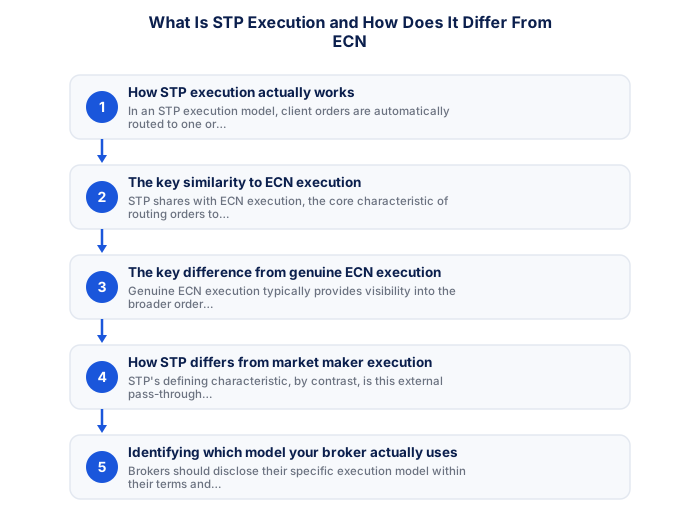
In an STP execution model, client orders are automatically routed to one or more liquidity providers (often banks or larger financial institutions) without manual dealing desk intervention, with the broker essentially acting as a conduit passing orders through to genuine external liquidity sources rather than internalising them.
It's worth understanding this as sitting between the two poles discussed elsewhere on this site regarding market maker and ECN execution, STP routes your order onward without the broker taking the opposite side, similar to ECN in that respect, but through a somewhat different underlying mechanism.
| Model | Broker Takes Opposite Side? | Order Routing |
|---|---|---|
| STP | No | Passed to liquidity providers |
| ECN | No | Matched directly with other participants |
| Market Maker | Yes | Internalised |
2. The key similarity to ECN execution
STP shares with ECN execution the core characteristic of routing orders to external liquidity rather than the broker taking the other side of client trades directly, addressing some of the potential conflict-of-interest concerns sometimes raised regarding pure market maker models.
It's worth appreciating why this similarity matters to you as a trader, both models share the fundamental characteristic of passing your order through to external liquidity rather than the broker internalising it, addressing much of the same conflict-of-interest concern discussed elsewhere on this site regarding market maker brokers.
- FSCA-regulated broker verified at fsca.co.za
- Demo account tested for minimum 60 days
- Trading plan written: entry, exits, position sizing
- Risk per trade defined (1-2% of account)
- Backup internet connection tested for load shedding
- Tax implications understood
- Predictable cost per trade
- Widens less during news
- Better for news traders
- Slightly wider average
- Very low in calm markets
- Widens during high-impact news
- Lower average cost
- Better for swing traders
3. The key difference from genuine ECN execution
Genuine ECN execution typically provides visibility into the broader order book, showing aggregated buy and sell interest across multiple liquidity providers, while STP execution often routes to liquidity without this same level of transparency, sometimes through a smaller number of liquidity relationships rather than the broader, more visible aggregation ECN platforms specifically provide.
It's worth checking your specific broker's execution policy document, discussed elsewhere on this site, for the precise technical details of how they route orders, since the specific distinction between STP and full ECN can matter for understanding exactly how your orders reach the market.
4. How STP differs from market maker execution
The market maker model involves the broker itself taking the other side of client trades, internalising risk rather than passing it through to external liquidity providers. STP's defining characteristic, by contrast, is this external pass-through routing, a structurally different approach to order execution despite both ultimately aiming to give clients tradeable pricing.
It's worth keeping all three models, market maker, STP, and ECN, clearly distinguished in your own understanding, discussed together throughout this site's broker execution content, since conflating them can lead to confusion when researching or comparing specific brokers.
| Item | Detail |
|---|---|
| Regulator | FSCA, fsca.co.za |
| Exchange control | SARB, resbank.co.za |
| Tax authority | SARS, sars.gov.za |
| JSE hours | 09:00-17:00 SAST Mon-Fri |
| Best forex session | 15:00-17:00 SAST |
| CGT annual exclusion | R50,000 (individuals) |
5. Identifying which model your broker actually uses
Brokers should disclose their specific execution model within their terms and conditions or product disclosure documentation. If this isn't clearly stated, contacting your broker's support team directly with a specific question about their execution model is a reasonable, direct way to clarify this for your own understanding.
It's worth asking your broker's support team directly which specific model they use if their marketing material doesn't clarify this explicitly, a properly transparent broker should have no difficulty confirming this detail when asked.
6. Does this distinction matter practically for most traders
For most retail traders following swing and position trading styles, the specific STP versus ECN distinction matters somewhat less than broader, more practically relevant factors like broker selection, regulatory standing, spread competitiveness, and platform reliability, though traders specifically pursuing high-frequency styles like scalping may find this distinction more practically relevant given their particular sensitivity to execution quality.
A genuinely well-regulated broker will also keep client funds in segregated accounts, separate from the company's own operating capital, so your deposited funds aren't exposed if the broker itself runs into financial difficulty.
ECN aggregates prices from multiple providers for the best available rate.
STP routes your order directly to a single liquidity provider without dealer intervention. ECN aggregates prices from multiple providers, typically offering tighter spreads at higher volume in exchange for a separate commission.
★ Why It Matters
Worth asking your broker directly: how many liquidity providers feed into their specific STP model, since "STP" describes a routing process rather than a guaranteed depth of pricing. Two brokers both claiming STP execution can still offer meaningfully different actual spread quality.
✕ Common mistakes
- Assuming STP execution guarantees the same depth as genuine ECN access. STP doesn't always provide the order-book transparency true ECN execution offers.
- Treating 'STP' as a single, standardised pricing guarantee across all brokers. It describes a routing process, and pricing quality can still vary meaningfully between providers.
- Choosing a broker based on the STP or ECN label alone without further verification. The underlying liquidity relationships matter more than the labelling.
Key Takeaways
- STP routes orders directly to liquidity providers without dealing desk intervention, similar to ECN but typically without the same order-book transparency.
- STP routes client orders directly to liquidity providers without dealing desk intervention, similar in spirit to ECN execution.
- However, STP typically doesn't provide the same order-book transparency that genuine ECN execution offers.
- How STP execution actually works.
- The key similarity to ECN execution.
Frequently asked follow-up questions
Can a broker use both STP and market maker execution simultaneously?
Some brokers do use hybrid models, routing certain trades or clients through STP while internalising others; checking your specific broker's disclosure clarifies their particular approach.
Does STP execution guarantee tighter spreads than market maker execution?
Not automatically. Spread competitiveness depends on the broker's specific liquidity relationships and business model, making direct spread comparison more useful than execution model alone.
Is STP execution more heavily regulated than other models?
No, FSCA regulation applies to broker conduct generally regardless of the specific execution model chosen.
