i Short answer
REITs provide exposure to property markets through exchange-listed shares, with South African REITs available directly on the JSE and some accessible through CFDs.
📋 ON THIS PAGE
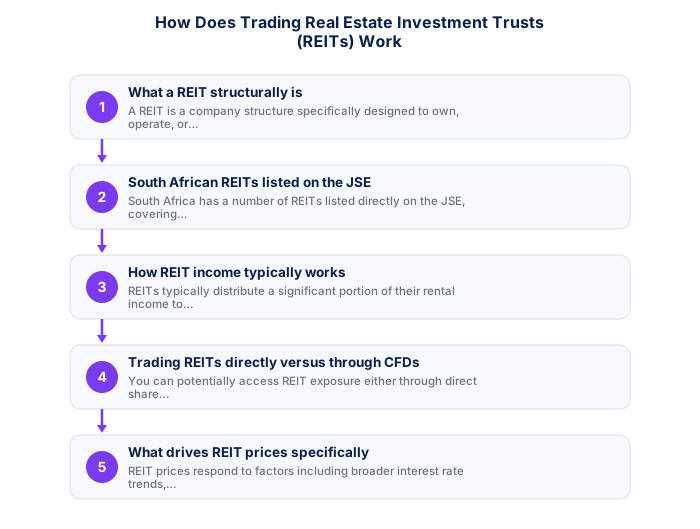
1. What a REIT structurally is
A REIT is a company structure specifically designed to own, operate, or finance income-generating real estate, with shares traded on a stock exchange similar to any other listed company, allowing investors to gain property market exposure without directly purchasing and managing physical property themselves.
It's worth understanding this structure as specifically designed to make real estate exposure accessible without requiring the substantial capital and operational involvement direct property ownership would demand, effectively letting you buy a proportional share of a diversified property portfolio through an ordinary, exchange-traded instrument.
| Feature | REITs | Direct Property |
|---|---|---|
| Liquidity | High, trades like a share | Low, slow to sell |
| Capital required | Low, buy a single share | High, full property purchase |
| Management involvement | None | Direct, or via agent |
| Income distribution | Regular, structured | Rental income, variable |
2. South African REITs listed on the JSE
South Africa has a number of REITs listed directly on the JSE, covering various property sectors including commercial, retail, and industrial property, providing direct South African market exposure through this exchange-listed structure.
It's worth researching the specific property sector focus of any individual REIT you're considering, since a REIT concentrated in retail property, for example, faces genuinely different demand dynamics and risks than one focused on industrial or logistics property, worth understanding this specific exposure rather than treating REITs as a single, undifferentiated category.
- FSCA-regulated broker verified at fsca.co.za
- Demo account tested for minimum 60 days
- Trading plan written: entry, exits, position sizing
- Risk per trade defined (1-2% of account)
- Backup internet connection tested for load shedding
- Tax implications understood
3. How REIT income typically works
REITs typically distribute a significant portion of their rental income to shareholders as regular distributions, reflecting their underlying property income-generating purpose, similar in spirit to dividend payments from other listed companies, though the specific structure and tax treatment can differ.
It's worth checking a specific REIT's historical distribution consistency directly, rather than assuming all REITs distribute equally reliably, since actual payout patterns can vary based on the underlying property portfolio's occupancy rates and broader financial performance.
4. Trading REITs directly versus through CFDs
You can potentially access REIT exposure either through direct share ownership via a traditional brokerage account, or through CFDs tracking specific REIT prices, where available through your specific broker.
It's worth weighing this choice the same way you would for any other instrument category discussed throughout this site, direct ownership offers genuine dividend-style income entitlement without leverage risk, while CFD trading offers leverage flexibility without that formal ownership status, worth choosing deliberately based on which genuinely matters more for your specific goals.
| Item | Detail |
|---|---|
| Regulator | FSCA, fsca.co.za |
| Exchange control | SARB, resbank.co.za |
| Tax authority | SARS, sars.gov.za |
| JSE hours | 09:00-17:00 SAST Mon-Fri |
| Best forex session | 15:00-17:00 SAST |
| CGT annual exclusion | R50,000 (individuals) |
5. What drives REIT prices specifically
REIT prices respond to factors including broader interest rate trends, property market conditions specifically, and the particular REIT's own operational performance and tenant occupancy levels.
It's worth following interest rate trends specifically closely when trading REITs, given how directly property valuations and REIT financing costs tend to respond to prevailing interest rate conditions, this connects REIT analysis meaningfully to the broader SARB policy awareness discussed throughout this site.
6. How this compares to direct property investment
Unlike direct physical property investment, REITs offer considerably greater liquidity, since exchange-listed shares can typically be bought and sold far more readily than physical property, while still providing genuine underlying property market exposure.
Both are highly sensitive to interest rate changes.
REIT CFDs offer instant liquidity and leverage unavailable in direct property investment. Both are highly sensitive to interest rate changes, particularly SARB rate decisions.
★ Why It Matters
Worth knowing: South African REITs tend to show meaningful sensitivity to SARB interest rate decisions specifically, since higher rates increase financing costs for the underlying property assets. This connection is often more direct than for other JSE-listed sectors.
✕ Common mistakes
- Treating all REITs as equally interest-rate sensitive. Sensitivity varies depending on each REIT's specific debt structure.
- Assuming REIT price movement mirrors the broader property market exactly. Listed REIT prices can diverge from underlying property valuations for periods.
- Not distinguishing REIT trading from direct property investment risk. These carry genuinely different liquidity and risk characteristics.
Key Takeaways
- REITs provide exposure to property markets through exchange-listed shares, with South African REITs available on the JSE and some accessible via CFDs.
- REITs provide exposure to property markets through exchange-listed shares, with South African REITs available directly on the JSE and some accessible through CFDs.
- What a REIT structurally is.
- South African REITs listed on the JSE.
- How REIT income typically works.
See also: What Is a Basket Trade and Can I Trade Multiple Instruments Together? and Which ETF Should a South African Beginner Actually Buy?.
Frequently asked follow-up questions
Are South African REIT distributions taxed differently from regular dividends?
REIT distributions can carry different tax treatment from standard dividends; consulting a tax professional or checking current SARS guidance clarifies the specific current treatment.
Can I trade international REITs from South Africa?
Some brokers may offer CFDs on international REITs alongside South African options. Checking your specific provider confirms availability.
Do REIT prices move similarly to general JSE Top 40 trends?
There's often some correlation given shared broad market sentiment, though REITs also respond to their own specific property-market and interest-rate-sensitive factors.
Is REIT investing considered higher or lower risk than other JSE shares?
Risk profiles vary by specific REIT and property sector; this isn't uniformly higher or lower risk than other listed shares, requiring individual assessment of each specific REIT.
Can REITs be included within a broader diversified JSE share portfolio?
Yes, many investors include REIT exposure as one component within a broader diversified portfolio approach.
