i Short answer
The FAIS Act is the primary South African legislation governing how financial advice and intermediary services, including broker services, must be provided.
It requires representatives to be properly authorised, meet fit-and-proper standards, and treat clients fairly.
📋 ON THIS PAGE
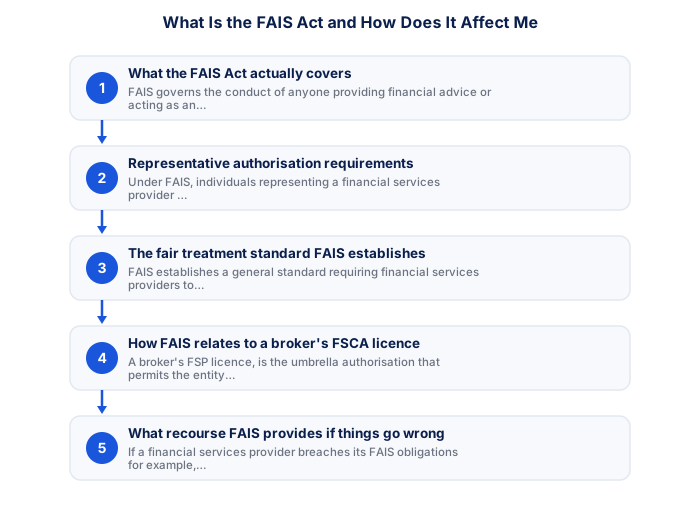
1. What the FAIS Act actually covers
FAIS governs the conduct of anyone providing financial advice or acting as an intermediary in financial services transactions in South Africa, covering a broad range of financial products including forex and CFD trading services. The Act sets out specific obligations around disclosure, suitability of advice (where advice is actually given, as opposed to simple execution-only services), and the general standard of care a financial services provider owes its clients.
For most retail CFD and forex trading, the relevant FAIS provisions concern intermediary services, facilitating your access to a financial product, rather than personalised financial advice, since most brokers explicitly position themselves as execution-only platforms rather than as advisors recommending specific trades to specific clients.
This distinction between execution-only service and genuine personalised advice is worth keeping firmly in mind, since it directly determines what standard of accountability applies to any specific interaction you have with a broker's staff. Understanding which category a given conversation actually falls into helps you calibrate how much weight to place on anything said to you during it.
2. Representative authorisation requirements
Under FAIS, individuals representing a financial services provider, including sales staff, client relationship managers, or anyone engaging with clients in a way that could influence their financial decisions, must generally be properly authorised, meeting fit-and-proper requirements covering competence, honesty, and financial soundness. This authorisation sits alongside, but is distinct from, the broader FSP licence the broker itself holds.
This means that beyond checking a broker's own FSP licence on the FSCA register, you can reasonably expect any individual representative actively engaging with you about your account to hold the relevant authorisation under FAIS, and reputable brokers will be able to confirm this status if asked directly.
- Search FSP name or number at fsca.co.za
- Confirm licence is current and not suspended
- Check scope covers forex and CFD activity
- Confirm client funds in segregated accounts
- Read FSCA enforcement actions history
- Test customer support before depositing
- Client funds legally segregated
- FSCA complaints process available
- SA consumer protections apply
- ZAR account, no FX conversion costs
- Some offshore brokers offer wider instruments
- Regulatory overhead passed on in spreads
- Stricter position limits for retail clients
- FICA verification required before trading
- Client funds segregated
- Formal FSCA complaints process
- SA consumer protections apply
- ZAR account available
- Fund safety not guaranteed
- Overseas disputes only
- SA law does not apply
- Currency conversion costs
It's worth asking this question directly and specifically, rather than assuming authorisation exists simply because someone works for a properly licensed broker. Individual representative authorisation and the broker's own overarching FSP licence are related but genuinely separate things, and a properly compliant broker should have no difficulty confirming an individual representative's specific status when asked.
3. The fair treatment standard FAIS establishes
FAIS establishes a general standard requiring financial services providers to treat clients fairly throughout the entire relationship, from initial marketing and onboarding through to ongoing account servicing and, where relevant, complaint handling. This includes specific obligations around clear, accurate disclosure of product risks and costs, avoiding misleading marketing claims, and ensuring any advice given (where applicable) is suitable for the client's specific circumstances.
This fair treatment standard underpins many specific disclosure requirements, the mandatory loss-percentage disclosure for CFD providers, clear fee schedules, and transparent risk warnings all flow from this broader FAIS-driven fair treatment obligation, rather than being arbitrary, broker-specific choices.
Recognising this connection helps explain why these specific disclosures feel so consistent across different regulated brokers, they're not each broker independently choosing to be transparent out of goodwill, they're fulfilling a shared underlying legal obligation that applies uniformly across the entire regulated industry.
4. How FAIS relates to a broker's FSCA licence
A broker's FSP licence is the umbrella authorisation that permits the entity to operate as a financial services provider in the first place. FAIS compliance is a specific, ongoing obligation that sits within and alongside that licence, governing the actual conduct of the business and its representatives on a continuing basis, rather than being a separate, one-time authorisation requirement.
In practice, this means FSCA oversight of a broker covers both the initial licensing decision and ongoing FAIS-driven conduct supervision, giving the regulator multiple angles from which to assess and act on broker behaviour if problems arise, rather than relying on a single static licensing checkpoint.
| Protection | FSCA Regulated | Offshore Unregulated |
|---|---|---|
| Client fund segregation | ✓ Required | Varies by broker |
| SA complaints process | ✓ Available | ✗ Not available |
| SA consumer law applies | ✓ Yes | ✗ No |
| ZAR account available | ✓ Typically | Often USD/EUR only |
This layered structure is worth understanding as a genuine strength of the regulatory framework rather than unnecessary complexity. A broker could theoretically maintain a valid FSP licence while still falling short on ongoing FAIS conduct obligations, which is exactly why checking a broker's current standing periodically, rather than relying on a single check made years ago, remains a worthwhile habit.
5. What recourse FAIS provides if things go wrong
If a financial services provider breaches its FAIS obligations, for example, through misleading advice, inadequate disclosure, or unfair treatment, clients have recourse through the FSCA's complaints process, and in more serious cases, through the Financial Services Tribunal or other relevant dispute resolution mechanisms established specifically to handle FAIS-related grievances.
This FAIS-specific recourse layer is part of the broader regulatory protection package that distinguishes FSCA-regulated brokers from unregulated ones, reinforcing why broker verification matters as a practical, concrete safeguard rather than a purely theoretical consideration.
Keeping clear, dated records of any advice or representations made to you, particularly anything that felt like it crossed from general information into specific, personalised recommendation, gives you considerably stronger footing if you ever need to invoke this recourse process, compared to relying on memory alone to reconstruct what was actually said.
6. Checking FAIS compliance practically before trading
Beyond the standard FSP licence check on the FSCA register, you can reasonably ask any broker representative you interact with to confirm their own individual FAIS authorisation status, and a properly compliant broker should be able to provide this confirmation without hesitation. Reluctance or inability to confirm this specific detail, particularly from someone actively advising on or facilitating your trading decisions, is worth treating as a meaningful warning sign.
This additional verification layer complements, rather than replaces, broader broker licensing checks, together they give a more complete picture of both the entity's and the individual representative's regulatory standing before you commit any capital to a trading relationship.
The FAIS Act requires FSP-licensed brokers to act in your best interests, disclose conflicts of interest, and ensure products are suitable. The FAIS Ombud handles disputes when advice or conduct falls short.
★ Why It Matters
Worth checking: confirm whether the person or platform giving you trading guidance is operating under their own FAIS authorisation or simply providing general, non-personalised education. This distinction has real legal weight even when the practical content sounds similar.
✕ Common mistakes
- Not reading the FAIS disclosure document provided at onboarding. It specifically reveals protections and obligations that apply to your relationship with a provider.
- Treating FAIS compliance as identical to general FSCA broker licensing. These address related but distinct aspects of regulatory protection.
- Assuming all guidance carries the same regulatory weight regardless of source. Formally licensed advice and general education carry genuinely different legal status.
Key Takeaways
- The FAIS Act regulates financial advice and intermediary services in South Africa. Learn what it requires of brokers and what protection it gives traders.
- The FAIS Act is the primary South African legislation governing how financial advice and intermediary services, including broker services, must be provided.
- It requires representatives to be properly authorised, meet fit-and-proper standards, and treat clients fairly.
- What the FAIS Act actually covers.
- Representative authorisation requirements.
Frequently asked follow-up questions
Does FAIS apply to execution-only trading platforms?
FAIS provisions around intermediary conduct still apply even where no personalised advice is given, though the specific obligations around advice suitability are most relevant where actual advice is provided rather than pure execution services.
Is FAIS authorisation the same as an FSP licence?
No, FAIS representative authorisation applies to individuals, while an FSP licence is held by the broker entity itself; both are relevant but distinct regulatory layers.
Can I check an individual's FAIS authorisation status myself?
The FSCA register primarily covers entity-level FSP licensing; individual representative status is generally best confirmed by asking the broker directly, since this specific detail isn't always presented in the same public-facing format as entity licensing.
Does FAIS protect me if I make my own trading decisions without any advice?
FAIS specifically governs advisory and intermediary conduct; if you're trading entirely on your own judgement without receiving personalised advice, this particular protection is less directly relevant than the broader FSCA conduct rules covering execution and fund handling.
Can a broker lose its FAIS authorisation separately from its FSP licence?
Yes, these can theoretically be affected independently, since FAIS representative status and the underlying FSP licence are governed by related but distinct compliance requirements within the same broader regulatory framework.
Is FAIS the same thing as FSCA regulation generally?
FAIS is specific legislation governing advisory and intermediary conduct, while FSCA regulation encompasses this and other broader regulatory mandates.
Does FAIS apply to trading educators?
Generally not in the same way it applies to licensed advisors and brokers, since there's a distinction between financial advisors and trading educators.
Can I verify FAIS licensing myself without professional help?
Yes, the official FSCA register is publicly searchable and doesn't require professional assistance for basic verification.
Does every employee at a brokerage need their own individual FAIS authorisation?
Not necessarily everyone; specifically those rendering financial services or advice directly to clients typically need this authorisation, while purely administrative or technical staff may not.
