Home โ€บ Forex Pairs & Currencies โ€บ What Is a Currency War and Has This Ever Affected the Rand?

What Is a Currency War and Has This Ever Affected the Rand?

i Short answer

A currency war describes competitive efforts by multiple countries to weaken their own currencies for trade advantage.

The Rand is sometimes affected as a broader side effect of these dynamics, rather than typically being a deliberate, direct target.

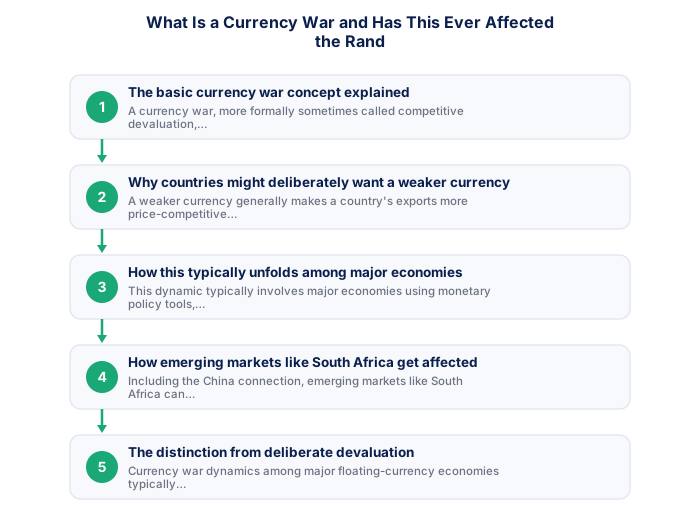
1. The basic currency war concept explained

A currency war, more formally sometimes called competitive devaluation, describes a situation where multiple countries simultaneously pursue policies aimed at weakening their own currencies, each seeking to gain trade competitiveness advantage, creating a kind of escalating, mutually-reinforcing dynamic across these participating economies.

!
Apply any framework to your specific circumstances

Generic rules in trading guides are starting points, not universal mandates. Your account size, risk tolerance, and SA context all require calibration to your situation.

โœ“
Practical tip: Apply each concept in this guide to your specific account size, risk tolerance, and instruments. Generic rules always need calibration to your individual trading setup.

2. Why countries might deliberately want a weaker currency

A weaker currency generally makes a country's exports more price-competitive in international markets while making imports more expensive, creating a genuine economic incentive some countries pursue, particularly during periods of weak domestic demand or significant trade deficit concerns.

General Trading Readiness Checklist
  • FSCA-regulated broker verified at fsca.co.za
  • Demo account tested for minimum 60 days
  • Trading plan written: entry, exits, position sizing
  • Risk per trade defined (1-2% of account)
  • Backup internet connection tested for load shedding
  • Tax implications understood
DODON'T
Apply each concept to your specific account size and instruments
Use generic rules without calibrating to your own setup
Test any new approach on demo before live application
Skip demo when trying new methods
Keep written records of every decision and its rationale
Rely on memory to evaluate your trading performance
Review performance against your rules, not just P&L
Judge trading quality solely by whether money was made

3. How this typically unfolds among major economies

This dynamic typically involves major economies using monetary policy tools, or sometimes more direct intervention, with each country's actions potentially prompting responsive actions from trading partners concerned about losing their own relative competitiveness.

South African traders accessing forex and CFD markets should understand that the instruments they trade through FSCA-regulated brokers are derivative contracts rather than ownership of the underlying asset. This means that all profits and losses are settled in cash, position sizes can be adjusted to suit any account size, and the same trading infrastructure provides access to global markets from a ZAR-denominated account. Understanding this fundamental structure helps traders make better decisions about instrument selection, position sizing, and account management.

79%retail CFD accounts lose money
1-2%recommended max risk per trade
100+demo trades before going live
5 yearsSARS minimum record keeping
South African Trading Quick Reference
Regulator
FSCA, fsca.co.za
Tax authority
SARS, sars.gov.za
Exchange control
SARB, resbank.co.za
JSE trading hours
09:00-17:00 SAST Mon-Fri
Best forex window
15:00-17:00 SAST (overlap)
CGT exclusion
R40,000 per year (individual)

4. How emerging markets like South Africa get affected

Including the China connection, emerging markets like South Africa can experience genuine spillover effects from major economy currency dynamics, even without being deliberate targets, since broader global capital flows and trade competitiveness shifts affect these economies as a side consequence of larger powers' currency policies.

SA Trading Quick Reference
ItemDetail
RegulatorFSCA, fsca.co.za
Exchange controlSARB, resbank.co.za
Tax authoritySARS, sars.gov.za
JSE hours09:00-17:00 SAST Mon-Fri
Best forex session15:00-17:00 SAST
CGT annual exclusionR40,000 (individuals)

5. The distinction from deliberate devaluation

Currency war dynamics among major floating-currency economies typically operate through the kind of market-driven depreciation, achieved through monetary policy and broader economic positioning, rather than the formal devaluation mechanism specifically relevant to fixed or pegged exchange rate systems.

6. Practical relevance for South African traders specifically
South African traders following USD/ZAR benefit from monitoring broader global currency policy dynamics among major economies as one additional layer of fundamental context, recognising that significant shifts in major economy currency competitiveness can produce meaningful spillover effects on Rand sentiment even without South Africa being directly, deliberately targeted.

South African traders have a natural advantage when analysing ZAR-denominated instruments because they observe the domestic drivers of rand movements directly and continuously. The key analytical discipline is separating USD/ZAR movements that are driven by global USD strength from those driven by SA-specific factors. When the rand is weakening at the same time as other major EM currencies, the driver is typically global risk appetite, not a SA-specific issue. When the rand is weakening while EM peers are stable or strengthening, a domestic SA factor is at work and requires a different analytical and positioning response.

For South African traders operating within the FSCA-regulated environment, the combination of clear regulatory oversight, ZAR account access, and the unique analytical opportunities provided by rand-specific market drivers creates a well-structured foundation for developing a professional trading practice. The key to converting this foundation into consistent results is not finding the perfect strategy or the perfect instrument but developing the discipline to execute a sound strategy consistently across a large enough sample of trades to allow the strategy's statistical edge to express itself.

South African traders who maintain a weekly review routine, checking the SARB economic calendar for the coming week, reviewing the Eskom load shedding schedule, assessing the current GNU coalition stability backdrop, and marking key support and resistance levels on the instruments they trade, consistently outperform traders who approach each session without any structured preparation. This weekly routine takes 30 to 45 minutes and produces a clearer analytical framework that reduces impulsive decisions and improves the quality of trade selection throughout the week.

South African traders operate in a market environment that combines global exposure with unique domestic factors that most international trading frameworks do not address. The combination of FSCA regulatory oversight, SARB exchange control considerations, SARS tax treatment, load shedding operational risk, and rand-specific dynamics creates a trading environment that is both distinctive and analytically rich. Traders who develop expertise across both global trading fundamentals and SA-specific market dimensions build a more sound foundation than those who apply international frameworks without local adaptation. This local knowledge compounds over time, producing analytical advantages that persist across market cycles and that cannot be replicated by simply following international trading content produced without South Africa in mind.

South African traders operate in a market environment that combines global exposure with unique domestic factors that most international trading frameworks do not address. The combination of FSCA regulatory oversight, SARB exchange control considerations, SARS tax treatment, load shedding operational risk, and rand-specific dynamics creates a trading environment that is both distinctive and analytically rich. Traders who develop expertise across both global trading fundamentals and SA-specific market dimensions build a more sound foundation than those who apply international frameworks without local adaptation. This local knowledge compounds over time, producing analytical advantages that persist across market cycles and that cannot be replicated by simply following international trading content produced without South Africa in mind.

South African traders who build systematic habits around preparation, execution, and review consistently outperform those who rely on instinct and informal processes. Preparation involves a written analysis before each session. Execution means following predefined rules regardless of emotional state. Review means recording every trade and assessing performance against the rules, not against the monetary outcome alone. This three-part structure converts trading from a reactive activity into a repeatable professional practice, and it is accessible to any trader willing to invest the consistent daily effort it requires.

โ˜… Why It Matters

Something worth tracking : the Rand tends to be more of a bystander than a direct participant in major-economy currency wars, but it often experiences amplified volatilityVolatility measures how much and how quickly an instrument's price fluctuates.Click to read more โ†’ as a liquid emerging-market proxy that global funds use to express broader risk positioning during these episodes.

Direct targeting
Not SA policy
SA doesn't competitively devalue
Indirect exposure
As EM currency
US-China tensions affect the Rand
How currency war dynamics reach the Rand
Risk-off trigger
EM sell-off
Dollar strengthens
all EM pairs weaken
SA doesn't intervene
SARB policy
Watch
major economy tensions

South Africa doesn't competitively devalue the Rand. However, currency war dynamics between major economies, particularly US and China, affect global risk appetite and create indirect EM sell-offs that move the Rand.

โœ• Common mistakes

  • Assuming the Rand is a deliberate target in major-economy currency disputes. It tends to be more of a bystander, affected indirectly rather than targeted directly.
  • Ignoring how global funds use liquid EM currencies to express broader positioning. This mechanism explains much of the Rand's sensitivity during these events.
  • Assuming currency war dynamics are rare enough to ignore in analysis. Episodes of competitive currency weakening recur periodically.
Are CFDs available on JSE-listed shares for South African traders?

Yes. Most major FSCA-regulated CFD brokers offer contracts on JSE-listed shares and the JSE Top 40 index. These allow leveraged trading on SA equities through a single account without needing a separate stockbroker.

Do overnight financing charges apply to forex positions held over the weekend?

Most brokers apply three days of financing on positions held over the weekend, typically charged on Wednesday. This reflects the two-day settlement cycle that extends over Saturday and Sunday in the interbank market.

South Africa's financial markets have structural characteristics that differentiate them from the global trading environment covered in most international trading education resources. The JSE's significant weighting toward resources and mining companies means it responds differently to global commodity cycles than more diversified international indices. USD/ZAR's dual sensitivity to global EM risk appetite and domestic SA fundamentals creates a richer analytical environment for traders who are willing to develop both dimensions of analysis, rather than relying solely on technical charts that ignore the fundamental context entirely.

South African traders have a natural analytical advantage on rand-paired currencies because they observe the domestic drivers of ZAR directly and continuously. The technical relationships between major currency pairs and the USD/ZAR, particularly the negative correlation between USD/ZAR and risk-on periods, become more predictable once you understand which component of USD/ZAR movement is driven by global USD strength and which is driven by SA-specific fundamental factors. Building this analytical separation into your daily market review produces more precise ZAR trading hypotheses than treating USD/ZAR as a single undifferentiated signal.

Understanding how South African market conditions differ from the global trading environment covered in most textbooks gives local traders a genuine analytical edge. The JSE's resources weighting, the rand's dual sensitivity to global EM flows and domestic fundamentals, and the specific calendar of SA market events, SARB MPC dates, budget speeches, credit rating reviews, create a richer analytical environment than pure technical analysis alone captures. Building awareness of these SA-specific layers alongside standard trading principles produces more sound analysis for ZAR instruments and JSE-listed products.

Key Takeaways

  1. A currency war describes competitive efforts by multiple countries to weaken their own currencies, with the Rand sometimes affected as a side effect rather than a target.
  2. A currency war describes competitive efforts by multiple countries to weaken their own currencies for trade advantage.
  3. The Rand is sometimes affected as a broader side effect of these dynamics, rather than typically being a deliberate, direct target.
  4. The basic currency war concept explained.
  5. Why countries might deliberately want a weaker currency.

Frequently asked follow-up questions

Is South Africa typically considered a participant in currency wars?

South Africa is more typically affected as a broader side effect of major economy dynamics, rather than being a primary, deliberate participant in this kind of competitive positioning.

Does the term currency war reflect a formal, official conflict?

No, this is a descriptive, somewhat informal term for competitive currency dynamics, rather than referring to any formal, officially declared conflict between countries.

How can I track whether currency war dynamics are currently affecting markets?

Following reputable international financial news and economic analysis sources helps provide ongoing awareness of these broader global dynamics.

๐Ÿ“š Sources & further reading

This article draws on general information published by the South African regulators and established financial education resources listed below. Always check each source directly for the most current detail.

Explore more South African trading guides on TradeAnswers.

๐Ÿ›ก๏ธ
Practice without risk

Trade This Pair With Zero Risk

Get a feel for this currency pair's real behaviour on a free, FSCA-regulated demo account.

Trade This Pair Free
  • FSCA RegulatedTrade with confidence
  • Practice Risk FreeReal market conditions
  • Beginner FriendlyPerfect for learning

79% of retail CFD accounts lose money. Demo accounts do not guarantee future profits.