Home โ€บ Forex Pairs & Currencies โ€บ What Is Currency Devaluation and How Does It Differ From Depreciation?

What Is Currency Devaluation and How Does It Differ From Depreciation?

i Short answer

Devaluation is a deliberate government or central bank action under a fixed or pegged exchange rate regime.

Depreciation refers to market-driven decline in a floating currency's value, like the Rand.

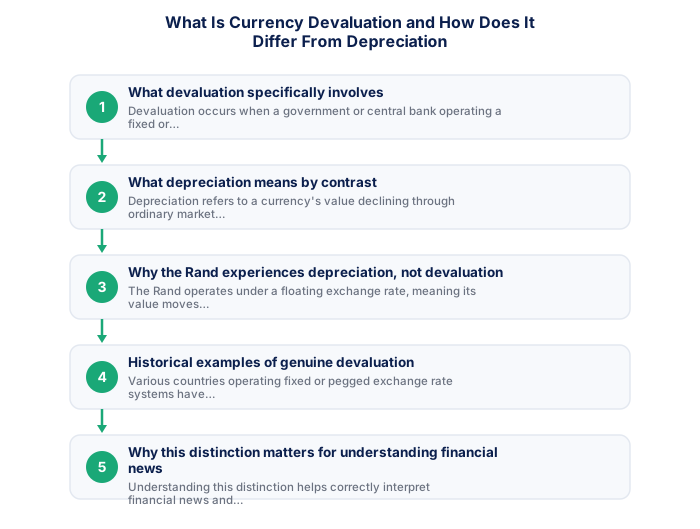
1. What devaluation specifically involves

Devaluation occurs when a government or central bank operating a fixed or pegged exchange rate, deliberately and officially lowers the currency's fixed value relative to another currency or basket, representing an intentional policy decision rather than something markets determine independently.

It's worth understanding why this requires a fixed or pegged system specifically, devaluation is fundamentally a deliberate policy action, a government or central bank choosing to reset their currency's fixed value, a decision that simply doesn't apply to a currency whose value already floats freely based on market forces.

!
Apply any framework to your specific circumstances

Generic rules in trading guides are starting points, not universal mandates. Your account size, risk tolerance, and SA context all require calibration to your situation.

โœ“
Practical tip: Apply each concept in this guide to your specific account size, risk tolerance, and instruments. Generic rules always need calibration to your individual trading setup.
Devaluation vs depreciation
FeatureDevaluationDepreciation
Caused byDeliberate government/central bank actionMarket forces
Exchange rate regimeFixed or peggedFloating
Applies to the RandNoYes

2. What depreciation means by contrast

Depreciation refers to a currency's value declining through ordinary market forces under a floating exchange rate regime, reflecting genuine supply and demand dynamics rather than any single deliberate government action setting a new official rate.

It's worth appreciating why this distinction matters analytically, depreciation reflects the aggregate outcome of countless market participants' independent decisions, discussed throughout this site's fundamental analysis content, rather than a single, deliberate policy choice by one authority.

General Trading Readiness Checklist
  • FSCA-regulated broker verified at fsca.co.za
  • Demo account tested for minimum 60 days
  • Trading plan written: entry, exits, position sizing
  • Risk per trade defined (1-2% of account)
  • Backup internet connection tested for load shedding
  • Tax implications understood
DODON'T
Apply each concept to your specific account size and instruments
Use generic rules without calibrating to your own setup
Test any new approach on demo before live application
Skip demo when trying new methods
Keep written records of every decision and its rationale
Rely on memory to evaluate your trading performance
Review performance against your rules, not just P&L
Judge trading quality solely by whether money was made

South African traders accessing forex and CFD markets should understand that the instruments they trade through FSCA-regulated brokers are derivative contracts rather than ownership of the underlying asset. This means that all profits and losses are settled in cash, position sizes can be adjusted to suit any account size, and the same trading infrastructure provides access to global markets from a ZAR-denominated account. Understanding this fundamental structure helps traders make better decisions about instrument selection, position sizing, and account management.

3. Why the Rand experiences depreciation, not devaluation

The Rand operates under a floating exchange rate, meaning its value moves continuously based on market forces, rather than being fixed by SARB at an official rate that could subsequently be deliberately devalued, financial media accurately describes Rand weakness as depreciation rather than devaluation for this specific reason.

It's worth using this correct terminology deliberately in your own analysis and reading, since precise language here reflects genuine understanding of how the Rand's value is actually determined, worth correcting this common misuse when you encounter it in casual conversation or less careful reporting.

79%retail CFD accounts lose money
1-2%recommended max risk per trade
100+demo trades before going live
5 yearsSARS minimum record keeping
South African Trading Quick Reference
Regulator
FSCA, fsca.co.za
Tax authority
SARS, sars.gov.za
Exchange control
SARB, resbank.co.za
JSE trading hours
09:00-17:00 SAST Mon-Fri
Best forex window
15:00-17:00 SAST (overlap)
CGT exclusion
R40,000 per year (individual)

4. Historical examples of genuine devaluation

Various countries operating fixed or pegged exchange rate systems have historically conducted deliberate devaluations at different points, often in response to unsustainable pressure on maintaining the fixed rate given underlying economic conditions, these represent genuinely different events structurally from the kind of floating-currency depreciation.

It's worth researching these specific historical episodes further if genuine interest in monetary history appeals to you, understanding real historical examples of devaluation helps solidify the conceptual distinction beyond the abstract definition alone.

SA Trading Quick Reference
ItemDetail
RegulatorFSCA, fsca.co.za
Exchange controlSARB, resbank.co.za
Tax authoritySARS, sars.gov.za
JSE hours09:00-17:00 SAST Mon-Fri
Best forex session15:00-17:00 SAST
CGT annual exclusionR40,000 (individuals)

5. Why this distinction matters for understanding financial news

Understanding this distinction helps correctly interpret financial news and avoid confusion when reading about currency events in other countries that do operate fixed or pegged systems, where genuine devaluation remains a structurally possible policy action in a way it isn't for the freely floating Rand.

It's worth applying this correct terminology test whenever you read financial commentary about currency movements, noticing when a source uses these terms precisely versus loosely gives you a useful, quick signal about that source's general accuracy and rigor.

6. The connection to currency pegs

Lesotho's loti and Namibia's dollar, maintained at fixed parity with the Rand, would theoretically be subject to genuine devaluation risk if their respective authorities chose to alter this fixed peg relationship, representing a structurally different scenario than the Rand's own floating depreciation.

South African traders have a natural advantage when analysing ZAR-denominated instruments because they observe the domestic drivers of rand movements directly and continuously. The key analytical discipline is separating USD/ZAR movements that are driven by global USD strength from those driven by SA-specific factors. When the rand is weakening at the same time as other major EM currencies, the driver is typically global risk appetite, not a SA-specific issue. When the rand is weakening while EM peers are stable or strengthening, a domestic SA factor is at work and requires a different analytical and positioning response.

South African traders operate in a market environment that combines global exposure with unique domestic factors that most international trading frameworks do not address. The combination of FSCA regulatory oversight, SARB exchange control considerations, SARS tax treatment, load shedding operational risk, and rand-specific dynamics creates a trading environment that is both distinctive and analytically rich. Traders who develop expertise across both global trading fundamentals and SA-specific market dimensions build a more sound foundation than those who apply international frameworks without local adaptation. This local knowledge compounds over time, producing analytical advantages that persist across market cycles and that cannot be replicated by simply following international trading content produced without South Africa in mind.

South African traders operate in a market environment that combines global exposure with unique domestic factors that most international trading frameworks do not address. The combination of FSCA regulatory oversight, SARB exchange control considerations, SARS tax treatment, load shedding operational risk, and rand-specific dynamics creates a trading environment that is both distinctive and analytically rich. Traders who develop expertise across both global trading fundamentals and SA-specific market dimensions build a more sound foundation than those who apply international frameworks without local adaptation. This local knowledge compounds over time, producing analytical advantages that persist across market cycles and that cannot be replicated by simply following international trading content produced without South Africa in mind.

โ˜… Why It Matters

Something worth being precise about in your own thinking: because the Rand floats freely, every Rand move is technically a depreciation or appreciation, never a devaluation, using the term 'devaluation' for Rand weakness is a common but technically incorrect usage worth avoiding in your own analysis.

Currency depreciation versus devaluation
Depreciation
Devaluation
Mechanism
Market-driven, gradual
Government policy decision
Exchange rate type
Free-floating
Pegged or managed
Rand applies
Yes, free-floating
No, not currently
Speed
Gradual or sudden
Sudden, announced
SA relevance
Yes, Rand depreciates
Historical context only
Currency depreciation is market-driven, the Rand's normal experience.
Devaluation is a government policy decision, used with pegged currencies.

The Rand depreciates or appreciates naturally through market forces as a free-floating currency. Devaluation is a deliberate government policy decision, associated with pegged or managed exchange rate regimes.

โœ• Common mistakes

  • Calling Rand weakness a 'devaluation' rather than depreciation. Since the Rand floats freely, this terminology is technically incorrect, though commonly used.
  • Assuming devaluation and depreciation involve the same underlying mechanism. Devaluation is deliberate policy action; depreciation is market-driven.
  • Treating floating currencies as susceptible to devaluation in the technical sense. True devaluation specifically applies to fixed or pegged exchange rate regimes.
  • Using these terms interchangeably in your own analysis or communication. Precision here reflects a deeper understanding of currency mechanics.
Are CFDs available on JSE-listed shares for South African traders?

Yes. Most major FSCA-regulated CFD brokers offer contracts on JSE-listed shares and the JSE Top 40 index. These allow leveraged trading on SA equities through a single account without needing a separate stockbroker.

Do overnight financing charges apply to forex positions held over the weekend?

Most brokers apply three days of financing on positions held over the weekend, typically charged on Wednesday. This reflects the two-day settlement cycle that extends over Saturday and Sunday in the interbank market.

South African traders who approach their trading activity with the same rigour they would apply to any skilled professional discipline typically develop more durable results than those who treat trading as primarily intuitive. This means maintaining written records of every trade and its rationale, reviewing performance at regular intervals with specific metrics rather than general impressions, and updating trading rules based on evidence from actual performance rather than from theory alone. The structured approach separates traders who improve continuously from those who repeat the same errors across extended periods without identifying the underlying cause.

South African traders have a natural analytical advantage on rand-paired currencies because they observe the domestic drivers of ZAR directly and continuously. The technical relationships between major currency pairs and the USD/ZAR, particularly the negative correlation between USD/ZAR and risk-on periods, become more predictable once you understand which component of USD/ZAR movement is driven by global USD strength and which is driven by SA-specific fundamental factors. Building this analytical separation into your daily market review produces more precise ZAR trading hypotheses than treating USD/ZAR as a single undifferentiated signal.

Understanding how South African market conditions differ from the global trading environment covered in most textbooks gives local traders a genuine analytical edge. The JSE's resources weighting, the rand's dual sensitivity to global EM flows and domestic fundamentals, and the specific calendar of SA market events, SARB MPC dates, budget speeches, credit rating reviews, create a richer analytical environment than pure technical analysis alone captures. Building awareness of these SA-specific layers alongside standard trading principles produces more sound analysis for ZAR instruments and JSE-listed products.

Key Takeaways

  1. Devaluation is a deliberate government or central bank action under a fixed exchange regime, while depreciation refers to market-driven decline in a floating currency.
  2. Devaluation is a deliberate government or central bank action under a fixed or pegged exchange rate regime.
  3. Depreciation refers to market-driven decline in a floating currency's value, like the Rand.
  4. What devaluation specifically involves.
  5. What depreciation means by contrast.

Frequently asked follow-up questions

Has the Rand ever been formally devalued historically?

Given its floating exchange rate structure, the Rand's value changes reflect market-driven depreciation or appreciation rather than formal government devaluation actions.

Can a floating currency theoretically still be devalued?

Not in the formal sense this term implies, since devaluation specifically requires a fixed rate that can be officially altered, which a genuinely floating currency doesn't have.

Is depreciation always bad for an economy?

This involves genuinely complex trade-offs. Depreciation can support export competitiveness while also increasing import costs, among various other effects.

๐Ÿ“š Sources & further reading

This article draws on general information published by the South African regulators and established financial education resources listed below. Always check each source directly for the most current detail.

Explore more South African trading guides on TradeAnswers.

๐Ÿ›ก๏ธ
Practice without risk

Trade This Pair With Zero Risk

Get a feel for this currency pair's real behaviour on a free, FSCA-regulated demo account.

Trade This Pair Free
  • FSCA RegulatedTrade with confidence
  • Practice Risk FreeReal market conditions
  • Beginner FriendlyPerfect for learning

79% of retail CFD accounts lose money. Demo accounts do not guarantee future profits.