Home โ€บ Beginners Glossary โ€บ What Does OTC Mean in Trading?

What Does OTC Mean in Trading?

i Short answer

OTC, or over-the-counter, refers to trading conducted directly between parties rather than through a centralised exchange.

This describes how most forex and CFD trading actually operates structurally, distinct from exchange-traded instruments like JSE shares.

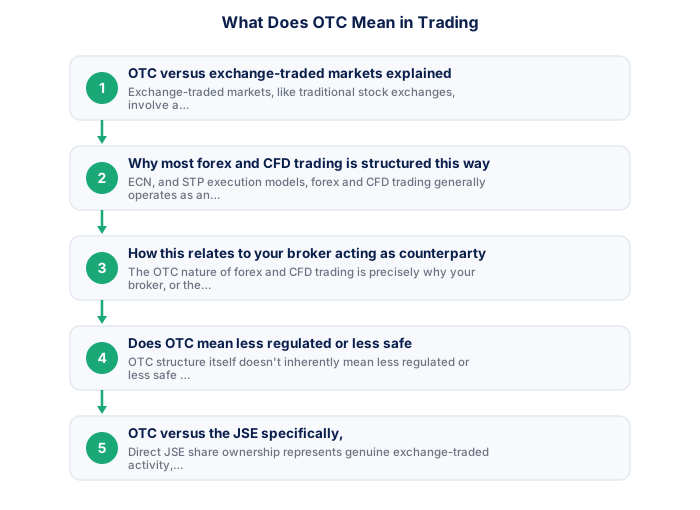
1. OTC versus exchange-traded markets explained

Exchange-traded markets, like traditional stock exchanges, involve a centralised venue where buyers and sellers meet through a standardised, regulated trading infrastructure, with prices determined through this centralised matching process. OTC markets, by contrast, involve trading conducted directly between two parties, without this centralised exchange structure standing between them.

It's worth understanding why this structural difference genuinely matters for you as a trader, in an exchange-traded market, price is determined by a centralised, transparent order book visible to all participants, while OTC pricing depends on your specific broker's own quoted prices, a distinction that directly shapes several practical considerations discussed throughout this site.

!
Apply any framework to your specific circumstances

Generic rules in trading guides are starting points, not universal mandates. Your account size, risk tolerance, and SA context all require calibration to your situation.

โœ“
Practical tip: Apply each concept in this guide to your specific account size, risk tolerance, and instruments. Generic rules always need calibration to your individual trading setup.

2. Why most forex and CFD trading is structured this way

Forex and CFD trading generally operates as an OTC market, with your broker (or the liquidityLiquidity describes how easily an instrument can be bought or sold without significantly affecting its price.Click to read more โ†’ providers your broker connects to) serving as your direct counterparty, rather than your order being matched through a centralised exchange the way exchange-listed shares typically are.

It's worth appreciating why this structure evolved this way historically, the sheer global scale and continuous, near round-the-clock nature of forex trading specifically doesn't fit neatly into a single, centralised exchange model the way a national stock market can.

General Trading Readiness Checklist
  • FSCA-regulated broker verified at fsca.co.za
  • Demo account tested for minimum 60 days
  • Trading plan written: entry, exits, position sizing
  • Risk per trade defined (1-2% of account)
  • Backup internet connection tested for load shedding
  • Tax implications understood
DODON'T
Apply each concept to your specific account size and instruments
Use generic rules without calibrating to your own setup
Test any new approach on demo before live application
Skip demo when trying new methods
Keep written records of every decision and its rationale
Rely on memory to evaluate your trading performance
Review performance against your rules, not just P&L
Judge trading quality solely by whether money was made

3. How this relates to your broker acting as counterparty

The OTC nature of forex and CFD trading is exactly why your broker, or the liquidity provider chain behind it, can serve as the actual counterparty to your trade, a structural feature quite different from how exchange-traded markets typically operate with more anonymous, centrally-matched counterparties.

South African traders should approach this aspect of trading with the same systematic discipline they apply to their entry and exit rules. Maintaining written records, reviewing outcomes periodically, and adjusting approach based on evidence rather than gut feeling produces better long-term results than relying on informal methods. The structured approach that separates consistently profitable traders from the majority is not about exceptional market insight but about consistently applying a sound framework to every decision.

79%retail CFD accounts lose money
1-2%recommended max risk per trade
100+demo trades before going live
5 yearsSARS minimum record keeping
South African Trading Quick Reference
Regulator
FSCA, fsca.co.za
Tax authority
SARS, sars.gov.za
Exchange control
SARB, resbank.co.za
JSE trading hours
09:00-17:00 SAST Mon-Fri
Best forex window
15:00-17:00 SAST (overlap)
CGT exclusion
R40,000 per year (individual)

4. Does OTC mean less regulated or less safe

OTC structure itself doesn't inherently mean less regulated or less safe. FSCA regulation applies to brokers operating OTC forex and CFD markets just as comprehensively as it applies to exchange-traded markets, though the specific regulatory mechanisms differ somewhat between these two structurally different market types.

It's worth being clear about this specifically, since 'OTC' can sound less formal or trustworthy to newer traders unfamiliar with the term, in reality, a properly FSCA-licensed OTC broker operates under the exact same fund segregation, disclosure, and conduct requirements discussed throughout this site's legal content.

SA Trading Quick Reference
ItemDetail
RegulatorFSCA, fsca.co.za
Exchange controlSARB, resbank.co.za
Tax authoritySARS, sars.gov.za
JSE hours09:00-17:00 SAST Mon-Fri
Best forex session15:00-17:00 SAST
CGT annual exclusionR40,000 (individuals)

5. OTC versus the JSE

Direct JSE share ownership is genuine exchange-traded activity, structurally distinct from OTC CFD trading, including the JSE Top 40 CFD product itself, which, despite tracking an exchange-listed index, is itself structured as an OTC CFD product rather than genuine exchange-traded activity.

It's worth keeping this distinction clear specifically when comparing costs and mechanics between direct JSE share ownership and JSE-linked CFD products, the two paths, despite both involving JSE-related exposure, operate through genuinely different underlying market structures.

6. Practical implications of trading within an OTC market

Practically, understanding that you're trading within an OTC market structure helps explain why your broker's pricing and execution quality matters so directly to your trading experience, and why concepts like dealing desks and liquidity providers are genuinely relevant considerations specific to this market structure.

South African traders using CFD and forex instruments should build clear awareness of the full cost structure of each trade before committing capital. The visible entry cost, the spread, is often the smallest component for positions held overnight or over multiple days. Overnight financing charges accumulate on the full notional value of the leveraged position, not just the margin deposited, which means positions held for a week can accumulate financing costs that exceed the entry spread many times over. Building these costs explicitly into position sizing and holding period decisions is a discipline that improves long-term trading economics significantly.

South African traders operate in a market environment that combines global exposure with unique domestic factors that most international trading frameworks do not address. The combination of FSCA regulatory oversight, SARB exchange control considerations, SARS tax treatment, load shedding operational risk, and rand-specific dynamics creates a trading environment that is both distinctive and analytically rich. Traders who develop expertise across both global trading fundamentals and SA-specific market dimensions build a more sound foundation than those who apply international frameworks without local adaptation. This local knowledge compounds over time, producing analytical advantages that persist across market cycles and that cannot be replicated by simply following international trading content produced without South Africa in mind.

South African traders operate in a market environment that combines global exposure with unique domestic factors that most international trading frameworks do not address. The combination of FSCA regulatory oversight, SARB exchange control considerations, SARS tax treatment, load shedding operational risk, and rand-specific dynamics creates a trading environment that is both distinctive and analytically rich. Traders who develop expertise across both global trading fundamentals and SA-specific market dimensions build a more sound foundation than those who apply international frameworks without local adaptation. This local knowledge compounds over time, producing analytical advantages that persist across market cycles and that cannot be replicated by simply following international trading content produced without South Africa in mind.

โ˜… Why It Matters

Worth understanding: because OTC forex has no single centralised price, the exact quote you see can differ slightly between brokers at the same instant. That's normal and expected, not evidence one broker is manipulating prices against you.

Exchange-traded versus OTC (over the counter)
Exchange-traded
OTC (over the counter)
Examples
JSE shares, futures
Forex, most CFDs
Centralised pricing
Yes
No, broker-quoted
Standardised contracts
Yes
No, terms vary
Regulation
Exchange rules
FAIS and broker terms
Transparency
High
Lower, varies by broker
Exchange-traded markets have centralised pricing and standardised contracts.
OTC markets like forex are decentralised with broker-quoted prices.

Exchange-traded markets have centralised pricing and standardised contracts. OTC markets like forex are decentralised, with prices quoted by your broker rather than a central exchange.

โœ• Common mistakes

  • Assuming all brokers show identical prices at every instant. Slight quote differences between OTC brokers are normal, not evidence of manipulation.
  • Treating OTC pricing as less trustworthy than exchange-traded pricing. It's a different structure, not an inherently less fair one.
  • Not understanding why your quote might differ slightly from another platform's. This is a structural feature of OTC markets, not a broker error.
  • Confusing OTC forex with exchange-traded instruments like JSE shares. These operate under genuinely different market structures.
How do I know if my broker is trustworthy?

Check that the broker holds a current FSCA FSP licence at fsca.co.za, keeps client funds segregated, is transparent about spreads and fees, and has accessible support. Independent reviews on platforms the broker does not control provide additional verification.

What should I do if I have a dispute with my broker?

Raise the issue through the broker's formal complaints process first. If unresolved, escalate to the FSCA for FSCA-regulated brokers or to the relevant overseas regulator for offshore brokers. Document all communications in writing.

South African traders who approach their trading activity with the same rigour they would apply to any skilled professional discipline typically develop more durable results than those who treat trading as primarily intuitive. This means maintaining written records of every trade and its rationale, reviewing performance at regular intervals with specific metrics rather than general impressions, and updating trading rules based on evidence from actual performance rather than from theory alone. The structured approach separates traders who improve continuously from those who repeat the same errors across extended periods without identifying the underlying cause.

South African traders using CFD instruments should build clear awareness of the full cost structure before committing to any position. The visible cost at entry, the spread, is often the smallest component for traders who hold positions overnight or over multiple days. Overnight financing charges accumulate on the full notional value of the leveraged position, not just the margin deposited, which means a larger leveraged position held for a week can incur financing costs that exceed the initial spread multiple times over. Calculating total expected costs before entry, including estimated holding period financing, is a discipline that improves position sizing and holding period decisions.

Understanding how South African market conditions differ from the global trading environment covered in most textbooks gives local traders a genuine analytical edge. The JSE's resources weighting, the rand's dual sensitivity to global EM flows and domestic fundamentals, and the specific calendar of SA market events, SARB MPC dates, budget speeches, credit rating reviews, create a richer analytical environment than pure technical analysis alone captures. Building awareness of these SA-specific layers alongside standard trading principles produces more sound analysis for ZAR instruments and JSE-listed products.

Key Takeaways

  1. OTC, or over-the-counter, refers to trading conducted directly between parties rather than through a centralised exchange, describing most forex and CFD trading.
  2. OTC, or over-the-counter, refers to trading conducted directly between parties rather than through a centralised exchange.
  3. This describes how most forex and CFD trading actually operates structurally, distinct from exchange-traded instruments like JSE shares.
  4. OTC versus exchange-traded markets explained.
  5. Why most forex and CFD trading is structured this way.

Frequently asked follow-up questions

Is all CFD trading OTC?

Generally yes, given how CFD products are structured, regardless of whether the underlying instrument being tracked is itself exchange-traded.

Does OTC trading affect my fund protection?

Fund segregation and FSCA protections apply based on your broker's regulatory compliance, independent of the OTC versus exchange-traded distinction itself.

Can I trade genuinely exchange-traded products through my CFD broker?

Some brokers offer direct share dealing alongside CFD products, including on the JSE, though these are genuinely distinct account types and structures.

๐Ÿ“š Sources & further reading

This article draws on general information published by the South African regulators and established financial education resources listed below. Always check each source directly for the most current detail.

Explore more South African trading guides on TradeAnswers.

๐Ÿ›ก๏ธ
Practice without risk

Turn This Definition Into Practice

Now that you know the term, see it play out on real charts. Practice on a free demo account with zero risk.

Start Practising Free
  • FSCA RegulatedTrade with confidence
  • Practice Risk FreeReal market conditions
  • Beginner FriendlyPerfect for learning

79% of retail CFD accounts lose money. Demo accounts do not guarantee future profits.