i Short answer
Equity is your account balance adjusted for the current floating profit or loss of all open positions, reflecting your true current account value.
This differs from your static balance, which only updates once a position is actually closed.
📋 ON THIS PAGE
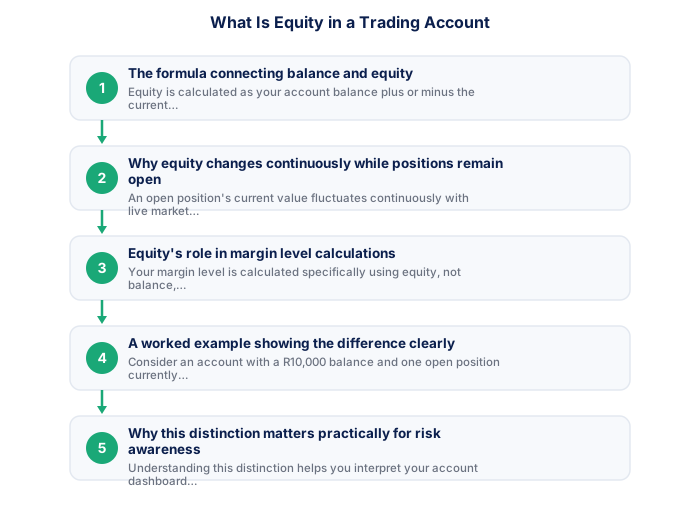
- The formula connecting balance and equity
- Why equity changes continuously while positions remain open
- Equity's role in margin level calculations
- A worked example showing the difference clearly
- Why this distinction matters practically for risk awareness
- Checking your current equity on your specific platform
1. The formula connecting balance and equity
Equity is calculated as your account balance plus or minus the current floating (unrealised) profit or loss of any open positions. If you have no open positions, your equity exactly equals your balance; once you open a position, equity begins fluctuating with that position's current floating result, while balance itself remains unchanged until the position is actually closed.
It's worth internalising this formula until it feels genuinely automatic, since balance and equity are two of the most fundamental figures you'll reference constantly throughout your trading, confusing the two can lead to miscalculating your actual available risk capacity.
2. Why equity changes continuously while positions remain open
An open position's current value fluctuates continuously with live market price movement, meaning your equity figure updates in real time reflecting this ongoing fluctuation, even though your underlying balance figure stays fixed until you actually close that specific position.
See also: Realised vs Unrealised Losses: Key Differences
It's worth checking your equity figure specifically, not just balance, whenever you're assessing your genuine current account status with open positions, discussed elsewhere on this site regarding free margin, since equity reflects your actual, real-time financial position more accurately than the more static balance figure.
- South African ID or valid passport
- Proof of residential address dated within 3 months
- Proof of bank account ownership
- Selfie or photo for biometric verification (some brokers)
- Source of funds declaration if depositing above threshold
Choose FSCA-regulated broker
Verify the FSP number is current at fsca.co.za.
Submit FICA documents
SA ID, proof of address within 3 months, bank account proof.
Fund via EFT
Make the initial deposit from your SA bank account in ZAR.
Open demo account first
Practice on demo before activating your live account.
Start with minimum capital
Begin with an amount you can afford to lose while learning.
3. Equity's role in margin level calculations
Your margin level is calculated specifically using equity, not balance, divided by used margin. This is precisely why a position moving significantly against you can trigger a margin call even if your underlying balance technically remains unchanged, since it's the fluctuating equity figure, reflecting your position's current floating loss, that actually determines this critical risk threshold.
It's worth connecting this directly to the margin call and stop-out mechanics discussed elsewhere on this site, understanding that equity, not balance, drives these critical calculations helps you appreciate why your account's risk status can shift considerably as open positions move, even without any new trading activity.
4. A worked example showing the difference clearly
Consider an account with a R10,000 balance and one open position currently showing a R500 floating loss. Your equity would be R9,500 (R10,000 minus R500), even though your balance remains R10,000 until you actually close that losing position. If the position later moves to show a R200 floating profit instead, your equity would become R10,200, again without your underlying balance changing at all during this fluctuation.
| Scenario | Balance | Floating P&L | Equity |
|---|---|---|---|
| Open position showing a loss | R10,000 | −R500 | R9,500 |
| Same position later shows a profit | R10,000 | +R200 | R10,200 |
It's worth calculating this yourself using your own actual account figures, rather than a generic example, seeing your own genuine balance-versus-equity gap when you have open positions reinforces this distinction more concretely than an abstract illustration alone.
| Rejection reason | Fix |
|---|---|
| Address proof older than 3 months | Get a recent utility bill or bank statement |
| Name mismatch between documents | Use documents with exactly matching full name |
| Poor quality scan | Retake with good lighting, all corners visible |
| PO Box address | Brokers require physical residential address only |
5. Why this distinction matters practically for risk awareness
Understanding this distinction helps you interpret your account dashboard correctly, checking your balance alone while ignoring equity can give a misleadingly stable impression of your account's true current value while open positions are actively fluctuating, potentially significantly, in ways the static balance figure doesn't reflect until those positions are eventually closed.
It's worth building a habit of glancing at equity specifically, alongside balance, as part of your regular account monitoring, discussed elsewhere on this site regarding checking positions during active trading, rather than only checking the more commonly referenced balance figure.
6. Checking your current equity on your specific platform
Most trading platforms display both balance and equity prominently within your account summary, typically updating the equity figure continuously in real time as open position values fluctuate with live market movement.
Your account balance shows settled profits and losses from closed trades. Equity adds your current unrealised P&L from open positions, which is what margin calls and free margin calculations are actually based on.
★ Why It Matters
Something worth checking specifically with your broker: whether their margin call calculation uses your equity at the moment of the calculation or some kind of intraday average, this technical detail can matter during fast-moving conditions where your equity is fluctuating significantly within seconds.
✕ Common mistakes
- Confusing static balance with real-time equity when assessing account health. Balance only updates once a position closes; equity reflects the current floating position.
- Assuming equity and balance are always the same number. They diverge whenever any position is currently open.
- Not monitoring equity continuously while positions remain open. It fluctuates in real time, unlike the more static balance figure.
Key Takeaways
- Equity is your account balance adjusted for the current floating profit or loss of all open positions, reflecting your true current account value.
- This differs from your static balance, which only updates once a position is actually closed.
- The formula connecting balance and equity.
- Why equity changes continuously while positions remain open.
- Equity's role in margin level calculations.
Frequently asked follow-up questions
Does equity ever exceed balance?
Yes, if your open positions show a current floating profit rather than a loss, your equity will exceed your balance until those positions are closed and the profit becomes realised.
Is equity the same as free margin?
No, free margin is your equity minus used margin representing the funds genuinely available for opening additional positions.
Why does my platform show different equity at different moments?
This reflects normal, continuous market price fluctuation affecting your open positions' current floating value, which is precisely what makes equity a dynamic, real-time figure rather than a fixed one.
