i Short answer
POPIA governs how FSCA-regulated brokers must collect, store, and process your personal information, including FICA documents.
This gives you specific legal rights over your trading data.
📋 ON THIS PAGE
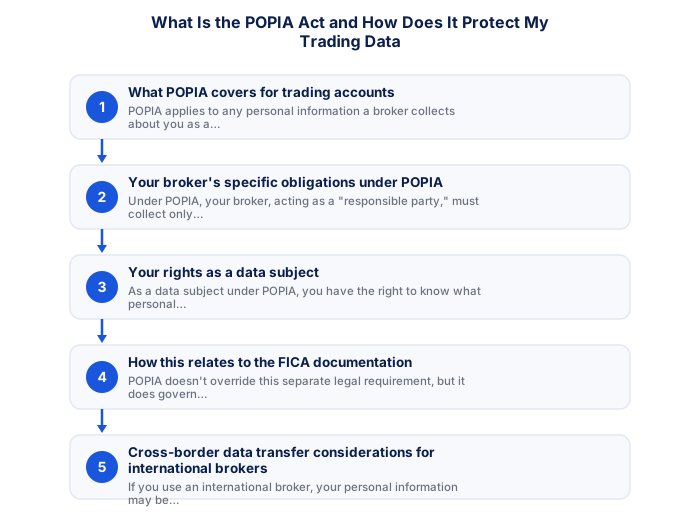
1. What POPIA covers specifically for trading accounts
POPIA applies to any personal information a broker collects about you as a client, including your identity documents, address, banking details, trading history, and any communication records. For a trading account specifically, this means everything from your initial account application through your ongoing trading activity falls within POPIA's scope of protection.
This protection operates alongside, rather than instead of, the broader FSCA regulatory framework, POPIA addresses how your personal information is handled, while FSCA regulation addresses the broker's overall conduct and financial soundness.
South African traders using leveraged instruments should build their risk management framework around the principle that no single trade should be capable of significantly damaging their overall trading capital. This means calculating position sizes before every trade rather than after entry, keeping stop-losses at levels determined by chart structure rather than by the amount you are willing to lose, and reviewing your risk per trade ratio regularly as your account grows or shrinks.
2. Your broker's specific obligations under POPIA
Under POPIA, your broker, acting as a "responsible party," must collect only the personal information genuinely necessary for its stated purposes (account opening, regulatory compliance, ongoing service), process this information securely, and not use it for purposes incompatible with why it was originally collected without your further consent.
This means a broker collecting your ID document for FICA verification, generally cannot then use that same document for an unrelated purpose without separate justification or consent, reflecting the purpose-limitation principle that POPIA establishes as a core protection.
- Search FSP name or number at fsca.co.za
- Confirm licence is current and not suspended
- Check scope covers forex and CFD activity
- Confirm client funds in segregated accounts
- Read FSCA enforcement actions history
- Test customer support before depositing
- Client funds legally segregated
- FSCA complaints process available
- SA consumer protections apply
- ZAR account, no FX conversion costs
- Some offshore brokers offer wider instruments
- Regulatory overhead passed on in spreads
- Stricter position limits for retail clients
- FICA verification required before trading
- Client funds segregated
- Formal FSCA complaints process
- SA consumer protections apply
- ZAR account available
- Fund safety not guaranteed
- Overseas disputes only
- SA law does not apply
- Currency conversion costs
3. Your rights as a data subject
As a data subject under POPIA, you have the right to know what personal information a broker holds about you, to request access to this information, to request correction of inaccurate information, and to request deletion of information the broker is no longer authorised to retain. You can also object to certain types of processing, such as direct marketing, on reasonable grounds.
Exercising these rights typically involves contacting your broker's compliance or support department directly with a specific, clearly stated request, similar to the kind of direct engagement.
4. How this relates to the FICA documentation
As, brokers are legally required to collect and retain certain identity verification documents for anti-money-laundering compliance purposes. POPIA doesn't override this separate legal requirement, but it does govern how securely this FICA documentation must be stored and how long it can reasonably be retained beyond what FICA itself requires.
It's worth appreciating why these two frameworks work together rather than in tension, discussed elsewhere on this site regarding FICA verification specifically, POPIA doesn't prevent brokers from collecting the identity documents FICA requires, it simply governs how that necessarily-collected data must then be protected and used.
| Protection | FSCA Regulated | Offshore Unregulated |
|---|---|---|
| Client fund segregation | ✓ Required | Varies by broker |
| SA complaints process | ✓ Available | ✗ Not available |
| SA consumer law applies | ✓ Yes | ✗ No |
| ZAR account available | ✓ Typically | Often USD/EUR only |
5. Cross-border data transfer considerations for international brokers
If you use an international broker, your personal information may be processed or stored on servers located in a different jurisdiction. POPIA requires that any such cross-border transfer maintain an adequate level of protection broadly equivalent to POPIA's own standards, meaning international brokers serving South African clients should still be applying meaningful data protection safeguards.
It's worth checking your specific broker's data handling disclosures directly if you're using an internationally-headquartered provider, discussed elsewhere on this site regarding local versus international brokers, confirming how your data specifically gets handled across borders where applicable.
6. What to do if you believe your data was mishandled
If you believe a broker has mishandled your personal information, raising this directly with the broker first, similar to the initial step in the broader complaints process, is a reasonable starting point. If unresolved, South Africa's Information Regulator, the body specifically established to oversee POPIA compliance, provides a further avenue for lodging a formal complaint.
If a dispute with the FSCA itself arises, for example over a licensing decision, the Financial Services Tribunal exists as an independent body where such decisions can be formally appealed, separate from the broker complaints process.
POPIA requires brokers to collect only necessary personal data, handle it securely, and notify you and the Information Regulator in the event of a data breach. You have the right to access and correct your data.
★ Why It Matters
Something worth doing once: formally request a copy of all personal data your broker holds on you, POPIA gives you this specific right, and reviewing what's actually held is a useful, concrete way to understand your real data footprint rather than just trusting it's handled appropriately.
✕ Common mistakes
- Assuming all brokers handle personal data with equal diligence. Compliance practices can vary between providers despite shared legal obligations.
- Not knowing your specific rights under this legislation. Understanding these rights helps you act if a concern arises.
- Treating data protection as solely the broker's responsibility with no role for you. Periodically reviewing what's held and how it's used remains a reasonable personal practice.
Key Takeaways
- POPIA governs how FSCA-regulated brokers must collect, store, and process your personal information, giving you specific rights over your trading data.
- POPIA governs how FSCA-regulated brokers must collect, store, and process your personal information, including FICA documents.
- This gives you specific legal rights over your trading data.
- What POPIA covers specifically for trading accounts.
- Your broker's specific obligations under POPIA.
Frequently asked follow-up questions
Does POPIA apply to international brokers serving South African clients?
POPIA's cross-border transfer provisions are relevant here, generally requiring an equivalent standard of protection even when data is processed outside South Africa.
Can I request a broker delete my data after closing my account?
You can request this, though brokers may need to retain certain records for a period to comply with separate FICA or financial recordkeeping obligations.
Is POPIA the same as GDPR?
They share similar underlying principles but are distinct laws; POPIA is South Africa's specific framework, while GDPR applies within the European Union.
Can I find out exactly what personal data a broker holds about me?
Yes, POPIA gives you the right to request access to your own personal information held by any responsible party, including a trading broker, within a reasonable timeframe.
Does POPIA cover information collected through cookies on a broker's website?
Generally yes, online tracking and cookie-based data collection falls within POPIA's broader scope of personal information processing, which is why many broker websites also publish a separate cookie policy.
