i Short answer
The Financial Intelligence Centre is South Africa's body responsible for combating money laundering and terrorist financing.
It receives and analyses suspicious transaction reports from financial institutions, including FSCA-regulated brokers.
📋 ON THIS PAGE
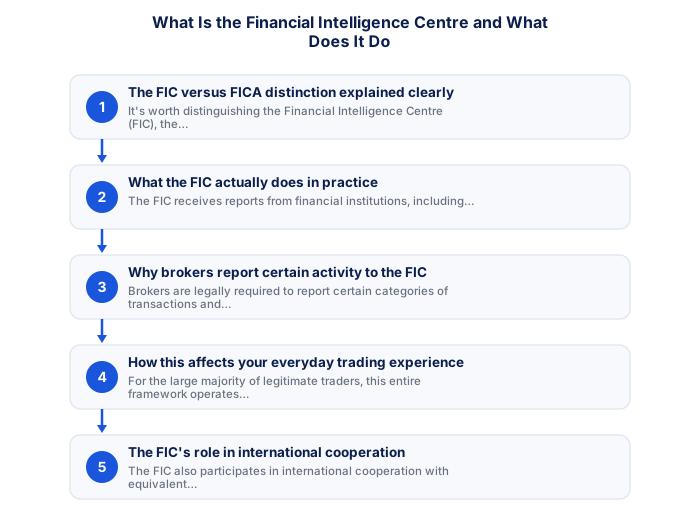
1. The FIC versus FICA distinction explained clearly
It's worth distinguishing the Financial Intelligence Centre (FIC), the institution, from FICA, the Financial Intelligence Centre Act, the legislation that established and enables this institution. The FIC is the body that implements and enforces the broader anti-money-laundering framework that FICA's specific client-verification requirements form one practical part of.
It's worth keeping these clearly distinct in your own understanding, FICA, discussed extensively elsewhere on this site, is the legislation setting out verification requirements, while the FIC is the actual government body established to receive and analyse the resulting reports and broader financial intelligence.
2. What the FIC actually does in practice
The FIC receives reports from financial institutions, including FSCA-regulated brokers, about suspicious or unusual transactions, analyses this information for patterns potentially indicating money laundering or terrorist financing, and shares relevant intelligence with law enforcement and other authorities when warranted. This analytical and intelligence-sharing function sits behind the scenes of everyday trading, generally invisible to legitimate clients going about normal trading activity.
It's worth understanding this as genuinely behind-the-scenes work, the FIC doesn't interact directly with individual traders in normal circumstances, its role operates at the institutional and law enforcement level, analysing patterns across the broader financial system.
- FSCA-regulated broker verified at fsca.co.za
- Demo account tested for minimum 60 days
- Trading plan written: entry, exits, position sizing
- Risk per trade defined (1-2% of account)
- Backup internet connection tested for load shedding
- Tax implications understood
3. Why brokers report certain activity to the FIC
Brokers are legally required to report certain categories of transactions and suspicious activity to the FIC, connecting directly to why FICA verification exists in the first place. Verifying client identity upfront makes it considerably harder for illicit funds to move through the financial system anonymously, supporting the FIC's broader detection and prevention mission.
It's worth understanding that this reporting obligation applies broadly and systematically, not as a targeted response to any specific individual, brokers report certain transaction types as a routine, mandatory compliance practice affecting all clients equally, not as a signal of suspicion about you specifically.
4. How this affects your everyday trading experience
For the large majority of legitimate traders, this entire framework operates invisibly, your broker completes FICA verification once during account opening, and your normal trading and withdrawal activity proceeds without any direct interaction with the FIC. This system is specifically designed to filter for genuinely unusual or suspicious patterns, not to create friction for ordinary, legitimate trading activity.
It's worth appreciating that for the overwhelming majority of legitimate retail traders, this entire system operates invisibly, the FIC's existence and function shouldn't meaningfully affect your genuine, ordinary trading experience at all.
| Item | Detail |
|---|---|
| Regulator | FSCA, fsca.co.za |
| Exchange control | SARB, resbank.co.za |
| Tax authority | SARS, sars.gov.za |
| JSE hours | 09:00-17:00 SAST Mon-Fri |
| Best forex session | 15:00-17:00 SAST |
| CGT annual exclusion | R50,000 (individuals) |
5. The FIC's role in international cooperation
The FIC also participates in international cooperation with equivalent financial intelligence bodies in other countries, reflecting the genuinely global nature of money laundering and terrorist financing risks, which often involve cross-border fund movement. This international dimension connects to the broader SARB exchange control framework, both forming part of South Africa's overall approach to monitoring cross-border financial flows.
It's worth understanding this international dimension as part of a broader, global effort against financial crime, discussed elsewhere on this site regarding South Africa's regulatory framework generally, rather than something specific or unique to South African trading.
6. What this means practically for legitimate, everyday traders
Practically, understanding the FIC's role helps explain why your broker asks for thorough documentation during account opening and why certain unusually large or unusual transactions might occasionally trigger additional verification questions, these aren't arbitrary broker policies, but reflect this broader, legally mandated anti-money-laundering framework that exists to protect the financial system's integrity, ultimately benefiting all legitimate participants within it.
If a dispute with the FSCA itself arises, for example over a licensing decision, the Financial Services Tribunal exists as an independent body where such decisions can be formally appealed, separate from the broker complaints process.
The Financial Intelligence Centre collects and analyses financial data to detect money laundering and terrorism financing. Brokers are accountable institutions that must report suspicious activity and verify customer identity.
★ Why It Matters
Worth knowing specifically: the FIC itself doesn't handle individual trader complaints about broker conduct, that's the FSCA's role, a common point of confusion given how often both bodies get mentioned together in regulatory discussions despite serving genuinely different functions.
✕ Common mistakes
- Confusing the FIC's anti-money-laundering mandate with general broker oversight. These are genuinely different regulatory functions, despite both bodies being frequently mentioned together.
- Assuming FICA verification requirements and FIC complaints handling are the same process. FICA is the legislation; the FIC is one specific body within the broader compliance framework.
- Not knowing which regulatory body handles which specific type of concern. This distinction saves time when an actual issue arises.
Key Takeaways
- The Financial Intelligence Centre combats money laundering and terrorist financing, working alongside FICA requirements that brokers must follow.
- The Financial Intelligence Centre is South Africa's body responsible for combating money laundering and terrorist financing.
- It receives and analyses suspicious transaction reports from financial institutions, including FSCA-regulated brokers.
- The FIC versus FICA distinction explained clearly.
- What the FIC actually does in practice.
Frequently asked follow-up questions
Will I be contacted directly by the FIC as a normal trader?
This is highly unlikely for legitimate trading activity; the FIC's interaction is primarily with financial institutions themselves, not directly with individual clients in normal circumstances.
Does FIC reporting mean my broker suspects me of wrongdoing?
No, certain transaction types or thresholds can trigger routine reporting requirements regardless of any actual suspicion, as part of standard regulatory compliance.
Is the FIC the same as the FSCA?
No, they are distinct bodies with different mandates; the FSCA regulates financial services conduct broadly, while the FIC focuses specifically on anti-money-laundering and counter-terrorist-financing.
Can I access the FIC's reports about specific suspicious transactions?
No, these reports and the FIC's underlying analysis are confidential and not accessible to the public or to the individual clients whose transactions may have been reported.
Does the FIC only deal with large transactions?
Not exclusively; while large transactions can attract attention, the FIC's reporting framework also covers patterns of unusual activity that may be flagged regardless of the specific transaction size involved.
