i Short answer
Financial advisors are specifically FSCA-licensed to give personalised financial advice designed for your individual circumstances.
Trading educators provide general education without this specific regulatory status or accountability.
📋 ON THIS PAGE
- What FSCA-licensed advice actually means
- What trading educators are permitted to do instead
- The key distinction: personalised versus general content
- Why this distinction carries real accountability implications
- How to tell which category a specific person falls into
- Why some educators blur this line, deliberately or not
1. What FSCA-licensed advice actually means
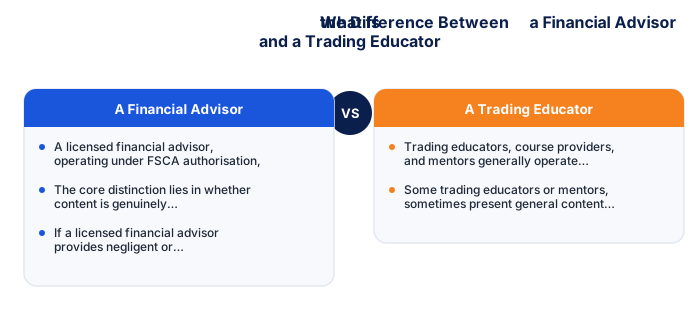
A licensed financial advisor, operating under FSCA authorisation, is permitted and accountable for providing advice specifically designed for an individual client's personal financial situation, goals, and risk tolerance, with this advice subject to specific regulatory standards, recordkeeping requirements, and a defined complaints and accountability framework if that advice proves negligent or unsuitable.
This accountability is precisely what you're paying for, implicitly or explicitly, when you engage a licensed advisor: a formal relationship where the advice given is documented, expected to reflect your actual disclosed circumstances, and subject to a genuine complaints process if it turns out to have been unsuitable or negligent, rather than simply general commentary you happened to hear at the right time.
2. What trading educators are permitted to do instead
Trading educators, course providers, and mentors generally operate outside this specific licensing framework, providing general educational content, market commentary, and skill-building instruction without the specific regulatory status, individualised suitability assessment, or accountability structure that licensed financial advice carries.
This isn't a lesser or illegitimate category, most trading education, including much of what a site like this one provides, falls squarely and appropriately here. The distinction matters for setting accurate expectations about accountability, not for judging the value or quality of the educational content itself.
- FSCA-regulated broker verified at fsca.co.za
- Demo account tested for minimum 60 days
- Trading plan written: entry, exits, position sizing
- Risk per trade defined (1-2% of account)
- Backup internet connection tested for load shedding
- Tax implications understood
3. The key distinction: personalised versus general content
The core distinction lies in whether content is genuinely personalised to your specific situation (financial advice, requiring licensing) versus general education applicable broadly to anyone learning the same concepts (trading education, not requiring this specific licensing), a course teaching general risk management principles differs meaningfully from someone reviewing your personal finances and recommending a specific, tailored course of action.
A useful test: does the content or advice depend on knowing specific details about your personal financial situation, income, existing investments, risk tolerance, goals, to be genuinely appropriate? If yes, that's the territory of licensed advice. If the same content would be equally valid for any reader regardless of their personal circumstances, that's general education, whatever confident tone it might be delivered in.
| Aspect | Licensed Financial Advisor (FSP) | Trading Educator |
|---|---|---|
| FSCA licence required | Yes: Category I or II FSP | No: not providing advice |
| Can give personalised advice | Yes | No: general education only |
| Legal accountability for outcomes | Yes: bound by FAIS | No |
| Can recommend specific instruments | Yes, within scope of licence | No |
| Can manage your money | Yes, if Category II licensed | No |
| Complaint mechanism | FSCA complaints process | Consumer court, CGSO: limited |
| Disclosure obligations | Mandated by FAIS | None formally required |
| Typical offering | Financial plan, product recommendation | Courses, webinars, strategies |
4. Why this distinction carries real accountability implications
If a licensed financial advisor provides genuinely negligent or unsuitable personalised advice, regulatory and legal accountability mechanisms exist. If a trading educator's general content doesn't suit your specific situation, this same accountability framework typically doesn't apply in the same way, since they were never operating under that specific licensed advisory relationship in the first place.
This is worth internalising before, not after, following guidance from either source. Treating general educational content as though it carries the same personalised accountability as licensed advice sets up an expectation that source was never actually positioned to meet, regardless of how confidently or specifically that content might have been presented.
| Item | Detail |
|---|---|
| Regulator | FSCA, fsca.co.za |
| Exchange control | SARB, resbank.co.za |
| Tax authority | SARS, sars.gov.za |
| JSE hours | 09:00-17:00 SAST Mon-Fri |
| Best forex session | 15:00-17:00 SAST |
| CGT annual exclusion | R50,000 (individuals) |
5. How to tell which category a specific person falls into
Checking whether someone explicitly claims to be providing personalised financial advice (requiring FSCA licensing, verifiable through the official register) versus general trading education (not requiring this specific license) helps clarify which category genuinely applies, with explicit, verifiable licensing claims warranting direct confirmation through official channels.
It's worth being specifically suspicious of anyone who implies licensed-advisor-level accountability, phrases like 'I'll manage this specifically for your situation' or 'trust me with your account,' without being able to point to an active FSCA licence covering that kind of individualised advisory relationship when checked against the official register.
6. Why some educators blur this line, deliberately or not
Some trading educators or mentors, sometimes present general content in ways that feel personalised or imply a level of tailored, accountable guidance they're not actually licensed or positioned to provide, recognising this distinction helps you understand exactly what kind of relationship and accountability you're genuinely engaging with.
This blurring isn't always deliberate manipulation, sometimes it reflects genuine enthusiasm and a sincere desire to help that inadvertently overstates the nature of the relationship. Regardless of intent, the practical protection is the same: verifying licensing status directly through the FSCA register rather than relying on how confident or personally invested someone's guidance happens to feel.
A financial advisor is an FSP under FAIS with a fiduciary duty. A trading educator provides general education without regulatory obligation to you personally. If an educator provides specific trade advice for payment, they may need an FSP.
★ Why It Matters
Worth checking specifically before paying anyone for guidance: search their name against the FSCA's register of authorised representatives, this single check immediately clarifies whether you're dealing with someone formally licensed to give personalised advice or someone providing general education only.
✕ Common mistakes
- Treating general education as equivalent to personalised financial advice. These carry genuinely different legal status and accountability.
- Not checking this distinction before paying for guidance. A simple registry check clarifies what kind of service you're actually receiving.
- Assuming confident, detailed guidance implies formal licensing. Confidence and licensing status are independent things worth verifying separately.
Key Takeaways
- Financial advisors are FSCA-licensed to give personalised financial advice, while trading educators provide general education without this regulatory status.
- Financial advisors are specifically FSCA-licensed to give personalised financial advice designed for your individual circumstances.
- Trading educators provide general education without this specific regulatory status or accountability.
- What FSCA-licensed advice actually means.
- What trading educators are permitted to do instead.
See also: Is AvaTrade Regulated by the FSCA in South Africa? and Is Forex Trading a Pyramid Scheme in South Africa?.
Frequently asked follow-up questions
Can a trading educator also be a licensed financial advisor?
Yes, some individuals hold both roles, though this requires genuine FSCA licensing for the advisory component specifically, verifiable through the official FSCA register.
Does a mentor need to disclose if they're not a licensed advisor?
There's no universal requirement for this specific disclosure, making it worthwhile to ask directly and verify independently rather than assuming this status either way.
Is general trading education illegal without FSCA licensing?
No, providing general educational content doesn't require this specific licensing; the licensing requirement applies to personalised financial advice.
If a course includes a one-on-one review of my own portfolio, does that cross into advice?
It can, depending on how specific and tailored the guidance becomes; a genuinely personalised recommendation about your own holdings starts to resemble advice rather than general education.
Can I ask a financial advisor general trading questions without it counting as formal advice?
Casual, general questions are typically fine, but once the response becomes a specific recommendation designed for your circumstances, it likely falls within the formal advisory relationship described above.
