i Short answer
Most traders, particularly beginners, benefit from focusing on just one or two currency pairs initially, developing genuine depth of understanding before expanding.
📋 ON THIS PAGE
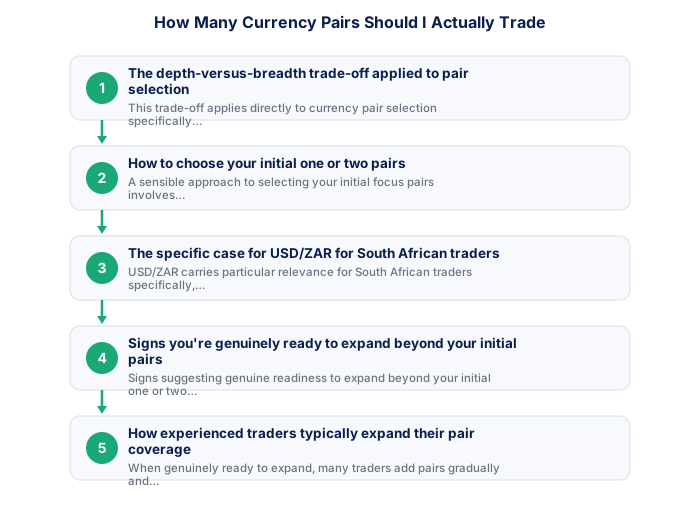
- The depth-versus-breadth trade-off applied to pair selection
- How to choose your initial one or two pairs
- The specific case for USD/ZAR for South African traders
- Signs you're genuinely ready to expand beyond your initial pairs
- How experienced traders typically expand their pair coverage
- Avoiding the temptation to chase opportunities across every pair
1. The depth-versus-breadth trade-off applied to pair selection
There's a genuine trade-off between developing deep understanding of a small number of instruments versus spreading attention across many. This applies directly to currency pair selection: each pair has its own volatility characteristics, typical session patterns, and relevant fundamental drivers, all of which take real time and attention to understand well.
Trying to track and trade many pairs at once as a newer trader often means only a surface-level grasp of each, rather than the deep, pattern-recognition-building familiarity that trading skill actually requires time to build.
It's worth thinking of this as the same underlying trade-off that applies to trading style selection generally, discussed throughout this site, focused depth on a smaller number of instruments tends to produce more genuine, applicable expertise than spreading attention thinly across many, in trading pairs just as in most other skill-based pursuits.
2. How to choose your initial one or two pairs
A sensible way to pick your first pair or two: genuine personal interest or relevance (which makes sustained attention easier), liquidity and cost (favouring more liquid, lower-cost major pairs for most beginners), and how well the pair's typical volatility and session timing fit your intended trading style.
Many beginners start with a major pair like EUR/USD, given its favourable liquidity and cost, sometimes alongside USD/ZAR given its direct relevance to South African traders.
| Lot type | Size | USD/ZAR pip value | Min recommended account |
|---|---|---|---|
| Standard | 100,000 units | ~R1.00 | R100,000+ |
| Mini | 10,000 units | ~R0.10 | R10,000+ |
| Micro | 1,000 units | ~R0.01 | R1,000+ |
| Nano | 100 units | ~R0.001 | R100+ |
- V = Pip value in account currency
- E = Current exchange rate of quote vs account currency
- L = Lot size (100,000 standard / 10,000 mini / 1,000 micro)
- USD/ZAR example = 1 pip = R1 per standard lot
- Leveraged instrument
- Long and short available
- Overnight financing applies
- No ownership of asset
- Typically unleveraged
- Physical currency received
- No daily financing
- Currency ownership
It's worth writing down your specific reasoning for choosing a given pair, rather than picking somewhat arbitrarily, having a clear, articulated reason, whether it's liquidity, personal relevance, or genuine analytical interest, helps you stay committed to genuinely developing depth with that pair rather than abandoning it prematurely for something that seems more exciting.
3. The specific case for USD/ZAR for South African traders
USD/ZAR carries particular relevance for South African traders given its direct connection to local economic conditions, and the familiarity South African traders likely already have with the relevant local context (SARB policy, domestic political developments) that directly affects this pair.
That existing context can give you a genuine head start on building the kind of deep, pair-specific understanding covered above, compared to starting from scratch with a pair involving currencies and economies less familiar from daily life.
4. Signs you're genuinely ready to expand beyond your initial pairs
Signs you're ready to expand beyond your initial pair or two: consistent trading discipline and reasonable results on your current pairs over a decent sample of trades, genuine spare capacity and interest in tracking more fundamental and technical context, and a clear reason for wanting to add a specific pair, not expansion just for its own sake.
It's worth reviewing your trading journal specifically for evidence of these readiness signs, rather than relying on a general sense that you're ready, concrete, documented evidence of consistent discipline and pattern recognition on your current pairs gives a more reliable basis for this decision than intuition alone.
5. How experienced traders typically expand their pair coverage
When ready to expand, many traders add pairs gradually and deliberately, perhaps one at a time, letting real depth develop with each addition before considering further expansion, rather than adding several new pairs at once, which risks recreating the same surface-level-understanding problem a bit further down the road.
It's worth applying the same patience to each new addition that you applied to your original pair or two, resisting the temptation to add several new pairs simultaneously once you've decided you're ready to expand, since that risks recreating the same shallow, unfocused coverage this entire approach was designed to avoid.
6. Avoiding the temptation to chase opportunities across every pair
A common temptation, especially for newer traders, is constantly scanning many different pairs for whatever looks most attractive at any given moment, rather than patiently waiting for genuine, criteria-meeting setups within a deliberately limited, well-understood pair selection.
Resisting that temptation, and accepting that a deliberately limited focus means missing some opportunities elsewhere in the market, reflects the same disciplined patience that matters for sustainable, sound trading practice over time.
Focusing deeply on 1-3 core pairs tends to produce better outcomes than spreading attention across many. Knowing a pair's quirks and session behaviour requires sustained, regular observation.
★ Why It Matters
Worth testing directly on yourself: track your win rate separately for each pair you trade over a few dozen trades, many traders discover a meaningful gap between their best and worst pair's performance, information that's invisible if all trades get lumped into one overall statistic.
✕ Common mistakes
- Trading many pairs at once before developing genuine depth in any. Beginners especially benefit from focusing on one or two pairs initially.
- Assuming performance is identical across all your traded pairs. Win rate often varies more between pairs than traders realise until measured.
- Adding new pairs without checking your overall correlation exposure. More pairs doesn't automatically mean more diversification.
- Not tracking results per pair separately in your trading journal. Lumping all trades together hides meaningful per-pair performance differences.
Key Takeaways
- Most traders benefit from focusing on just one or two pairs initially, developing genuine depth before considering expansion to additional pairs.
- Most traders, particularly beginners, benefit from focusing on just one or two currency pairs initially, developing genuine depth of understanding before expanding.
- The depth-versus-breadth trade-off applied to pair selection.
- How to choose your initial one or two pairs.
- The specific case for USD/ZAR for South African traders.
Frequently asked follow-up questions
Is it ever necessary to trade many pairs simultaneously?
Generally not, for most retail trading styles. Some advanced or institutional strategies do track many pairs, but it isn't required for sound, profitable retail trading.
Should I switch pairs if my current one isn't performing well?
Switching pairs frequently can prevent the depth-building above. First honestly assess whether the issue is actually pair-specific, or more about strategy execution and discipline.
Does focusing on one pair limit my long-term trading potential?
Not significantly. Many experienced, successful traders keep focusing primarily on a small number of well-understood pairs throughout their careers, rather than necessarily expanding over time.
