i Short answer
Eskom debt relief plans shift significant financial burden onto government finances directly, connecting to broader fiscal sustainability and credit rating dynamics.
📋 ON THIS PAGE
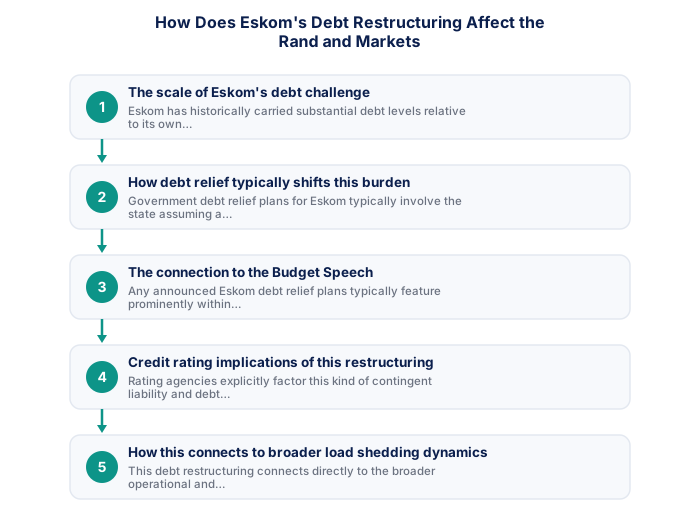
1. The scale of Eskom's debt challenge
Eskom has historically carried substantial debt levels relative to its own revenue generation capacity, one of several state-owned enterprises affecting the South African economy, creating an ongoing financial sustainability challenge that has required various forms of government intervention and support over time.
It's worth checking current, up-to-date figures directly from reputable South African financial media rather than relying on a fixed figure that quickly becomes outdated, since Eskom's specific debt levels and restructuring progress shift over time as government interventions and Eskom's own operational performance evolve.
2. How debt relief typically shifts this burden
Government debt relief plans for Eskom typically involve the state assuming a portion of this debt directly, effectively converting Eskom's corporate debt burden into broader government debt, directly affecting overall government fiscal sustainability metrics tracked closely around the Budget Speech and fiscal deficit figures.
It's worth understanding why this shift matters specifically for currency and market sentiment, moving debt from Eskom's balance sheet to the sovereign's doesn't make the underlying obligation disappear, it simply relocates which entity's creditworthiness that obligation now more directly affects, worth appreciating as a genuine transfer rather than a resolution.
See also: Why Does SA's Current Account Deficit Matter?
- SARB economic calendar checked for the week
- Next Eskom load shedding schedule reviewed
- GNU stability news reviewed
- Stats SA data releases noted
- Credit agency review dates checked
- US/global events that move EM risk noted
3. The connection to the Budget Speech
Any announced Eskom debt relief plans typically feature prominently within the annual Budget Speech, since this kind of debt assumption directly affects the broader fiscal deficit and debt trajectory figures markets and credit rating agencies closely monitor.
It's worth reading the specific Eskom-related sections of Budget Speech coverage carefully rather than only the headline figures, the detailed terms and conditions attached to any debt relief plan often matter as much to market interpretation as the headline amount itself.
| Event | Frequency | ZAR impact | Source |
|---|---|---|---|
| SARB MPC | 6x per year | High | resbank.co.za |
| Budget Speech | Annual (February) | Very high | treasury.gov.za |
| Credit reviews | Annual each agency | Very high | Agency sites |
| Stats SA CPI | Monthly | Medium | statssa.gov.za |
| Eskom stage | As needed | Low-medium | eskomsepush.com |
- SA context provides genuine informational edge
- ZAR pairs accessible via FSCA brokers in ZAR accounts
- Rand volatility creates larger intraday ranges
- 6 SARB meetings/year create regular macro setups
- Higher geopolitical risk than G10 pairs
- Load shedding creates unique operational disruptions
- SA rand liquidity thinner than major G10 pairs
- SA-specific news requires constant local monitoring
4. Credit rating implications of this restructuring
Rating agencies explicitly factor this kind of contingent liability and debt assumption into their broader creditworthiness assessment of South Africa, meaning significant Eskom debt relief announcements can directly feed into credit rating dynamics and associated currency effects.
It's worth following any rating agency commentary specifically issued around major Eskom restructuring announcements, these agencies often publish explicit statements explaining how a specific development factors into their assessment, giving you direct insight into professional analytical thinking on this exact question.
5. How this connects to broader load shedding dynamics
This debt restructuring connects directly to the broader operational and financial challenges around load shedding's effect on the Rand and markets, since resolving Eskom's debt burden is often viewed as connected to the utility's broader capacity to invest in and maintain reliable electricity generation infrastructure.
It's worth tracking both the financial restructuring progress and the operational, load-shedding-related progress together rather than separately, since genuine improvement on one front without corresponding improvement on the other tends to produce a more mixed, complicated market and Rand reaction than either factor moving in isolation.
6. Tracking this as part of broader fundamental analysis
South African traders following USD/ZAR benefit from tracking significant Eskom debt restructuring announcements and developments as one important input within broader fundamental analysis, alongside credit rating, fiscal, and load shedding factors.
South Africa's macroeconomic data is closely monitored by international rating agencies and institutional investors whose assessments directly affect the rand and SA bond yields. The most useful analytical habit for ZAR traders is tracking not just the absolute level of each data release but how it compares to market consensus expectations, because it is the surprise component, not the level, that drives the immediate market reaction. The Stats SA release calendar, SARB quarterly bulletin, and National Treasury's monthly statements are the primary official sources for this data before it is summarised in financial media.
How that relief is actually funded matters more for market reaction.
How Eskom debt relief is actually funded matters more for market reaction than the headline figure alone. Funding that shifts cost onto the fiscus tends to weigh more heavily.
★ Why It Matters
Worth watching around Budget Speech season: the market's reaction to Eskom-related announcements tends to hinge less on the headline debt figure and more on whether the funding mechanism shifts cost onto the already-strained fiscus or genuinely off it.
✕ Common mistakes
- Reacting to debt headline figures without checking the funding mechanism. How the relief is funded matters more than the headline number alone.
- Ignoring the Budget Speech timing when Eskom news breaks. These topics often connect directly around fiscal announcements.
- Assuming all SOE debt relief announcements have the same market impact. Funding structures that shift cost onto the fiscus tend to weigh more heavily.
- Not tracking credit rating agency commentary on this specific issue. Rating agencies often respond directly to how restructuring is funded.
How do the outages affect trading alongside Eskom's debt?
The debt moves the rand through fiscal risk; the outages move your ability to trade it at all. One is a market input, the other an operational constraint. Load shedding and your trading day covers the second.
South Africa's financial markets have structural characteristics that differentiate them from the global trading environment covered in most international trading education resources. The JSE's significant weighting toward resources and mining companies means it responds differently to global commodity cycles than more diversified international indices. USD/ZAR's dual sensitivity to global EM risk appetite and domestic SA fundamentals creates a richer analytical environment for traders who are willing to develop both dimensions of analysis, rather than relying solely on technical charts that ignore the fundamental context entirely.
South Africa's macroeconomic indicators are closely monitored by the international institutions and credit rating agencies whose assessments directly affect the rand and SA bond yields. Traders who follow South African economic data regularly develop an intuitive feel for how the data compares to market expectations, which is the key driver of market reaction rather than the absolute level of the indicator. The Stats SA release calendar, the SARB quarterly bulletin, and National Treasury's monthly expenditure statements are the primary official sources that provide this data before it is widely summarised in financial media.
Key Takeaways
- Eskom debt relief plans shift financial burden onto government finances, connecting directly to the fiscal and credit rating dynamics discussed throughout this site.
- Eskom debt relief plans shift significant financial burden onto government finances directly, connecting to broader fiscal sustainability and credit rating dynamics.
- The scale of Eskom's debt challenge.
- How debt relief typically shifts this burden.
- The connection to the Budget Speech.
Frequently asked follow-up questions
Has Eskom received debt relief in the past?
Various forms of government support and debt relief discussions have occurred over recent years. Checking current government and Treasury publications gives the most accurate, up-to-date information.
Does Eskom debt relief always weaken the Rand?
Not automatically or immediately. The market reaction depends on how this compares to prior expectations, rather than the announcement alone in isolation.
Are other state-owned enterprises facing similar debt challenges?
Some other SOEs have faced their own financial challenges, though Eskom's situation has received particularly extensive attention given its scale and critical infrastructure role.
