i Short answer
State-owned enterprise financial health affects government fiscal pressure and broader investor confidence, indirectly influencing Rand sentiment, particularly when bailouts become necessary.
📋 ON THIS PAGE
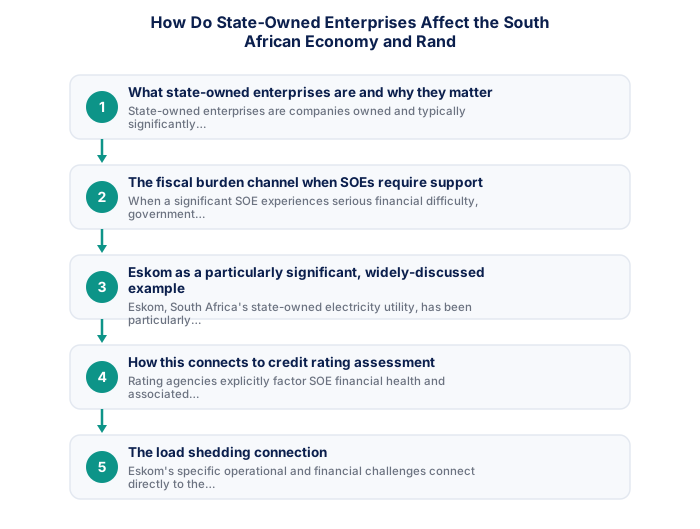
1. What state-owned enterprises are and why they matter
State-owned enterprises are companies owned and typically significantly controlled by government, operating across various sectors including energy, transport, and other infrastructure-related areas. Given their government ownership, their financial health carries direct implications for broader government finances and fiscal sustainability, distinct from how privately-owned companies' financial difficulties would typically be contained.
It's worth understanding why these entities carry outsized economic significance beyond their individual balance sheets, several major South African SOEs operate in genuinely foundational sectors, electricity, transport, that much of the broader economy depends on functioning reliably, meaning their financial or operational struggles ripple outward considerably further than a typical private company's difficulties would.
For related context, see Transnet's freight logistics crisis, dedicated coverage of Transnet's market impact.
See also: How Do Sovereign Credit Rating Reviews Affect the Rand?
2. The fiscal burden channel when SOEs require support
When a significant SOE experiences serious financial difficulty, government often faces pressure to provide financial support or guarantees to prevent broader economic disruption, given these entities' typically critical infrastructure role. This support directly affects government fiscal position, potentially affecting the credit rating and currency dynamics.
It's worth tracking this specific dynamic through South African budget announcements and fiscal updates, discussed elsewhere on this site regarding budget speech effects, since the scale of government support committed to struggling SOEs is precisely the kind of concrete figure that meaningfully affects fiscal outlook and, by extension, Rand sentiment.
- SARB economic calendar checked for the week
- Next Eskom load shedding schedule reviewed
- GNU stability news reviewed
- Stats SA data releases noted
- Credit agency review dates checked
- US/global events that move EM risk noted
3. Eskom as a particularly significant, widely-discussed example
Eskom, South Africa's state-owned electricity utility, has been particularly significantly discussed regarding this dynamic, given its substantial debt levels and critical infrastructure role, with its financial challenges and the associated load shedding both carrying genuine relevance to broader fiscal and currency sentiment.
It's worth following Eskom-specific news through reputable South African financial media specifically, given how frequently referenced this particular entity is in broader economic commentary, staying reasonably current on Eskom developments gives useful context for interpreting a meaningful share of South African economic and market news generally.
| Event | Frequency | ZAR impact | Source |
|---|---|---|---|
| SARB MPC | 6x per year | High | resbank.co.za |
| Budget Speech | Annual (February) | Very high | treasury.gov.za |
| Credit reviews | Annual each agency | Very high | Agency sites |
| Stats SA CPI | Monthly | Medium | statssa.gov.za |
| Eskom stage | As needed | Low-medium | eskomsepush.com |
- SA context provides genuine informational edge
- ZAR pairs accessible via FSCA brokers in ZAR accounts
- Rand volatility creates larger intraday ranges
- 6 SARB meetings/year create regular macro setups
- Higher geopolitical risk than G10 pairs
- Load shedding creates unique operational disruptions
- SA rand liquidity thinner than major G10 pairs
- SA-specific news requires constant local monitoring
4. How this connects to credit rating assessment
Rating agencies explicitly factor SOE financial health and associated contingent fiscal liability into their broader creditworthiness assessment, meaning significant SOE-related developments can directly feed into the credit rating dynamics and associated currency effects.
It's worth checking South Africa's current credit rating status periodically from the major agencies directly, rather than relying on secondhand summaries, since SOE-related fiscal risk is explicitly one of the factors these agencies weigh when determining and reviewing the country's rating.
5. The load shedding connection
Eskom's specific operational and financial challenges connect directly to the broader load shedding dynamic, illustrating how SOE-specific issues and broader economic effects often interconnect rather than operating as entirely separate, isolated factors.
It's worth appreciating this as a genuine, illustrative example of how interconnected South African economic factors tend to be, rather than isolated, independent issues, an SOE's specific operational challenges, broader economic growth, fiscal health, and currency sentiment are all genuinely linked through mechanisms like this one, worth keeping in mind when analysing any single factor in isolation.
6. Tracking SOE developments as part of broader fundamental analysis
South African traders following USD/ZAR specifically benefit from tracking significant SOE-related news and developments, particularly regarding major entities like Eskom, as one input within the broader fundamental analysis, alongside SARB policy, credit rating considerations, and the other factors.
This connects directly to the SARB's Monetary Policy Committee (MPC), which meets several times a year to set the repo rate, decisions that ripple through borrowing costs, the Rand, and market sentiment well beyond the immediate announcement.
Eskom's specific operational and financial challenges connect directly to broader load shedding effects, while rating agencies explicitly factor SOE financial health into sovereign risk assessments.
★ Why It Matters
Worth tracking specifically if you trade ZAR: scheduled SOE financial results and any mention of additional government guarantees tend to move sentiment more directly than the underlying operational news itself, the market reacts to the fiscal exposure implied, not the operational details.
✕ Common mistakes
- Reacting to every SOE headline as equally market-moving. Fiscal exposure and guarantee implications matter more than routine operational news.
- Ignoring the connection between SOE debt and the broader fiscus. This connection often drives sentiment more than the operational headlines themselves.
- Assuming SOE issues affect the Rand independently of Budget Speech timing. These topics often interact directly around fiscal announcements.
- Not distinguishing between funding mechanisms when assessing market impact. Some funding approaches add more fiscal strain than others.
How do the outages affect trading on top of the fiscal risk?
State-owned enterprise risk prices into the rand and the bond curve; the outages themselves break connectivity. Load shedding and your trading day covers that part.
Key Takeaways
- State-owned enterprise financial health affects government fiscal pressure and broader investor confidence, indirectly influencing Rand sentiment over time.
- State-owned enterprise financial health affects government fiscal pressure and broader investor confidence, indirectly influencing Rand sentiment, particularly when bailouts become necessary.
- What state-owned enterprises are and why they matter.
- The fiscal burden channel when SOEs require support.
- Eskom as a particularly significant, widely-discussed example.
Frequently asked follow-up questions
Are there other significant state-owned enterprises beyond Eskom worth tracking?
Yes, various other SOEs across sectors including transport and other infrastructure areas carry their own significance, though Eskom has historically received particularly extensive discussion.
Does SOE debt directly become part of South Africa's national debt figures?
This depends on the specific guarantee and support structure involved. Significant government guarantees can create contingent liability relevant to overall fiscal assessment.
Can positive SOE reform news support the Rand?
Genuine, credible reform progress can support improved investor confidence and credit rating assessment, potentially contributing to more favourable currency sentiment over time.
