i Short answer
China's role as one of South Africa's largest trading partners and a major commodity buyer means Chinese economic data and demand trends can meaningfully influence Rand sentiment.
📋 ON THIS PAGE
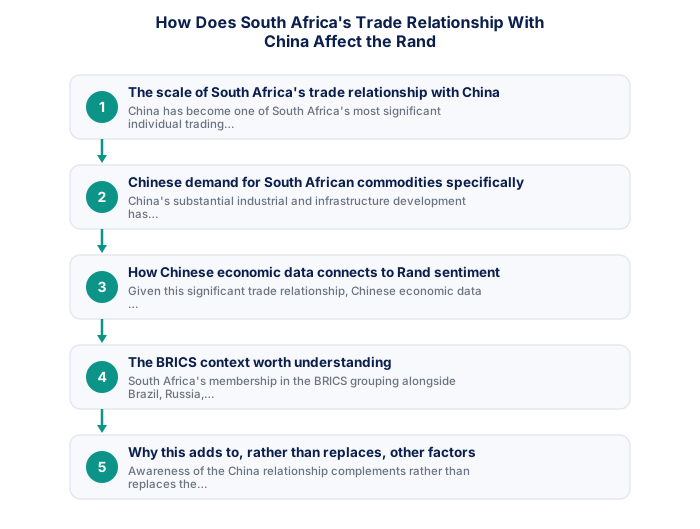
- The scale of South Africa's trade relationship with China
- Chinese demand for South African commodities specifically
- How Chinese economic data connects to Rand sentiment
- The BRICS context worth understanding
- Why this adds to, rather than replaces, other factors
- Practical implications for traders tracking this relationship
1. The scale of South Africa's trade relationship with China
China has become one of South Africa's most significant individual trading partners over recent decades, reflecting both substantial Chinese demand for South African exports and significant Chinese goods flowing into the South African market, making this bilateral relationship genuinely significant within South Africa's broader trade balance.
It's worth checking current, updated trade statistics directly from official sources periodically, rather than relying on a fixed historical impression, since the relative scale and character of this relationship has continued evolving and specific current figures give a more accurate picture than a general sense of 'China is important.'
2. Chinese demand for South African commodities specifically
China's substantial industrial and infrastructure development has historically driven significant demand for various commodities South Africa exports, connecting Chinese economic growth and demand trends directly to South African export revenue and, by extension, the broader Rand sentiment.
It's worth cross-referencing this specifically against the commodity currency discussion elsewhere on this site, since Chinese demand is one of the significant global drivers behind the commodity price trends that directly affect Rand sentiment through the mechanisms already discussed there.
See also: How Does SA's BRICS Membership Affect the Rand?
- SARB economic calendar checked for the week
- Next Eskom load shedding schedule reviewed
- GNU stability news reviewed
- Stats SA data releases noted
- Credit agency review dates checked
- US/global events that move EM risk noted
South Africa's financial markets have unique characteristics that differentiate them from the global trading environment covered in most trading education resources. The JSE's heavy weighting toward mining and resources companies means it behaves differently from broad equity indices in other markets. USD/ZAR's sensitivity to domestic political and infrastructure factors creates analytical opportunities for traders who follow South African news closely. Building a market knowledge base that includes SA-specific factors alongside global macroeconomic context gives local traders a genuine informational edge.
3. How Chinese economic data connects to Rand sentiment
Given this significant trade relationship, Chinese economic data, particularly growth figures and manufacturing or industrial activity indicators, can carry meaningful relevance for South African traders specifically following USD/ZAR, since weakening Chinese demand could translate into reduced demand for South African commodity exports, affecting the broader trade balance and currency dynamics.
It's worth adding major Chinese data releases to your broader economic calendar awareness, discussed elsewhere on this site, even though your primary focus may be South African and US data, since significant Chinese growth or manufacturing data can meaningfully affect Rand sentiment through this trade relationship channel.
| Event | Frequency | ZAR impact | Source |
|---|---|---|---|
| SARB MPC | 6x per year | High | resbank.co.za |
| Budget Speech | Annual (February) | Very high | treasury.gov.za |
| Credit reviews | Annual each agency | Very high | Agency sites |
| Stats SA CPI | Monthly | Medium | statssa.gov.za |
| Eskom stage | As needed | Low-medium | eskomsepush.com |
- SA context provides genuine informational edge
- ZAR pairs accessible via FSCA brokers in ZAR accounts
- Rand volatility creates larger intraday ranges
- 6 SARB meetings/year create regular macro setups
- Higher geopolitical risk than G10 pairs
- Load shedding creates unique operational disruptions
- SA rand liquidity thinner than major G10 pairs
- SA-specific news requires constant local monitoring
4. The BRICS context worth understanding
South Africa's membership in the BRICS grouping alongside Brazil, Russia, India, and China reflects this broader relationship within a wider geopolitical and economic cooperation framework, though the specific bilateral trade relationship operates as its own distinct, directly relevant economic factor beyond this broader multilateral context.
It's worth following major BRICS-related developments and summit outcomes as useful background context, rather than a primary trading signal on their own, this broader geopolitical grouping occasionally produces genuinely market-relevant announcements worth being aware of, even if their direct currency impact is usually more modest than bilateral trade data specifically.
5. Why this adds to, rather than replaces, other factors
Awareness of the China relationship complements rather than replaces the other factors, SARB policy, US Federal Reserve policy, domestic political developments, and broader emerging-market sentiment all remain simultaneously relevant alongside this specific China-related consideration.
It's worth resisting the temptation to treat any single factor, including this China relationship, as a standalone trading signal, the multi-factor approach discussed throughout this site's fundamental analysis content applies here specifically, this relationship is one genuine input among several worth weighing together.
6. Practical implications for traders tracking this relationship
South African traders following USD/ZAR specifically benefit from incorporating awareness of major Chinese economic data releases and broader Chinese demand trends as one additional input within their broader fundamental analysis, alongside the more commonly emphasised US and domestic South African factors.
This connects directly to the SARB's Monetary Policy Committee (MPC), which meets several times a year to set the repo rate, decisions that ripple through borrowing costs, the Rand, and market sentiment well beyond the immediate announcement.
SA's own trade data tends to confirm what was already priced in.
Chinese manufacturing PMI data often moves ZAR sentiment before South Africa's own trade data is even published, given the close link between Chinese demand and South African exports.
★ Why It Matters
Worth tracking directly if you trade ZAR: Chinese PMI (manufacturing) data releases, since this is one of the more direct, leading signals of Chinese industrial demand for South African mineral exports, often moving ZAR sentiment before South Africa's own trade data is even published.
✕ Common mistakes
- Assuming the relationship is symmetric and equally significant both ways. China's economy is vastly larger, making South Africa more sensitive to China than vice versa.
- Treating all Chinese economic news as equally relevant to the Rand. Manufacturing and commodity-demand data matters more directly than broader Chinese news.
- Not tracking commodity price moves as the connecting mechanism. Prices, not just trade volumes, are often the more immediate transmission channel.
Does South African economic data affect forex pairs other than USD/ZAR?
South African data primarily impacts USD/ZAR and other rand crosses such as EUR/ZAR and GBP/ZAR. The effect on non-ZAR pairs is generally negligible unless the data triggers broader emerging market sentiment shifts.
Key Takeaways
- China's significant role as a trading partner and commodity buyer means Chinese economic data and demand trends can meaningfully influence Rand sentiment.
- China's role as one of South Africa's largest trading partners and a major commodity buyer means Chinese economic data and demand trends can meaningfully influence Rand sentiment.
- The scale of South Africa's trade relationship with China.
- Chinese demand for South African commodities specifically.
- How Chinese economic data connects to Rand sentiment.
See also: How Did the Constitutional Court Strike Down Part of the NHI Act?.
Frequently asked follow-up questions
Is China South Africa's largest single trading partner?
China has ranked among South Africa's largest trading partners in recent years; checking current Statistics South Africa trade data provides the most accurate, up-to-date specific ranking.
Does a Chinese economic slowdown always weaken the Rand?
This general tendency can apply given the trade relationship described above, though other simultaneous factors can override or compound with this specific effect.
Should South African traders specifically track Chinese economic calendars?
Major Chinese data releases can be worth incorporating into broader economic calendar awareness, alongside the more commonly tracked US and South African releases.
