i Short answer
Backtest any freely shared strategy yourself rather than trusting claimed results, check whether its underlying logic makes sense, and confirm it isn't repackaged marketing for a paid offering.
📋 ON THIS PAGE
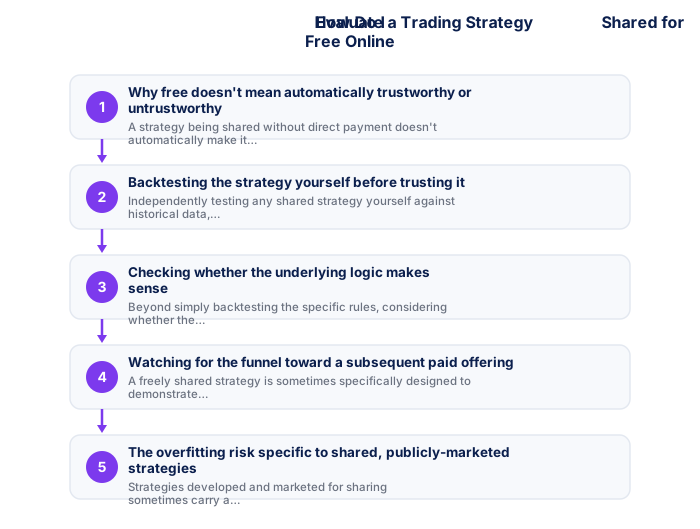
- Why free doesn't mean automatically trustworthy or untrustworthy
- Backtesting the strategy yourself before trusting it
- Checking whether the underlying logic genuinely makes sense
- Watching for the funnel toward a subsequent paid offering
- The overfitting risk specific to shared, publicly-marketed strategies
- A practical evaluation process to follow
1. Why free doesn't mean automatically trustworthy or untrustworthy
A strategy being shared without direct payment doesn't automatically make it either trustworthy or untrustworthy, some genuinely well-tested strategies are shared freely by experienced traders or educators, while others are shared specifically as a marketing tool, discussed later in this piece, regardless of their actual underlying quality.
It's worth applying the same evaluation rigour to a free strategy that you would to a paid one, rather than assuming cost alone tells you anything meaningful about quality, the absence of a price tag doesn't remove the need for the same independent verification any trading approach genuinely deserves before you commit real capital to it.
| Signal | Red Flag | Green Flag |
|---|---|---|
| Underlying logic | Unclear or unexplained | Clear, understandable rationale |
| Backtest results shown | None, or unrealistically smooth | Realistic, with drawdowns shown |
| Funnel to paid offer | Strong push toward upsell | Genuinely stands alone |
| Your own testing | Skipped entirely | Backtested independently first |
2. Backtesting the strategy yourself before trusting it
As, independently testing any shared strategy yourself against historical data, rather than simply trusting whatever results the original source claims, provides your own genuine, verified evidence of how the strategy has actually performed, rather than relying on potentially selective or exaggerated claimed results.
See also: What Is Algorithmic Trading and Are Trading Bots Worth Using?
It's worth being particularly thorough here specifically because a shared strategy's original claimed results are considerably harder to verify than your own backtest, running the numbers yourself, rather than trusting a screenshot or summary someone else provided, is the only way to genuinely know how the strategy actually performs against real historical data.
- Quantifiable rules remove subjectivity
- Backtestable on historical data
- Works consistently when edge is genuine
- Clear entry/exit criteria reduce hesitation
- Past performance does not guarantee future results
- Risk of overfitting to historical data
- Market regimes change, edges decay
- Requires discipline through drawdown periods
- Price and volume patterns
- Works on any liquid instrument
- Faster to learn basics
- Ignores fundamental context
- Economic and financial data
- Better for longer timeframes
- Deeper knowledge required
- Ignores entry precision
3. Checking whether the underlying logic genuinely makes sense
Beyond simply backtesting the specific rules, considering whether the strategy's underlying logic makes intuitive, fundamental sense, does it have a plausible explanation for why it might work, connecting to genuine market behaviour, helps distinguish a strategy with genuine, explicable logic from one that might have simply been curve-fitted to look good on a specific historical dataset without any genuine underlying rationale.
It's worth being able to articulate this underlying logic clearly in your own words before adopting any strategy, if you can't explain simply why a specific rule should work, beyond 'it tested well historically,' that's worth treating as a warning sign that the strategy might reflect overfitting rather than a genuine, durable market pattern.
- Written entry/exit rules with zero ambiguity
- Backtested on minimum 3 years of data
- Walk-forward tested on out-of-sample data
- SA-specific events included in test period
- Maximum drawdown within personal tolerance
- 100+ live demo trades with consistent performance
4. Watching for the funnel toward a subsequent paid offering
A freely shared strategy is sometimes specifically designed to demonstrate just enough apparent value to encourage purchasing a more complete paid course or mentorship programme, recognising this as a common marketing pattern, rather than assuming the free content is necessarily complete or sufficient on its own, supports more realistic expectations.
This isn't automatically dishonest, plenty of legitimate educators use a genuinely useful free strategy as an introduction to their broader paid offering, but it's worth evaluating the free strategy entirely on its own merits, independent of any pressure or expectation created by the upsell that typically follows.
| Win rate | 1:1 RR | 1.5:1 RR | 2:1 RR |
|---|---|---|---|
| 40% | Losing | Break even | Profitable |
| 50% | Break even | Profitable | Profitable |
| 55% | Profitable | Profitable | Profitable |
| 60% | Profitable | Profitable | Profitable |
6. A practical evaluation process to follow
A practical process involves independently backtesting the strategy across a meaningfully large, genuinely representative historical sample; assessing whether the underlying logic makes intuitive sense; forward-testing on demo before committing real capital; and remaining appropriately sceptical of any accompanying claims that seem disproportionately impressive relative to the broader realistic statistics.
The most common mistake when evaluating a trading strategy is judging it on too short a sample. A strategy with a 55% win rate and a 1.5:1 reward-to-risk ratio will produce losing months even under ideal conditions. Over 100 trades, natural variance means any given run of 30 trades could show results ranging from highly profitable to significantly negative, even if the strategy is working exactly as designed. This statistical reality explains why most retail traders abandon strategies prematurely. Meaningful strategy evaluation requires a minimum of 100 trades under consistent market conditions with consistent position sizing and consistent rule-following. Only after this minimum sample is complete can any objective assessment of the strategy's edge begin. South African traders should document each trade against the strategy's specific entry and exit rules, not just the monetary outcome, to build a genuinely useful performance record.
Independently backtesting it yourself is the only reliable check.
A strategy shared for free isn't automatically trustworthy or untrustworthy. Independently backtesting it yourself against historical data is the only reliable way to know.
★ Why It Matters
A red flag worth knowing specifically: a free strategy post that includes screenshots of recent winning trades but no full equity curve or losing trade examples is showing you a curated highlight reel, not evidence the strategy is actually sound over time.
✕ Common mistakes
- Trusting screenshots of winning trades without seeing the full picture. A complete equity curve is more informative than selected highlights.
- Not backtesting the strategy yourself before using it. Independent verification matters more than the source's claims.
- Assuming free strategies are tested less rigorously than paid ones. Price has little bearing on a strategy's underlying soundness.
- Applying a shared strategy without adapting it to your own instrument. A strategy validated elsewhere may not transfer directly to your market.
Does backtesting guarantee a strategy will work in live markets?
No. Backtesting shows historical performance, but past results do not guarantee future outcomes. Overfitting a strategy to historical data is a common trap that produces strategies that fail in live conditions.
Key Takeaways
- Backtest the strategy yourself, check whether its logic genuinely makes sense, and confirm it isn't simply repackaged marketing for a subsequent paid offering.
- Backtest any freely shared strategy yourself rather than trusting claimed results, check whether its underlying logic makes sense, and confirm it isn't repackaged marketing for a paid offering.
- Why free doesn't mean automatically trustworthy or untrustworthy.
- Backtesting the strategy yourself before trusting it.
- Checking whether the underlying logic genuinely makes sense.
Frequently asked follow-up questions
Should I trust a strategy more if it comes from a well-known trading personality?
Reputation alone isn't sufficient verification; independently testing the strategy yourself remains important regardless of the source's broader reputation or following.
Is it reasonable to test multiple free strategies before settling on one?
Yes, this reflects sound, careful evaluation; just ensure each is genuinely, independently tested rather than simply trying several without proper backtesting.
Can a free strategy ever be just as good as a paid one?
Yes, cost alone doesn't determine genuine quality. Independent testing matters more than whether payment was required to access the content.
