i Short answer
Walk-forward testing validates a strategy on data that comes sequentially after the period used for optimisation.
This provides a more realistic check against overfitting than backtesting alone typically offers.
📋 ON THIS PAGE
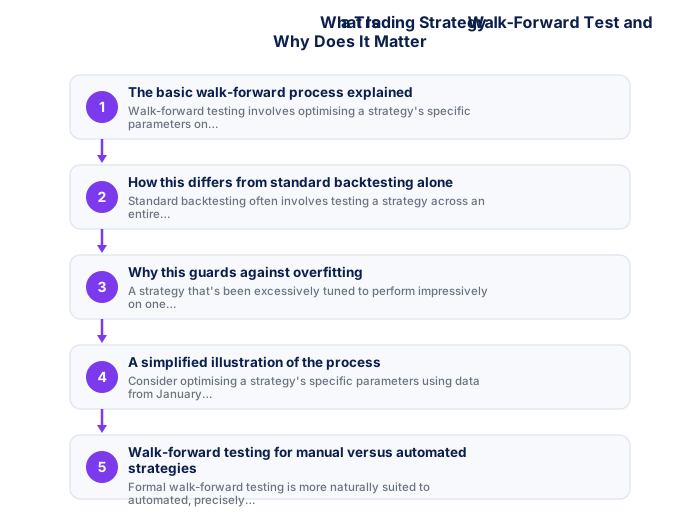
1. The basic walk-forward process explained
Walk-forward testing involves optimising a strategy's specific parameters on one historical period, then testing this exact, now-fixed configuration on a subsequent, later period the optimisation process never saw, then repeating this pattern by moving both windows forward in time, building a more realistic picture of how the strategy would have performed using only genuinely unseen, forward data at each step.
It's worth understanding this as a more rigorous, iterative extension of the standard backtest-then-forward-test sequence discussed elsewhere on this site, rather than optimising once and testing once, walk-forward testing repeats this cycle multiple times across rolling windows, giving a more sound picture of consistency across varied conditions.
2. How this differs from standard backtesting alone
As, standard backtesting often involves testing a strategy across an entire historical dataset at once, sometimes after already adjusting parameters based on how that same dataset's results looked, walk-forward testing specifically separates optimisation data from validation data sequentially, rather than allowing this kind of retrospective parameter adjustment across the same data being used to judge performance.
See also: What Is Algorithmic Trading for SA Traders?
It's worth appreciating why this repeated cycling matters so much, a single backtest and single forward test could simply reflect one particular, possibly unrepresentative pairing of historical and subsequent conditions, walk-forward testing's repeated cycles average out this single-instance risk.
- Quantifiable rules remove subjectivity
- Backtestable on historical data
- Works consistently when edge is genuine
- Clear entry/exit criteria reduce hesitation
- Past performance does not guarantee future results
- Risk of overfitting to historical data
- Market regimes change, edges decay
- Requires discipline through drawdown periods
- Price and volume patterns
- Works on any liquid instrument
- Faster to learn basics
- Ignores fundamental context
- Economic and financial data
- Better for longer timeframes
- Deeper knowledge required
- Ignores entry precision
3. Why this specifically guards against overfitting
As, a strategy that's been excessively tuned to perform impressively on one specific historical dataset often performs considerably worse on genuinely new, unseen data, walk-forward testing's sequential structure tests for this vulnerability by repeatedly validating against data the optimisation process never had access to.
It's worth treating consistent performance across multiple walk-forward cycles as considerably stronger evidence of genuine edge than a single, impressive backtest result, discussed elsewhere on this site regarding overfitting risk, the repeated, out-of-sample validation this process provides is precisely what a single backtest can't offer.
- Written entry/exit rules with zero ambiguity
- Backtested on minimum 3 years of data
- Walk-forward tested on out-of-sample data
- SA-specific events included in test period
- Maximum drawdown within personal tolerance
- 100+ live demo trades with consistent performance
South African traders who backtest their strategies should use historical data that includes periods of rand volatility and SA-specific events such as budget speeches, credit rating decisions, and periods of high load shedding. A strategy that performs well on global historical data but was not tested against SA-specific market conditions may behave differently when applied to ZAR instruments. Including at least one cycle of SARB rate changes and one period of political uncertainty in your historical test set provides a more realistic assessment of performance.
4. A simplified illustration of the process
Consider optimising a strategy's specific parameters using data from January through June, then testing this exact configuration on July data alone, without further adjustment. Then optimising again using February through July data, testing on August, and so on, repeating this rolling pattern provides multiple genuine, sequential out-of-sample validation periods rather than just one single backtest result.
It's worth attempting this process yourself on your own strategy, even in simplified form, actually working through even two or three walk-forward cycles gives you considerably more genuine insight into your strategy's consistency than reading about the concept alone.
| Win rate | 1:1 RR | 1.5:1 RR | 2:1 RR |
|---|---|---|---|
| 40% | Losing | Break even | Profitable |
| 50% | Break even | Profitable | Profitable |
| 55% | Profitable | Profitable | Profitable |
| 60% | Profitable | Profitable | Profitable |
5. Walk-forward testing for manual versus automated strategies
As, formal walk-forward testing is more naturally suited to automated, precisely codified strategies, given the considerable manual effort repeated optimisation and validation cycles would require without programmatic automation, manual traders can still apply the underlying principle more informally, by deliberately avoiding retrospective adjustment based on already-seen results.
It's worth being realistic about the genuine time investment manual walk-forward testing requires, given the multiple repeated cycles involved, discussed elsewhere on this site regarding automated backtesting platforms, this is precisely the kind of rigorous, repetitive testing where automation genuinely earns its keep for traders with the necessary technical skills.
6. Incorporating this into your own strategy development
For traders with access to automated backtesting platforms, incorporating formal walk-forward testing into your strategy development process before committing to live trading provides considerably more confidence in a strategy's genuine, forward-looking robustness than relying on a single, potentially overfitted backtest result alone.
A walk-forward test verifies it on unseen data not used in building it.
In-sample backtesting optimises a strategy on known data, which risks overfitting. Walk-forward testing verifies performance on genuinely unseen data held out from the optimisation process, far more trustworthy.
★ Why It Matters
Something worth doing as standard practice: always reserve a final chunk of your historical data that you never look at during optimisation at all, and only test on it once, right at the end, peeking at this 'untouched' data even once during development quietly contaminates the entire validation process.
✕ Common mistakes
- Using too small a reserved data sample for the final test. A meaningfully sized holdout period gives more reliable validation.
- Treating a single successful walk-forward test as permanent confirmation. Markets evolve, and periodic re-testing remains worthwhile.
- Not understanding why this differs from standard backtesting. It specifically guards against overfitting in a way standard backtesting alone doesn't.
Key Takeaways
- Walk-forward testing validates a strategy on data sequentially after optimisation, providing a more realistic check against overfitting than backtesting alone.
- Walk-forward testing validates a strategy on data that comes sequentially after the period used for optimisation.
- This provides a more realistic check against overfitting than backtesting alone typically offers.
- The basic walk-forward process explained.
- How this differs from standard backtesting alone.
Frequently asked follow-up questions
Is walk-forward testing required for every trading strategy?
Not strictly required, but it provides genuinely valuable additional confidence, particularly for strategies with several adjustable parameters where overfitting risk is more pronounced.
Can I perform walk-forward testing without programming skills?
Some platforms offer this as a built-in automated feature; manual traders can also apply the underlying principle through disciplined, sequential manual backtesting without formal automation.
Does passing walk-forward testing guarantee future profitability?
No, it improves confidence in a strategy's robustness but doesn't guarantee future results, given genuine market uncertainty.
