i Short answer
Dedicated backtesting platforms, including MetaTrader's built-in Strategy Tester, automate testing a strategy against large historical price datasets quickly and systematically.
Manual backtesting on standard charts remains a fully valid alternative for traders without programming skills.
📋 ON THIS PAGE
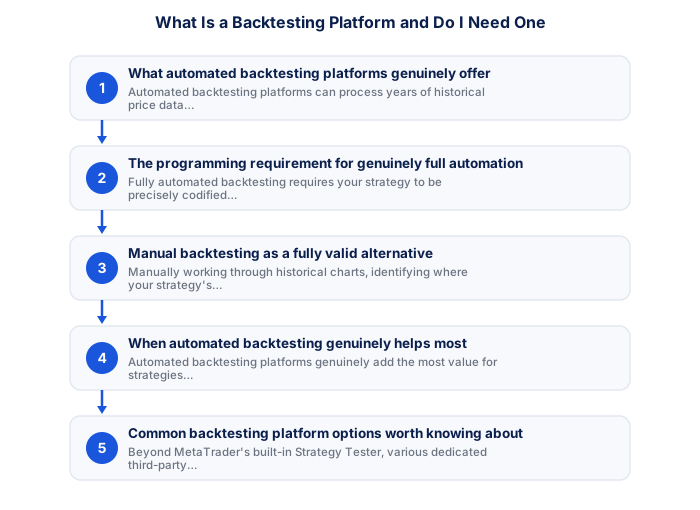
- What automated backtesting platforms genuinely offer
- The programming requirement for genuinely full automation
- Manual backtesting as a fully valid alternative
- When automated backtesting genuinely helps most
- Common backtesting platform options worth knowing about
- Choosing the right approach for your specific situation
1. What automated backtesting platforms genuinely offer
Automated backtesting platforms can process years of historical price data within minutes, systematically applying a precisely coded strategy's exact rules to identify every historical instance where a signal would have occurred, then calculating aggregate statistics like win rate, expectancy, and maximum drawdown across this large historical sample considerably faster than manual backtesting could achieve.
It's worth appreciating the genuine time-saving value here concretely, testing a strategy across years of historical data manually could take weeks of dedicated effort, while an automated platform can run the equivalent test in minutes, a difference worth taking seriously when evaluating whether this investment makes sense for you.
See also: What Is Algorithmic Trading and Can South Africans Use Trading Bots?
2. The programming requirement for genuinely full automation
Fully automated backtesting requires your strategy to be precisely codified into executable code or a platform-specific scripting language, like MQL for MetaTrader, which itself requires either programming capability or access to someone who can help translate your strategy's rules into this precise, codified format.
It's worth being honest with yourself about your own current technical background before assuming this path suits you, learning even the basic programming skills needed for genuine automated backtesting represents a real, separate time investment worth weighing against your actual available time and interest.
- Quantifiable rules remove subjectivity
- Backtestable on historical data
- Works consistently when edge is genuine
- Clear entry/exit criteria reduce hesitation
- Past performance does not guarantee future results
- Risk of overfitting to historical data
- Market regimes change, edges decay
- Requires discipline through drawdown periods
- Price and volume patterns
- Works on any liquid instrument
- Faster to learn basics
- Ignores fundamental context
- Economic and financial data
- Better for longer timeframes
- Deeper knowledge required
- Ignores entry precision
3. Manual backtesting as a fully valid alternative
Manually working through historical charts, identifying where your strategy's signals would have occurred, and recording hypothetical outcomes by hand remains a fully valid, accessible approach requiring no programming skill whatsoever, though it's more time-consuming for processing very large historical samples compared to automated tools.
Manual backtesting also builds a particular kind of deep, intuitive chart-reading familiarity that purely automated processing, while faster, doesn't necessarily develop in the same direct, hands-on way.
- Written entry/exit rules with zero ambiguity
- Backtested on minimum 3 years of data
- Walk-forward tested on out-of-sample data
- SA-specific events included in test period
- Maximum drawdown within personal tolerance
- 100+ live demo trades with consistent performance
4. When automated backtesting genuinely helps most
Automated backtesting platforms genuinely add the most value for strategies with precisely definable, objective rules that lend themselves well to programmatic codification, and particularly for traders wanting to test across very large historical samples or numerous parameter variations quickly, which would be genuinely impractical to perform manually within a reasonable timeframe.
It's worth checking whether your actual strategy complexity genuinely requires this level of tooling before investing time or money into it, a relatively simple, rules-based strategy can often be tested thoroughly enough through careful manual backtesting, without needing the additional overhead automated platforms introduce.
| Win rate | 1:1 RR | 1.5:1 RR | 2:1 RR |
|---|---|---|---|
| 40% | Losing | Break even | Profitable |
| 50% | Break even | Profitable | Profitable |
| 55% | Profitable | Profitable | Profitable |
| 60% | Profitable | Profitable | Profitable |
5. Common backtesting platform options worth knowing about
Beyond MetaTrader's built-in Strategy Tester, various dedicated third-party backtesting platforms exist, some specifically designed for traders without programming backgrounds, offering visual, rule-building interfaces that translate strategy logic into testable code without requiring direct programming knowledge, representing a middle ground between fully manual backtesting and requiring genuine coding skill.
It's worth testing any platform's free tier or trial thoroughly before committing to a paid subscription, confirming the specific platform genuinely supports your strategy's particular logic and the instruments you actually trade before relying on it for serious strategy development.
6. Choosing the right approach for your specific situation
For most retail traders without programming backgrounds, particularly beginners still developing their core strategy and discipline, starting with manual backtesting provides a genuinely sufficient, accessible foundation. Considering dedicated automated backtesting platforms becomes more worthwhile once you've developed a specific strategy with sufficiently precise, objective rules and want to test it more extensively than manual backtesting can practically accommodate.
Automated platforms run faster with less visual bias for systematic approaches.
Manual backtesting on existing charts is accessible and appropriate for most retail traders. Automated platforms run faster and with less visual selection bias, better suited to more systematic approaches.
★ Why It Matters
Worth checking specifically before trusting any backtest result: whether the platform accounts for realistic spread and slippage during the simulated period, a backtest run on a frictionless, cost-free price feed can show a profitable strategy that turns marginal or negative once real trading costs are included.
✕ Common mistakes
- Assuming a dedicated platform is necessary regardless of your needs. Manual backtesting remains a fully valid option for many traders.
- Not checking whether the platform's historical data quality is reliable. Poor quality data can produce misleading backtest results.
- Treating backtested results as a guarantee of future performance. It's evidence, not certainty, about how a strategy might perform going forward.
Key Takeaways
- Dedicated backtesting platforms automate testing a strategy against large historical datasets, though manual backtesting remains a valid, accessible alternative.
- Dedicated backtesting platforms, including MetaTrader's built-in Strategy Tester, automate testing a strategy against large historical price datasets quickly and systematically.
- Manual backtesting on standard charts remains a fully valid alternative for traders without programming skills.
- What automated backtesting platforms genuinely offer.
- The programming requirement for genuinely full automation.
See also: Should I Use Automated Trading Bots or Expert Advisors? and What Is a Trading Edge and How Do I Know If I Have One?.
Frequently asked follow-up questions
Is automated backtesting more accurate than manual backtesting?
Not inherently more accurate, just faster for processing large samples. Both approaches are subject to the same overfitting and look-ahead bias risks if not conducted carefully.
Do I need to learn programming to use any backtesting platform?
Some platforms offer visual, no-code rule-building interfaces, providing a middle ground between manual backtesting and full programming requirement.
Can I combine manual and automated backtesting approaches?
Yes, some traders use manual backtesting initially to develop and refine a strategy concept, then move to automated testing once the strategy's rules become sufficiently precise and well-defined for codification.
