i Short answer
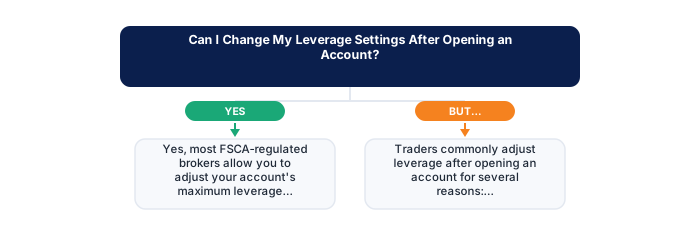
Yes, most FSCA-regulated brokers let you adjust your account's maximum leverage after it's open, typically through self-service settings or by contacting support.
📋 ON THIS PAGE
- How to actually change this setting in practice
- Why traders commonly adjust this setting after opening
- Restrictions and processing delays worth expecting
- Effect on any existing open positions when you change this
- Why choosing lower leverage deliberately is often sound practice
- Situations where brokers might restrict this specific change
1. How to actually change this setting in practice
The exact steps vary by broker, but you'll usually find a leverage dropdown somewhere in your account settings or client portal, showing the ratios available to you. Some brokers require a brief confirmation process, acknowledging that you understand the implications of the change, before applying it. The change typically takes effect immediately for new positions once confirmed.
Can't find the setting? Ask support directly. Most regulated brokers process leverage adjustment requests quickly through their live chat or email channels, and the documentation required is usually minimal for reductions. Increases to higher leverage tiers may involve a more formal approval step depending on your account type and the broker's internal requirements.
It's worth locating this setting when your account is new and you have time to find it without urgency, rather than discovering it doesn't work as expected when you actually want to use it. A few minutes spent confirming the process at account setup avoids a frustrating search during an active trading period.
Some brokers differentiate leverage settings by instrument class, you might have a different maximum available for forex pairs than for equity CFDs or commodities. Understanding whether your broker applies a single leverage cap across all instruments or instrument-specific limits tells you exactly what you're working with across your full range of positions.
| Feature | Decreasing Leverage | Increasing Leverage |
|---|---|---|
| Typically restricted? | No, generally unrestricted | Sometimes, above certain thresholds |
| Qualification required | No | Possibly, depending on broker and FSCA limits |
| Affects existing open positions | No | No |
| Processing speed | Usually immediate | May involve a short review |
2. Why traders commonly adjust this setting after opening
People usually adjust leverage for one of a few reasons: deliberately dialling down their maximum as a personal risk safeguard as they gain experience, increasing it after meeting certain qualification requirements, or adjusting in response to a change in their trading approach that requires different capital deployment.
The first reason, deliberately reducing leverage as a self-imposed discipline, is worth highlighting specifically because it runs counter to the way leverage is usually marketed. The trader who opens an account with maximum leverage available and then voluntarily reduces it as their understanding of position sizing develops is actually demonstrating more sophisticated risk management than the one who leaves it at maximum indefinitely.
- P = Position size in lots
- R = ZAR amount at risk (1-2% of account)
- S = Stop distance in pips from entry
- V = Pip value per lot for this instrument
Set account risk %
Define the maximum percentage of capital at risk per trade, typically 1-2%.
Measure stop distance
Find your stop-loss level on the chart and measure its distance from entry in pips.
Calculate pip value
Use a pip value calculator or your platform's tool for the specific instrument and lot size.
Compute position size
Position size = (ZAR at risk) divided by (stop distance in pips times pip value).
Check margin available
Confirm the required margin for the calculated size is within your available free margin.
Adjusting leverage upward is a different kind of decision. Regulatory requirements in South Africa mean that retail clients have maximum leverage caps set by the FSCA framework, and increasing to higher tiers typically requires demonstrating qualifying criteria. The asymmetry between how easy it is to reduce leverage versus how much more process is involved in increasing it reflects the consumer protection intent embedded in this regulatory framework.
Some traders also revisit leverage settings seasonally or around high-volatility periods, reducing their available maximum during events like SARB interest rate announcements, national elections, or major international data releases where price gaps and volatility spikes are more likely. This kind of proactive adjustment is a practical risk management tool that doesn't require closing existing positions.
3. Restrictions and processing delays worth expecting
A few brokers require no open positions before processing a leverage change, or limit how frequently you can adjust the setting, mainly to prevent rapid toggling from undermining the risk management purpose of the change. These restrictions are typically disclosed in the broker's terms or account FAQ, and checking them before you need to act avoids discovering a constraint at an inconvenient moment.
It's worth checking your broker's specific process before you actually need it, rather than discovering a restriction mid-trade. Processing times can vary from instant to a few business days depending on the broker's back-office processes and whether the change requires human review versus automatic system processing.
| Account | Risk % | Max loss (ZAR) | At 1:30 leverage | Notional position |
|---|---|---|---|---|
| R50,000 | 1% | R500 | 1:30 | R15,000 |
| R50,000 | 2% | R1,000 | 1:30 | R30,000 |
| R50,000 | 5% | R2,500 | 1:30 | R75,000 |
| R100,000 | 1% | R1,000 | 1:30 | R30,000 |
- Access larger positions with less capital
- Amplifies returns on winning trades
- Short-selling available without share borrowing
- Losses amplified equally, 10x leverage, 10x loss
- Overnight financing reduces long-term returns
- Margin calls can force closure at worst moments
FSCA-regulated brokers must maintain records of leverage settings and changes as part of their client account documentation obligations. This means any leverage change you request creates a documented record, which is generally positive from a compliance and dispute-resolution standpoint if questions arise about your account configuration at a later stage.
The practical implication of processing delays is worth planning around specifically if you're reducing leverage in anticipation of a volatile period. A request submitted on a Thursday afternoon ahead of a Friday market event might not process before that event occurs. Understanding your broker's processing timeline lets you make adjustments with adequate lead time.
4. Effect on any existing open positions when you change this
Changing your leverage setting only affects positions opened after the change. Anything already open continues under the leverage conditions it was opened with, your margin requirements for those positions don't change when you adjust the account-level setting.
If you want the new leverage setting applied to an existing trade specifically, you'll need to close it and reopen it under the updated leverage. There's no mechanism to retroactively adjust the leverage on a live position, the terms it was opened under are fixed until that position is closed.
This is genuinely worth double-checking before you assume a leverage change has affected an open position you're actively managing. Acting on the assumption that a position is now running at lower leverage, and therefore has different margin call characteristics, when it's actually running at the leverage it was opened with could produce unexpected consequences if the position moves against you.
The practical implication for your margin calculations is also worth noting. If you reduce leverage on your account but have existing positions opened at the previous higher leverage, your account's effective leverage is a blend of the old (existing positions) and new (subsequent positions) settings. Your margin calculations need to account for this mixture rather than applying the new leverage uniformly.
5. Why choosing lower leverage deliberately is often sound practice
Deliberately capping your own leverage below your broker's maximum is one of the more practical risk management habits a trader developing discipline can adopt. At maximum leverage, a relatively small adverse price movement can generate a margin call before you've had meaningful time to assess the position, reducing leverage meaningfully extends the buffer between adverse movement and forced exit.
Think of it as a structural version of the same logic behind stop-loss orders: a hard leverage cap baked into your settings provides a constraint that doesn't depend on remembering to apply it or making a good decision in the moment. It works even when your discipline momentarily lapses in a way that a self-imposed rule about position sizing might not.
- Confirm account equity
- Calculate 1-2% risk in ZAR
- Identify stop-loss level from chart
- Measure stop distance in pips
- Look up pip value for instrument
- Compute position size
- Verify required margin fits free margin
For traders who are prone to sizing positions too aggressively during periods of conviction, a common pattern during both winning and losing streaks, a voluntary leverage reduction removes the option of using excess leverage even when the temptation exists. The constraint doesn't have to be permanent; it can be reviewed and adjusted upward once consistent discipline at the lower setting is demonstrated.
South African retail clients should also be aware that the FSCA-mandated leverage caps for retail accounts exist precisely because research on retail trading outcomes consistently shows the relationship between higher leverage and higher loss rates. Working within or below those caps is aligned with the intent of the regulation, not a limitation to be circumvented as early as possible.
6. Situations where brokers might restrict this specific change
Reducing leverage is generally unrestricted, any client can request it at any time. Increasing leverage past certain thresholds is a different matter. Some brokers require qualification criteria or a formal professional client assessment to access higher leverage tiers, particularly for leverage ratios above the FSCA retail client maximums.
This asymmetry, easy to scale down, requires more process to scale up, reflects the protective intent in the financial services regulatory framework more broadly. Regulators' concern is with the harm that can result from excessive leverage, not with traders choosing to use less of it. Brokers operating under FSCA oversight implement this in their account terms.
One practical flag: some brokers have internal policies that interpret leverage increase requests as requiring fresh due diligence on the client's experience and financial position, even for clients who've held accounts for years. This isn't unreasonable from a regulatory compliance standpoint, but it does mean the process for increasing leverage may be less smooth than the process for reducing it.
If you're considering increasing leverage to a tier that requires qualification, treating it as a deliberate process rather than an administrative step is worthwhile. The documentation you'll need to provide, and the suitability conversation you may need to have with your broker, is an opportunity to make sure the increased leverage genuinely serves your strategy rather than simply expanding your risk exposure.
✕ Common mistakes
- Never lowering leverage voluntarily. Reducing your own cap is one of the few genuinely free risk upgrades available.
- Assuming maximum leverage is the same as appropriate leverage. These are very different concepts, see why leverage can be dangerous.
- Not checking how quickly leverage changes take effect. Some brokers apply a short processing delay.
- Increasing leverage after a losing streak to recover faster. This compounds risk exactly when discipline matters most.
Does this change my margin call risk?
A stop-loss closes a position at a price you chose; a margin call is triggered by your equity falling against the margin you have committed. A stop placed far away can still leave the account breaching its margin level first. The margin calculator page covers how the two interact.
Can I lose more than my deposit if I use leverage?
Most FSCA-regulated brokers provide negative balance protection, capping your maximum loss at your deposited amount. Confirm whether your specific broker offers this before trading with leverage.
Key Takeaways
- Yes, most brokers allow adjusting leverage settings after account opening, though some restrictions and processing times may apply. Learn how it works.
- Yes, most FSCA-regulated brokers let you adjust your account's maximum leverage after it's open, typically through self-service settings or by contacting support.
- How to actually change this setting in practice.
- Why traders commonly adjust this setting after opening.
- Restrictions and processing delays worth expecting.
Frequently asked follow-up questions
Does changing leverage affect my account balance directly?
No, adjusting leverage settings doesn't directly change your account balance; it changes the margin requirements and maximum position sizes available for future trades.
Can I set different leverage for different instruments?
Some brokers allow instrument-specific leverage settings, while others apply a single account-wide setting; checking your specific broker's structure clarifies which approach applies to your account.
Is there a cost to changing my leverage setting?
Generally no, this is typically a free account setting adjustment rather than a service carrying its own specific fee.
