What this page covers
Quick answer: Most brokers offer several account types on the same platform. Key figures: standard spread, pips 1.4; raw spread, pips 0.0-0.3; raw commission per lot USD 7; where raw starts winning 5 lots. Figures current at 19 November 2026, from Financial Sector Conduct Authority.
Most brokers offer several account types on the same platform. The difference is almost entirely in how they charge you, and the cheapest headline is rarely the cheapest total.

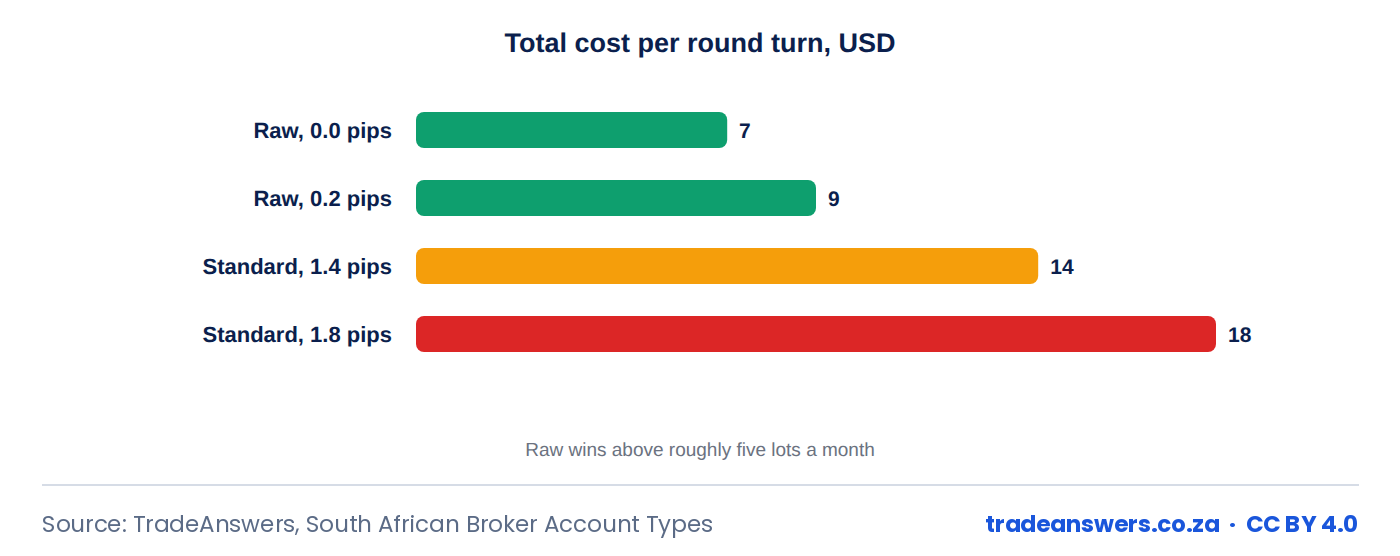
⬇ Download this chart (PNG) · Free to reuse with the credit “Source: TradeAnswers, South African Broker Account Types” (CC BY 4.0).
| Account | Spread | Commission | Typical minimum | Suits |
|---|---|---|---|---|
| Standard | Wider, 1.0 to 1.8 pips | None | R1,000 to R5,000 | Lower frequency trading |
| Raw or ECN | 0.0 to 0.3 pips | USD 6 to 7 per lot | R5,000 to R20,000 | Frequent trading |
| Islamic | As the base account | Administration fee instead of swap | As the base | Swap-free requirement |
| Professional | Raw | Negotiated | High | Large volume |
| Demo | Simulated | Simulated | None | Learning the platform |
Source: TradeAnswers, South African Broker Account Types. Free to reuse with attribution (CC BY 4.0).
| Account | Spread cost | Commission | Total per round turn |
|---|---|---|---|
| Standard, 1.4 pips | USD 14.00 | USD 0.00 | USD 14.00 |
| Raw, 0.2 pips | USD 2.00 | USD 7.00 | USD 9.00 |
| Raw, 0.0 pips | USD 0.00 | USD 7.00 | USD 7.00 |
| Standard, 1.8 pips | USD 18.00 | USD 0.00 | USD 18.00 |
TradeAnswers · CC BY 4.0
| Item | Why |
|---|---|
| Total cost at your volume | Raw wins above a few lots a month, standard below |
| Overnight swap | Dominates the cost on a position held for weeks |
| Base currency | A rand account avoids conversion on every deposit |
| Minimum lot size | Decides the smallest position you can size properly |
| Whether the licence covers your account | An offshore entity may hold it, not the local FSP |
TradeAnswers · CC BY 4.0
📋 ON THIS PAGE
How these figures work
Raw spread accounts are cheaper only above a certain volume. Below roughly five lots a month the commission usually outweighs the tighter spread.
An Islamic account replaces swap with a flat administration fee, which on a long-held position can exceed the swap it replaced. Compare the two over the period you actually hold. To apply these figures to your own numbers, use the broker cost comparison calculator to compare the cost of a standard and a raw spread account.
Worked example: when a raw account starts to pay
From the cost table above, a standard account at 1.4 pips costs $14 per standard lot round turn and a raw account at 0.2 pips plus $7 commission costs $9, a saving of $5 a lot.
| Volume | Saving | In rand at R16.93 |
|---|---|---|
| 2 lots a month | $10 | About R169 |
| 5 lots a month | $25 | About R423 |
| 20 lots a month | $100 | About R1,693 |
| 20 lots a month, for a year | $1,200 | About R20,316 |
At low volume the saving is small and the higher minimum deposit of a raw account can matter more; at 20 lots a month the difference pays for a lot of other costs.
★ What this means in practice
Check which legal entity holds your account. A broker with a South African FSP number may still book retail clients through an offshore entity, which changes what protection applies (FSCA FSP search).
✕ Common mistakes
- Picking the raw spread account by default. Commission makes it more expensive than a standard account at low trading volumes.
- Choosing an Islamic account to avoid costs. It swaps overnight interest for an admin fee, which can cost more on longer holds.
- Not checking which entity holds the account. The same brand can place South African clients with an offshore entity under a different regulator.
Terms used on this page
Spotted an outdated figure? If a figure or rate on this page no longer matches its source, email us the page and the source. A material correction is dated on the Updates Log; how figures are compiled and checked is set out in our data methodology.
Cite this page
Barosso, G. (2026, September 29). South African Broker Account Types. TradeAnswers. https://www.tradeanswers.co.za/south-african-broker-account-types.htmlBarosso, G (2026) South African Broker Account Types, TradeAnswers, figures current at 19 November 2026, https://www.tradeanswers.co.za/south-african-broker-account-types.htmlThe tables and the CSV on this page are free to reuse under a CC BY 4.0 licence: attribution with a link to this page. See the Press & Data Licence page.
Frequently asked questions
Is a raw spread account cheaper?
Only above roughly five lots a month. Below that the commission usually outweighs the tighter spread.
What does a standard lot cost?
About USD 14 on a 1.4 pip standard account, against about USD 9 on a raw account at 0.2 pips plus USD 7 commission.
What is an Islamic account?
Swap is replaced by a flat administration fee. On a long-held position that fee can exceed the swap it replaced.
Should I open a rand account?
It avoids a currency conversion on every deposit and withdrawal, which adds up for anyone who moves money in and out often.
Does a demo account behave like a live one?
The prices are usually real but execution is not. Slippage and rejection do not appear on a demo.
Which entity holds my account?
Worth checking. A broker with a South African FSP number may still book retail clients through an offshore entity.
Can I have two account types with one broker?
Usually yes, for example a raw spread account and a standard account, each with separate margin.
 Download this data