What this page covers
SWIFT does not move money. It moves instructions. The money moves through a chain of banks that each hold an account with the next, and every link in that chain can take a fee.
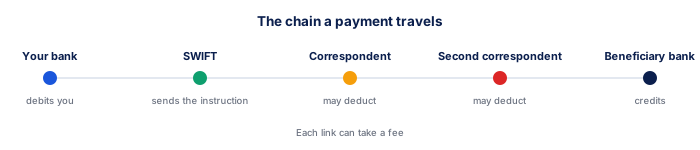
| Step | What happens |
|---|---|
| Your bank debits your account | In rand, at the rate it quoted you |
| It sends a SWIFT message | An instruction, not the funds |
| Correspondent bank receives it | A bank holding accounts in the target currency |
| It may deduct a fee | USD 15 to USD 40, in transit |
| Further correspondents may follow | Each may deduct |
| The beneficiary bank credits the account | Possibly less its own fee |
| Code | Meaning | Effect |
|---|---|---|
| OUR | The sender pays all charges | The recipient gets the full amount, you pay more |
| SHA | Shared | You pay your bank, intermediaries deduct from the amount |
| BEN | The beneficiary pays | Everything is deducted from the amount sent |
| Problem | Usual cause |
|---|---|
| The amount arrived short | An intermediary deducted a fee under SHA or BEN |
| The transfer is delayed | Compliance screening at a correspondent |
| It was returned | A detail mismatched the beneficiary account |
| It cannot be traced | Ask for the SWIFT message reference, a UETR |
| Weekend or holiday delay | Correspondent banks keep their own calendars |
How these figures work
The figures on this page come from the body that publishes them and change on a schedule rather than continuously, which is what makes them worth keeping in one place. If you need an exact amount to arrive, send OUR and ask what the total cost will be. SHA is cheaper up front and unpredictable at the other end.
Every SWIFT payment now carries a unique end-to-end transaction reference, a UETR. Ask your bank for it: it is what lets a transfer be traced rather than guessed about.
★ What this means in practice
A correspondent delay is not your bank being slow. The funds sit at an intermediary under screening, and your bank often cannot see more than you can.
✕ Common mistakes
- If you need an exact amount to arrive, send OUR and ask what the total c. If you need an exact amount to arrive, send OUR and ask what the total cost will be. SHA is cheaper up front and unpredictable at the other end.
- Every SWIFT payment now carries a unique end-to-end transaction referenc. Every SWIFT payment now carries a unique end-to-end transaction reference, a UETR. Ask your bank for it: it is what lets a transfer be traced rather than guessed about.
- A correspondent delay is not your bank being slow. A correspondent delay is not your bank being slow. The funds sit at an intermediary under screening, and your bank often cannot see more than you can.
- Taking a figure without its date. A number from a reference page is only as good as when it was last checked, which is why the date sits at the top of this one.
Notes on reading these figures
- If you need an exact amount to arrive, send OUR and ask what the total cost will be. SHA is cheaper up front and unpredictable at the other end.
- Every SWIFT payment now carries a unique end-to-end transaction reference, a UETR. Ask your bank for it: it is what lets a transfer be traced rather than guessed about.
- A correspondent delay is not your bank being slow. The funds sit at an intermediary under screening, and your bank often cannot see more than you can.
To put this into practice, the Forex Transfer Costs runs the arithmetic on your own numbers; Offshore Transfer Process covers the same ground in ordinary language; Broker Deposits and Withdrawals goes into the detail this page only summarises; Exchange Control Allowances is the related figure worth reading beside it; and South African Bank Charges covers what this page leaves out.
Terms used on this page
Frequently asked questions
Does SWIFT move money?
No. It moves instructions. The value moves through correspondent banks that hold accounts with each other.
Why can a transfer arrive short?
Each correspondent in the chain can deduct a fee under SHA or BEN. Only OUR guarantees the full amount arrives.
How do I trace a payment?
Ask your bank for the UETR, the unique end-to-end transaction reference. Without it a trace is guesswork.
What is a nostro account?
An account one bank holds with a foreign bank in that currency. It is where the value actually sits as it moves.
Why is my transfer delayed?
Usually compliance screening at a correspondent. The funds are held there and your bank often cannot see more than you can.
Is the SWIFT code the same as the BIC?
Yes. The bank identifier code is what people mean by a SWIFT code.
 Download this data