i Short answer
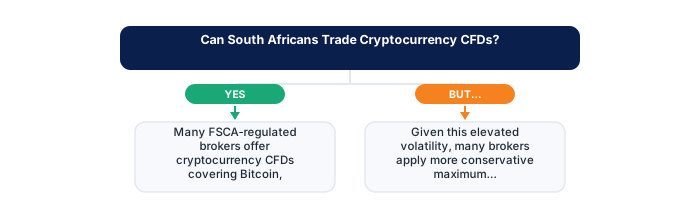
Yes. Many FSCA-regulated brokers offer cryptocurrency CFDs covering Bitcoin, Ethereum, and various other digital assets.
These instruments carry notably higher volatility than most traditional asset classes, including precious metals and major forex pairs.
📋 ON THIS PAGE
- How crypto CFDs differ from owning actual cryptocurrency
- The regulatory status of crypto CFD trading
- Why volatility is particularly pronounced with this asset class
- Typical leverage restrictions on crypto CFDs
- How this differs from genuine cryptocurrency exchange trading
- Risk management considerations specific to crypto
1. How crypto CFDs differ from owning actual cryptocurrency
A cryptocurrency CFD tracks a digital asset's live price without involving any actual ownership or custody. You speculate on Bitcoin's price movement, for example, and profit or lose based on that movement, but you never hold Bitcoin, you don't need a wallet, and there are no blockchain transactions associated with your position. The instrument is a contract between you and your broker that references Bitcoin's price.
This distinction is worth keeping absolutely clear before trading either path, since the two carry meaningfully different risk profiles, different regulatory treatments, and different practical implications. With a CFD, your exposure is purely to price movement and your risk is limited to the capital in your trading account. With actual cryptocurrency ownership, you also carry custody risk, wallet security risk, and exposure to the specific exchange or platform you're using.
The practical advantages of crypto CFDs for South African retail traders include the ability to use an FSCA-regulated broker (rather than a cryptocurrency exchange with less regulatory clarity), familiar trading infrastructure, and the ability to take short positions, which many direct crypto exchanges don't support for retail clients.
See also: How Does SARS Tax Cryptocurrency Gains in South Africa?
See also: What Is Options Trading and How Does It Work in South Africa?
The absence of actual ownership is also an absence of network participation: you don't receive staking rewards, hard fork airdrops, or any of the economic benefits that come with actually holding a digital asset. If you want exposure to a specific blockchain ecosystem beyond pure price speculation, a CFD doesn't provide that.
| Feature | Crypto CFD | Owning Actual Crypto |
|---|---|---|
| Ownership of underlying asset | No | Yes |
| Can go short | Yes | Not directly |
| Leverage available | Yes, typically capped | No, unless margin trading on an exchange |
| FSCA-regulated broker oversight | Yes, via CFD framework | Varies by exchange |
| Custody responsibility | Broker | You, or the exchange |
2. The regulatory status of crypto CFD trading specifically
Cryptocurrency CFDs through a properly licensed broker fall under the same broad CFD regulatory framework as other instruments. The broker is subject to FSCA oversight, client fund segregation requirements, and the full suite of retail client protections that apply to other CFD products: the cryptocurrency nature of the underlying reference asset doesn't change the regulatory treatment of the instrument itself.
South Africa has moved further than many jurisdictions on the direct-ownership side of cryptocurrency regulation: the FSCA formally declared crypto assets a financial product under FAIS, which means providers of crypto asset services need FSCA authorisation. This is a developing regulatory area, and the distinction between crypto CFD regulation (mature) and direct crypto asset service regulation (still developing) is worth being aware of.
- SARB economic calendar checked for the week
- Next Eskom load shedding schedule reviewed
- GNU stability news reviewed
- Stats SA data releases noted
- Credit agency review dates checked
- US/global events that move EM risk noted
It's worth checking a broker's specific licensing category directly rather than assuming 'regulated' automatically covers crypto CFD trading. A broker's FSCA licence covers the activities for which they're specifically authorised, and verifying that crypto CFDs are within the scope of their particular licence is worthwhile. Checking the FSCA public register directly gives you authoritative confirmation.
The regulatory trend both in South Africa and globally has been toward increased oversight of both crypto CFDs and direct crypto asset services, which means the specific rules governing these products may continue to evolve. Keeping broadly current with FSCA developments through their official communications is useful for anyone actively trading in this space.
3. Why volatility is particularly pronounced with this asset class
Crypto markets have historically run considerably more volatile than major forex pairs or commodity markets. Daily percentage moves that would be extreme in forex: five percent, ten percent, or more in a single session, have occurred regularly in major cryptocurrencies during both up and down markets. This volatility creates both larger potential gains and larger potential losses than most other retail trading instruments.
It's worth actually comparing crypto's typical daily volatility figures against a major forex pair's using a charting tool rather than relying on general impressions. The contrast tends to be more striking than people expect even when they know crypto is 'volatile.' Mapping that volatility onto your usual position sizing framework before your first live crypto CFD trade reveals the adjustment required for a given risk tolerance.
| Event | Frequency | ZAR impact | Source |
|---|---|---|---|
| SARB MPC | 6x per year | High | resbank.co.za |
| Budget Speech | Annual (February) | Very high | treasury.gov.za |
| Credit reviews | Annual each agency | Very high | Agency sites |
| Stats SA CPI | Monthly | Medium | statssa.gov.za |
| Eskom stage | As needed | Low-medium | eskomsepush.com |
- SA context provides genuine informational edge
- ZAR pairs accessible via FSCA brokers in ZAR accounts
- Rand volatility creates larger intraday ranges
- 6 SARB meetings/year create regular macro setups
- Higher geopolitical risk than G10 pairs
- Load shedding creates unique operational disruptions
- SA rand liquidity thinner than major G10 pairs
- SA-specific news requires constant local monitoring
The volatility in crypto also doesn't follow the same patterns as traditional markets. Crypto can move sharply around the clock: including on weekends when most other markets are closed, driven by factors that traditional technical and fundamental analysis frameworks capture less reliably than for established asset classes. News events, social media sentiment, and macro factors interact differently in crypto markets than in forex or equity markets.
Weekend moves deserve specific attention for South African traders. Cryptocurrency markets trade continuously while major forex pairs don't. A position left open over a South African weekend: with no ability to manage it until Monday, is exposed to two full days of crypto market movement without active oversight. This weekend gap risk is absent from forex positions that benefit from the market's closure.
4. Typical leverage restrictions on crypto CFDs
Because of crypto's volatility, many brokers cap maximum leverage lower for crypto CFDs than for forex or major indices. Where retail forex might offer leverage up to 1:30 under FSCA retail client limits, crypto CFDs at the same broker may be capped at 1:2 or 1:5. This directly reflects the higher daily price movements that crypto generates relative to other asset classes.
This lower cap is worth appreciating as a genuine protective measure rather than a limitation to work around. Applying standard forex leverage to an instrument with ten times the typical daily volatility would create margin call and stop-out risk that most retail traders don't anticipate or price into their position sizing.
Understanding the effective leverage on a crypto CFD in terms of your position's actual exposure to price movement, not just the nominal leverage multiple, is more useful than comparing leverage multiples across asset classes directly. A 1:5 leverage position on an asset that moves five percent daily creates the same absolute exposure as a 1:25 leverage position on an asset that moves one percent daily.
Checking the specific leverage caps for crypto CFDs at your broker before trading them is worth doing explicitly, since the caps differ between brokers and may differ between specific cryptocurrencies at the same broker. Major pairs like BTC/USD typically have different caps than smaller altcoin CFDs at the same platform.
5. How this differs from genuine cryptocurrency exchange trading
Genuine cryptocurrency exchange trading: actually buying and holding digital assets through a dedicated exchange, involves custody, private key management, and the specific risks associated with the exchange itself as a custodian. The exchange risk has been demonstrated repeatedly in the industry's history through exchange failures and security breaches that have resulted in client funds being lost.
A crypto CFD with an FSCA-regulated broker sidesteps these custody risks because you're never holding the underlying asset: your exposure is to the price movement only, and your capital sits at the regulated broker rather than at a cryptocurrency exchange. The trade-off is that you also don't benefit from actual ownership, as noted earlier.
It's worth being honest with yourself about which activity you're actually seeking before choosing between the two. Someone genuinely interested in participating in a blockchain ecosystem: potentially using DeFi protocols, receiving network rewards, or holding assets long-term, is seeking something that a CFD doesn't provide. Someone who wants speculative price exposure without the custody complexity of direct ownership is better served by a CFD.
There's also a liquidity difference worth noting: closing a crypto CFD is typically straightforward during market hours, with standard order execution. Exiting a direct cryptocurrency position during a market stress event: when exchange order books thin out or exchange functionality is impaired, can be more difficult and less predictable. The CFD structure provides execution certainty that direct exchange trading doesn't always match.
6. Risk management considerations specific to crypto
Given crypto's volatility, disciplined position sizing matters even more here than in other asset classes. A position size appropriate for forex: two percent of account risked based on a typical forex range, may represent a very different risk exposure when applied to an instrument with five to ten times the typical daily move. Calibrating position size to the asset's specific current volatility range, rather than using the same formula as for forex, produces more appropriate risk sizing.
Stop-losses in crypto markets also require wider placement than in forex to accommodate the normal daily noise: a stop placed one percent below entry on a standard forex position would represent less than a typical daily range for many cryptocurrencies, and would be triggered routinely by intraday volatility unrelated to the underlying thesis being wrong. Understanding the typical daily range for your specific crypto instrument before setting stops prevents placing them too tight to survive normal market movement.
Worth being precise about a common confusion: a crypto CFD profits or loses based on the referenced crypto's price movement, but you never hold the crypto asset. If Bitcoin doubles in value over five years, a CFD position held during that period captures that price movement, but the practical reality of holding a leveraged CFD for five years involves overnight financing costs, margin requirements, and liquidity considerations that make multi-year crypto CFD holding very different from direct long-term ownership.
✕ Common mistakes
- Confusing a crypto CFD with owning actual cryptocurrency. A CFD position has no wallet, private key, or self-custody involved.
- Underestimating crypto's volatility relative to forex or indices. Position sizing that works for forex can be far too large for crypto.
- Trading crypto CFDs without checking weekend liquidity conditions. Liquidity and spreads can shift meaningfully outside weekday hours.
- Assuming all brokers offer the same range of crypto pairs. Availability varies considerably between FSCA-regulated providers.
Does this apply to JSE shares too?
Available on the bigger names. Remember that a CFD on a share pays no dividend in the way holding it does; an adjustment is passed instead. Trading JSE shares through a forex broker covers it in full.
Key Takeaways
- Yes, many FSCA-regulated brokers offer cryptocurrency CFDs, though these instruments carry notably higher volatility than most traditional asset classes.
- Many FSCA-regulated brokers offer cryptocurrency CFDs covering Bitcoin, Ethereum, and various other digital assets.
- These instruments carry notably higher volatility than most traditional asset classes, including precious metals and major forex pairs.
- How crypto CFDs differ from owning actual cryptocurrency.
- The regulatory status of crypto CFD trading specifically.
See also: What Is a Basket Trade and Can I Trade Multiple Instruments Together? and Which ETF Should a South African Beginner Actually Buy?.
Frequently asked follow-up questions
Which cryptocurrencies are typically available as CFDs?
Bitcoin and Ethereum are most commonly available, with some brokers offering a broader range of additional digital assets; checking your specific broker's instrument list confirms exact availability.
Is crypto CFD trading riskier than buying cryptocurrency directly?
Both carry genuine risk. CFD trading adds leverage-related risk, while direct ownership adds custody and wallet security considerations not present in CFD trading.
Do crypto CFDs trade on weekends like traditional markets close?
Unlike most forex and traditional markets, cryptocurrency markets often continue trading throughout weekends, reflecting this asset class's generally continuous, always-on trading nature.
